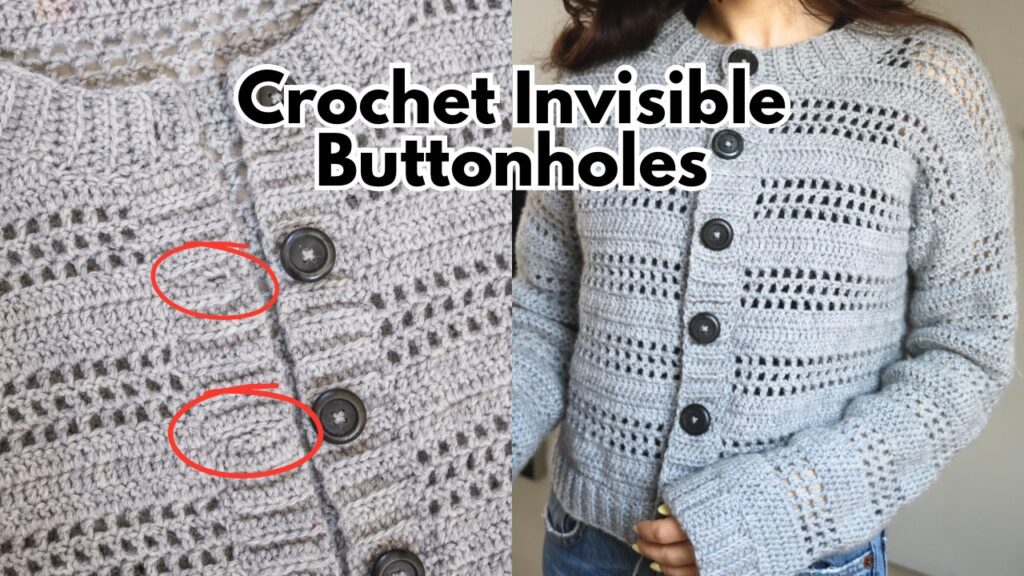
If you’ve ever poured hours into a beautiful crochet cardigan only to finish it off with a button band that looks… well, a little off, you are not alone. We’ve all been there, staring at those big, gaping holes created by simple chain spaces that stretch out over time.
Today, I am sharing one of my absolute favorite techniques: How to Crochet Invisible Buttonholes on Half Double Crochet (HDC) Ribbing. This method is a total game-changer because it keeps your button band looking incredibly neat and structured, even when your cardigan is unbuttoned.
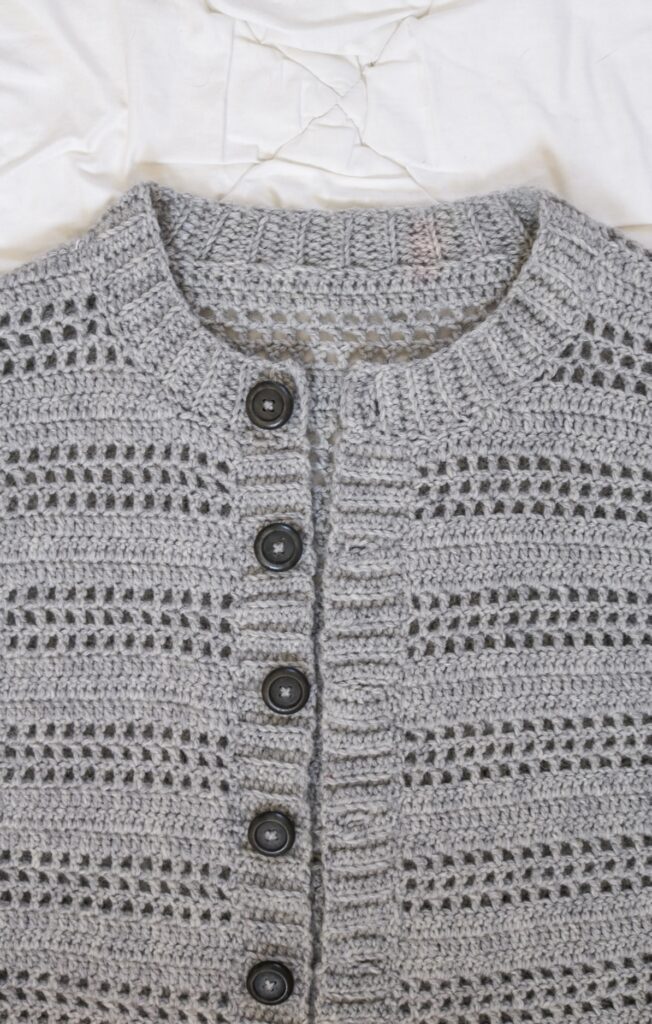
I originally used this technique for my Bari Cardigan pattern, which features back-loop HDC ribbing, but the beauty of this method is that it’s versatile enough to work for various ribbing styles. Whether you are whipping up a cozy winter gift or a lightweight spring layer, this technique will give your project that polished, store-bought finish we all crave.
Why You’ll Love This Technique
- No More Gaps: Traditional chain spaces can leave large holes. This method uses foundation stitches to fill the gap, making the hole disappear into the ribbing.
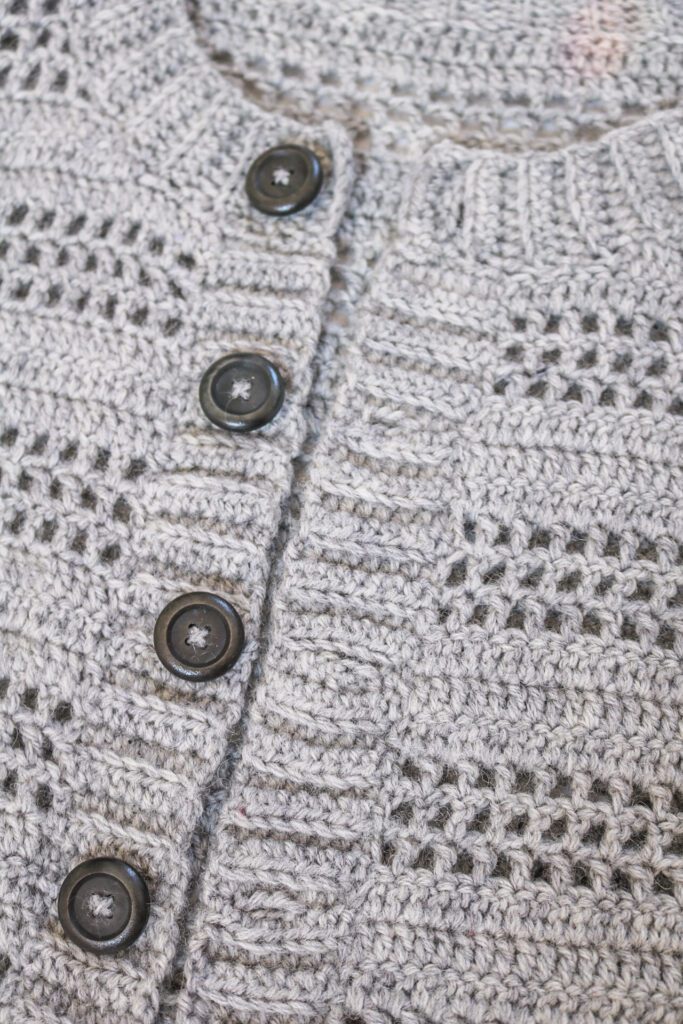
- Professional Finish: The buttonhole blends seamlessly with the HDC texture, maintaining the “ribbed” look.
- Sturdy Construction: By anchoring the foundation stitches back to the ribbing, the buttonhole is reinforced and less likely to sag.
- Customizable: While this tutorial uses a 3-stitch gap, you can easily adjust the stitches for larger or smaller buttons.
Materials
- Yarn: Your project yarn (matching the weight/fiber of your cardigan).
- Crochet Hook: The same size hook you are using for your ribbing.
- Stitch Markers: Essential for marking button placement before you start.
- Buttons: Have these on hand to check the size of your hole!
Abbreviations
This tutorial assumes you are attaching a vertical button band to a main fabric panel. The ribbing is created by alternating two types of rows: one worked towards the panel (attaching with slip stitches) and one worked away from the panel.
- Ch: Chain
- Hdc: Half Double Crochet
- BLO: Back Loop Only (insert hook under the back loop only)
- Fhdc: Foundation Half Double Crochet (instructions included below)
- Sl st: Slip Stitch
- St(s): Stitch(es)
- RS: Right Side
- WS: Wrong Side
Special Note on Button Placement: Before beginning your button band, ensure you have placed stitch markers on the opposite button band (or along the edge) so you know exactly where your buttonholes need to live. For the Bari Cardigan, the spacing is calculated by measuring the distance between the top and bottom buttons and dividing evenly.
How to Crochet Buttonholes on HDC Ribbing
Here is how to work the buttonhole rows. We will cover both scenarios: working the row towards the body of the sweater and working the row away from it. See the video at the end of the post for visual guidance!
Technique 1: The “Towards the Panel” Buttonhole Row
Use this method when you are crocheting down the ribbing strip towards the main body of your cardigan to attach it.
My button band has 7 stitches and the buttons holes is across 3 of those stitches (2 sts before and after button hole). This can be easily customized based on the width of your button band and of your buttons.
Row Instructions:
- Start: Ch 2. Work 1 hdc in the BLO of the first 2 sts.
- Create the Gap: Skip the next 3 sts on the ribbing (this creates the space for the button).
- Bridge with Fhdc: You will now make 3 Foundation Half Double Crochets (Fhdc) floating in the air to bridge the gap:
- First Fhdc: Yarn over, insert hook into the base of the last hdc you just made (the blo of the stitch where you made your last HDC). Pull up a loop (3 loops on hook). Yarn over, pull through one loop (creates the “chain”). Yarn over, pull through all three loops.
- Second Fhdc: Yarn over, insert hook into the “chain” bottom of the previous Fhdc. Pull up a loop. Yarn over, pull through one loop. Yarn over, pull through all three loops.
- Third Fhdc: Repeat the process one more time for a total of 3 Fhdc.
- Anchor the Bridge: Yarn over. Insert your hook into the “chain” of the last Fhdc you made AND into the BLO of the next stitch on the ribbing (the first stitch after the skipped gap). Yarn over and pull through all loops on your hook.
- Note: This step connects your floating bridge firmly back to the ribbing.
- Finish Row: Work 1 hdc in the BLO of the final st (or as many sts remain).
- Attach: Skip 1 space on the main panel edge, then sl st into the next 2 spaces to anchor the row.
Technique 2: The “Away from Panel” Buttonhole Row
Use this method when you have just slip stitched to the body and are working back up the ribbing strip.
Row Instructions:
- Start: Turn your work. Skip the 2 slip stitches used to attach the previous row.
- Work Initial Sts: Work 1 hdc in the BLO of the next 2 sts.
- Create the Gap: Just like before, skip 3 sts on the ribbing.
- Bridge with Fhdc: Make 3 Fhdc exactly as described above:
- Yarn over, insert into the previous stitch, pull up a loop. Yarn over, pull through 1 (chain). Yarn over, pull through 3.
- Repeat 2 more times so you have 3 floating stitches.
- Anchor the Bridge: Yarn over, insert hook into the chain base of the last Fhdc AND the BLO of the next stitch on the ribbing. Yarn over and pull through all loops.
- Finish Row: Work 1 regular hdc (or BLO hdc as per your pattern pattern) in the last stitch.
Finishing & Assembly
Once you have completed your button band:
- Weave in ends: Use a tapestry needle to weave in your starting and ending tails.
- Sew on Buttons: Line up your buttons on the opposite band, ensuring they correspond perfectly with your new invisible holes.
- Block: Lightly steam block your button band to relax the stitches and make those buttonholes lay perfectly flat.
FAQ
Q: How can I make button holes on Single Crochet (SC) ribbing? A: The concept is identical. Instead of using Foundation HDC, you would use Foundation SC to bridge the gap.
Q: What if my buttons are larger or smaller? A: You can easily adjust the size. If you have a tiny button, skip 2 stitches and make 2 Fhdc. For a chunky toggle, skip 4 or 5 stitches and make a corresponding number of Fhdc. The rule of thumb is: Skipped Stitches = Number of Fhdc.
Q: Why do we use Foundation stitches instead of just chaining? A: A simple chain creates a thin, flimsy arch that stretches out easily with visible hole. Foundation stitches add bulk and texture, mimicking the look of the actual ribbing row so the “hole” is barely visible until you push a button through it.