We all have that moment in our crochet journey where we fall in love with the Mesh Stitch (often used in Filet Crochet). It’s airy, it’s geometric, and it works up incredibly fast. But let me guess, you’ve been sticking to rectangular projects like scarves or blankets because the idea of shaping seems terrifying.
I’ve been there! You want to make a breezy summer top or a triangular shawl, but you aren’t sure how to create armholes or necklines without creating jagged, “stair-step” edges. You want that smooth, professional slope, but the holes in the mesh make it confusing to know where to put your hook.
Here is the good news: Decreasing in mesh stitch is actually quite logical once you break it down. By using taller stitches (like Trebles and Double Trebles), we can bridge the gap and create a smooth angled edge.
Materials & Tools
Since this is a technique tutorial, you can practice with whatever you have on hand! However, if you are planning a specific project, here is what I recommend:
- Yarn: A smooth, worsted weight or DK cotton yarn works best for learning. I used Drops – Muskat. Fuzzy yarns (like mohair) can make it hard to see the “mesh” structure.
- Hook: Use the hook size recommended on your yarn label (usually a 4.0mm – 5.5mm).
- Stitch Markers: Very helpful for marking the beginning of the row before you turn!
Gauge
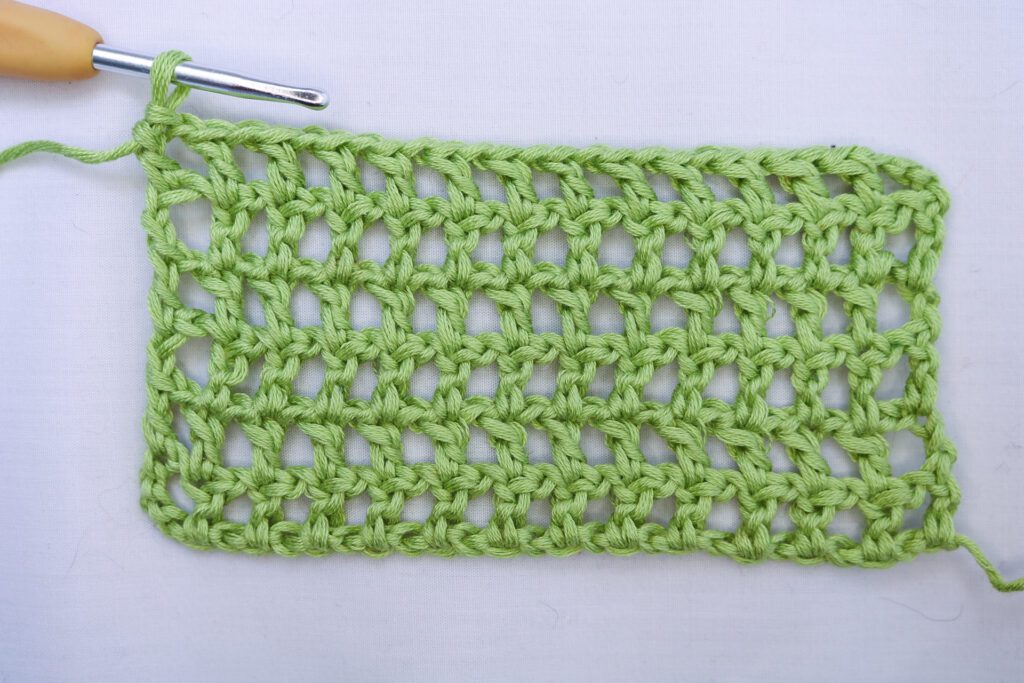
For this tutorial, gauge is not critical. We are focusing on the anatomy of the stitch. However, in a finished garment, remember that 1 Mesh Square usually equals 2 stitches (1 DC + 1 ch) or 3 stitches (1 DC + 2 chs) depending on your pattern.
In this tutorial, we assume a standard mesh where 1 Square = 2 Stitches width.
Pattern Notes & Abbreviations
Abbreviations (US Terms):
- Ch: Chain
- Sc: Single Crochet
- Dc: Double Crochet
- Tr: Triple Crochet (yarn over twice)
- Dtr: Double Treble Crochet (yarn over 3 times)
- St(s): Stitch(es)
- Yo: Yarn over
- Sk: Skip
- DcSkTrcTog: Double Crochet, Skip, Triple Crochet Together
- DcSk3DtrcTog: Double crochet, Skip 3, Double Triple Crochet Together
How to Decrease Mesh Stitch: The Instructions
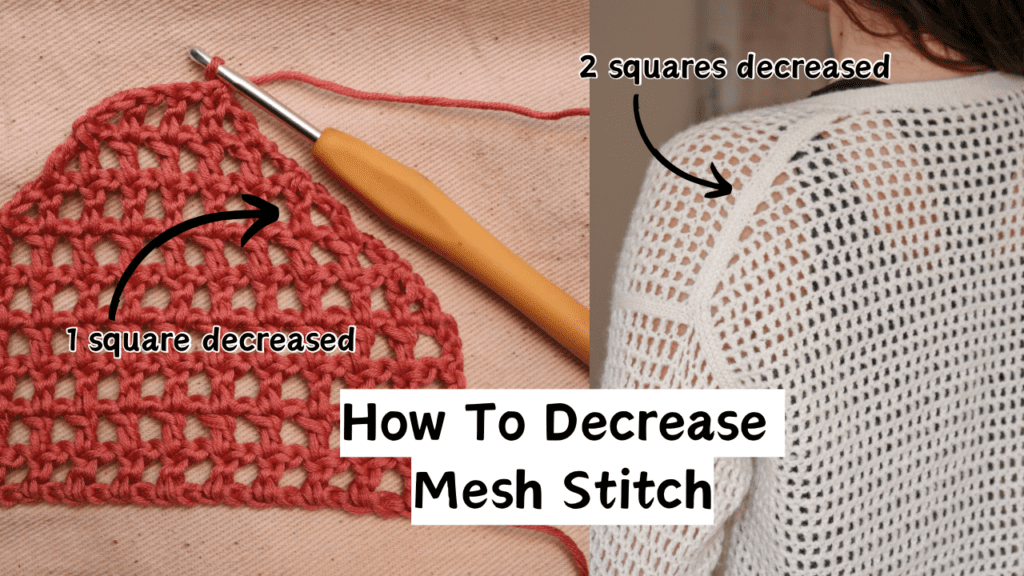
Before we dive in, let’s visualize the process. Imagine these decreases like merging lanes on a highway.
When you decrease, you are taking two or more separate “lanes” (stitches) and forcing them to merge into a single exit point at the top. This pulls the fabric inward to create that beautiful slanted edge.
We are going to cover two main techniques: a subtle slope (decreasing 1 square) and a sharp slope (decreasing 2 squares).
1. Decreasing One Mesh Square
Use this method to effectively remove 2 stitches. This creates a standard triangle shape at the edge.
At the Start of the Row:
This is the easiest slope to create!
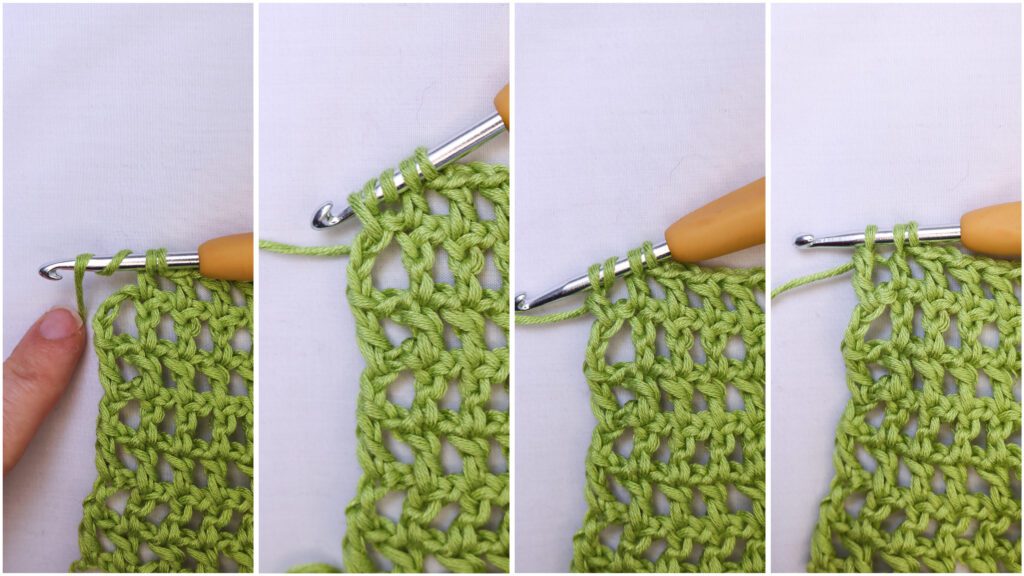
Row beggining: C3. Sk 1 st and dc in next st. Continue row normally.
Here is this broken down into steps.
Step 1: Ch 3 and turn your work.
Step 2: Skip the first stitch (the stitch right below your chain).
Step 3: Skip the next stitch (the chain space of the previous row).
Step 4: Dc into the next Dc stitch.
Designer Note: The initial Ch 3 does not count as a stitch for the next row. It acts as a bridge. When you come back on the return row, you will not crochet into this chain.
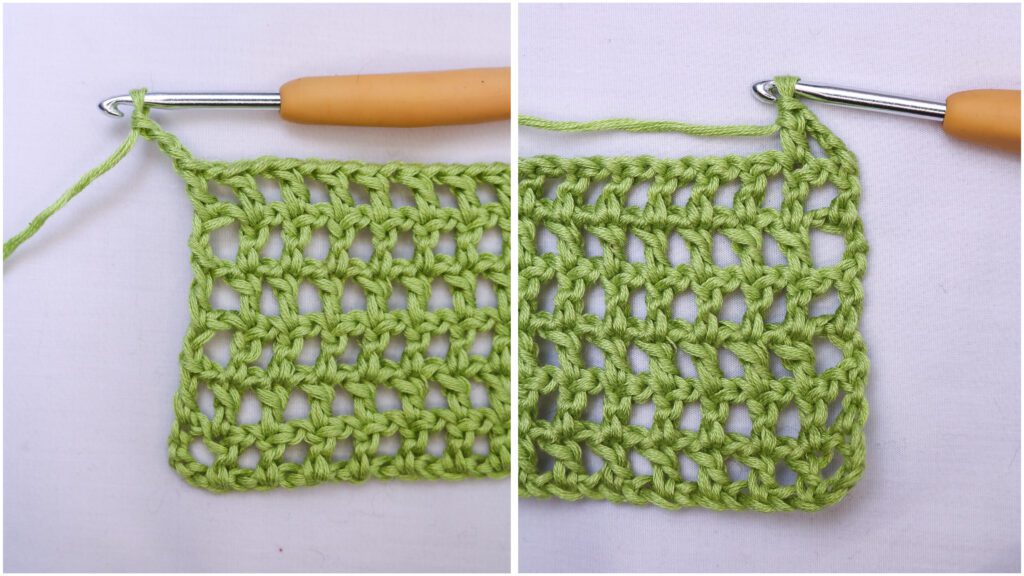
At the End of the Row:
We use taller stitches here to “reach” back to the previous row while leaning inward.
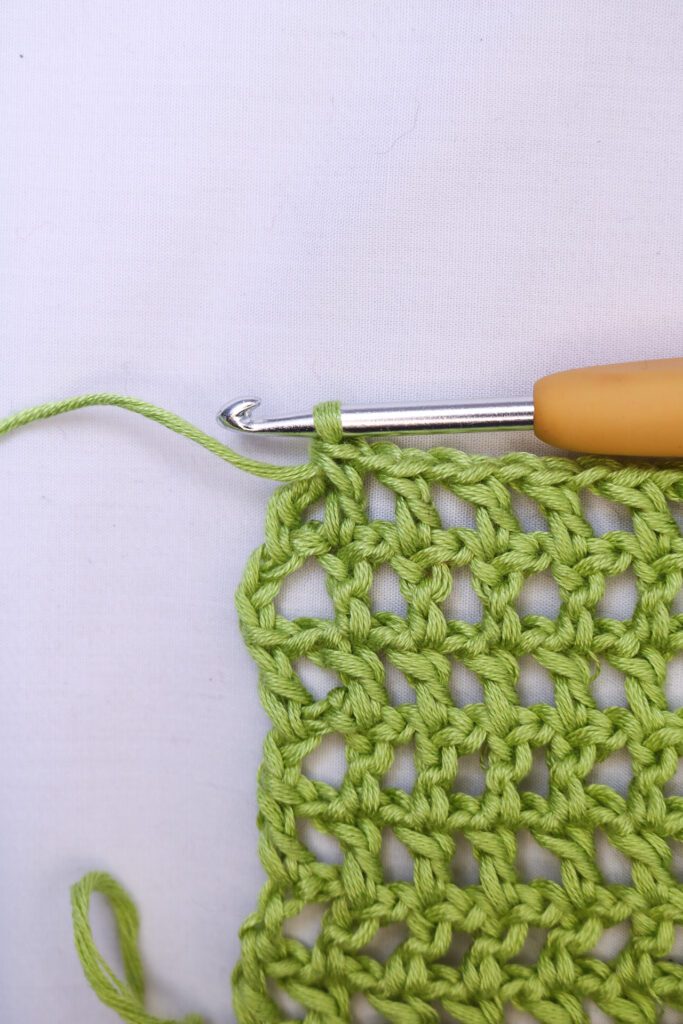
Row end: crochet till 4 sts are remaining. Ch 1, sk1 and DcSkTrcTog in last 3 sts.
Here is this broken down into steps.
Step 1: Work in pattern until you are near the end. Ch 1.
Step 2 (Partial DC): Yo, insert hook into the next stitch (the Dc before the gap). Yo and pull up a loop. Yo and pull through two loops. Stop here. (2 loops on hook).
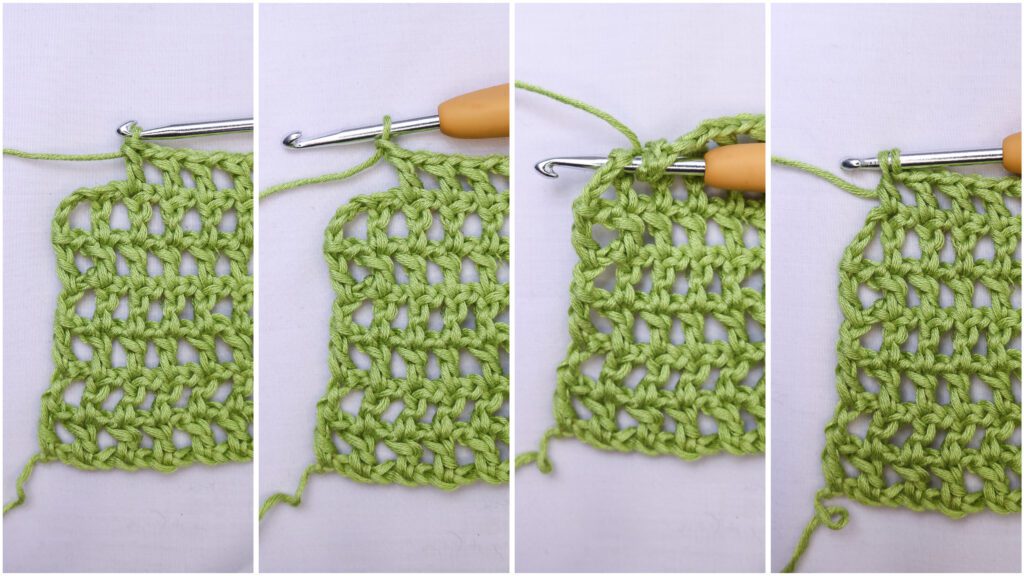
Step 3: Skip one stitch (the chain space).
Step 4 (Partial TR): Yo twice, insert hook into the very last stitch of the row. Yo, pull up a loop. (Yo, pull through 2 loops) twice. Stop here.
Step 5: You should now have 3 loops on your hook. Yo and pull through all three loops at once.
2. Decreasing Two Mesh Squares
Use this method to remove 4 stitches or 2 squares. This creates a “Big Triangle” and a much steeper slant.
At the Start of the Row:
Because we are skipping more distance, we need a longer starting chain to prevent the work from puckering.
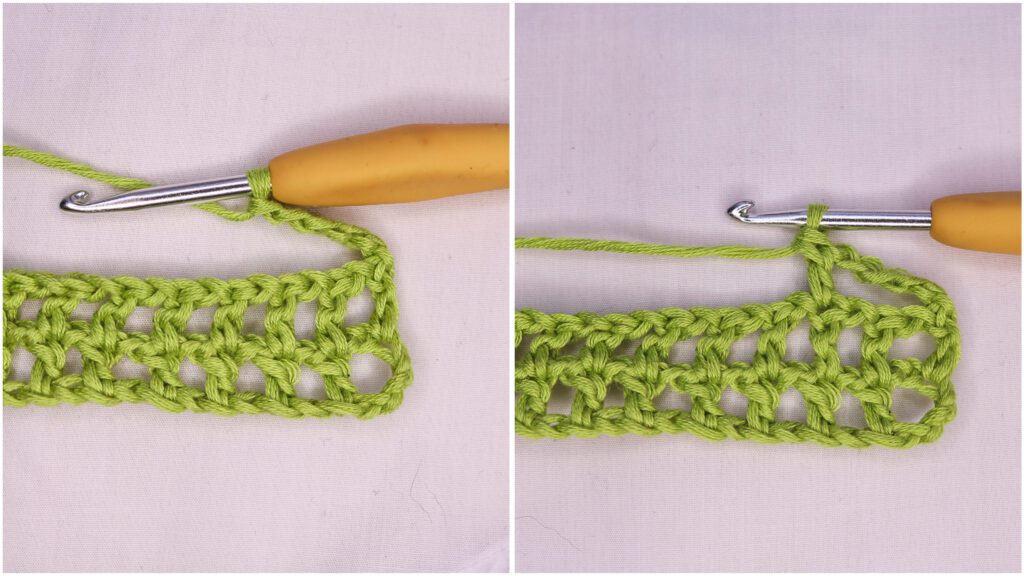
Row beggining: Ch 5, sk 3 sts and dc into next st.
Here is this broken down into steps:
Step 1: Ch 5 (or Ch 4 if your tension is naturally loose) and turn your work.
Step 2: Skip two full squares (this equals skipping 3 specific stitches/spaces).
Step 3: Dc into the next vertical Dc stitch.
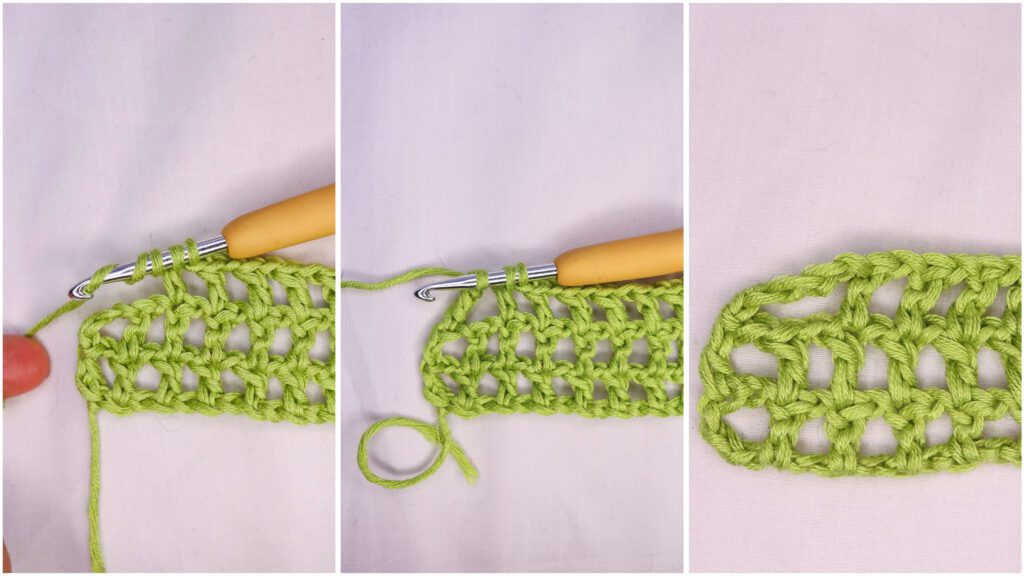
At the End of the Row:
Here comes the fun part the Double Treble (Dtr)! We need this extra height to span across two squares.
Row end: Crochet until 5 sts are remaining. Ch 1, sk1 and DcSk3DtrcTog in last 4 sts.
Here is this broken down into steps:
Step 1: Work in pattern until the end. Ch 1.
Step 2 (Partial DC): Yo, insert hook into the next Dc. Yo, pull up a loop, Yo, pull through 2 loops.
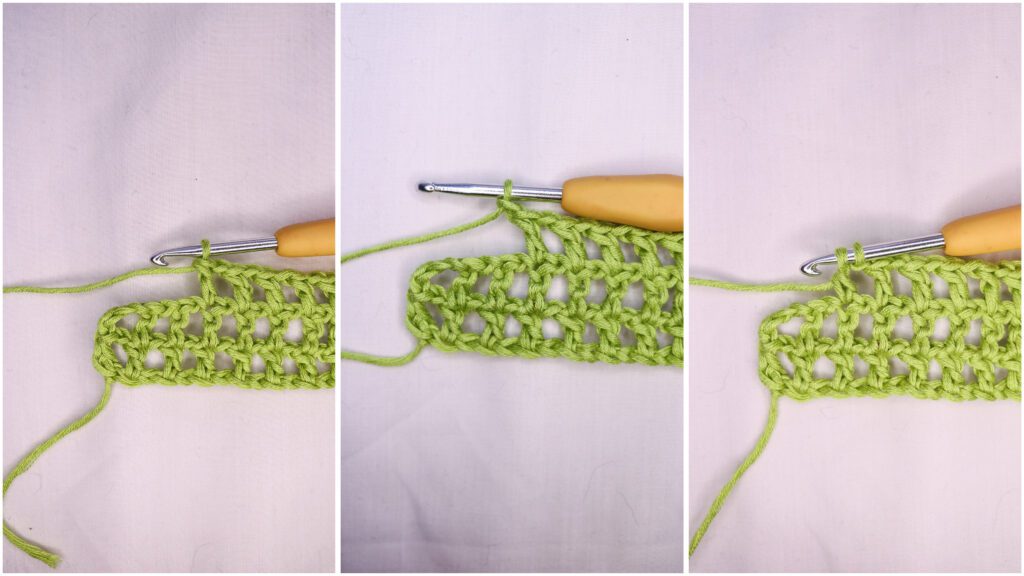
Stop here. Step 3: Skip 3 stitches (equivalent to two mesh squares).
Step 4 (Partial DTR):
- Yo 3 times.
- Insert hook into the very last stitch of the row.
- (Yo, pull through 2 loops) three times. Step 5: You will have 3 loops remaining on your hook. Yo and pull through all three loops to close the stitch.
Finishing & FAQ
My edge looks a little bubbly. What did I do wrong?
Nothing! Mesh stitch is inherently flexible. Once you block your piece (wet it and pin it to shape), in will flatten out perfectly. If you tention is very tight or loose, try to make one more or less stitch at the beginning of rows.
Can I use this for Filet Crochet pictures?
Absolutely. If you are making a filet crochet heart or letter, you use these decreases to shape the background around the image.
How do I weave in ends on such an open fabric?
This is tricky! I recommend weaving your ends down the post of a Double Crochet stitch, and then back and forth through the solid base of the stitches, rather than through the chain spaces.