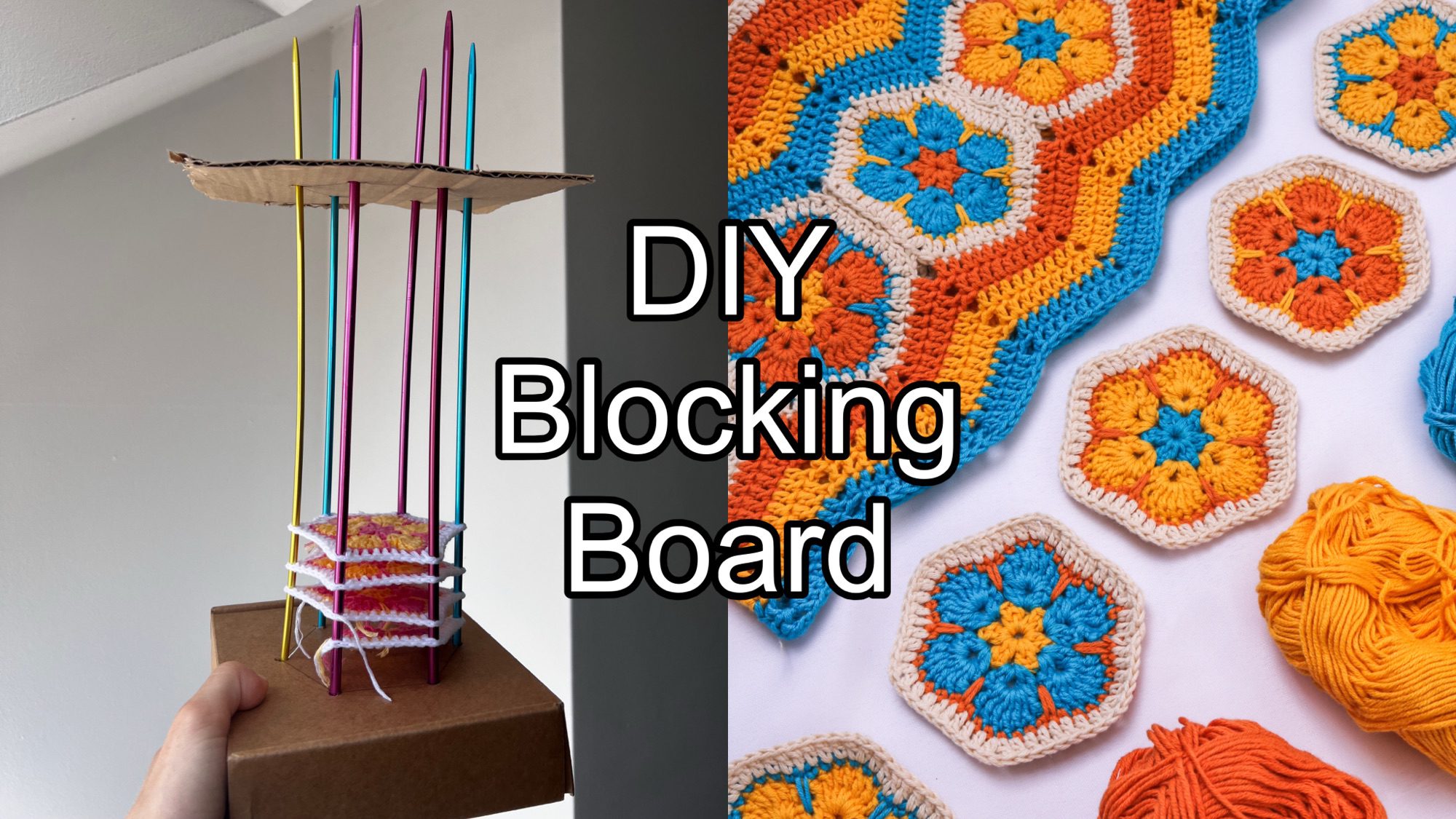
How to Make a DIY Blocking Board for Crochet Squares and Hexagons
If you’ve ever joined a bunch of crochet motifs together only to find they don’t quite line up, you already know why blocking matters. Blocking is the difference between a project that looks handmade in the “homemade” way and one that looks polished, even, and professional. And the easiest way to block lots of same-size pieces quickly is with a blocking board.
The good news: you don’t need to buy one. In this tutorial I’ll walk you through making a DIY blocking board at home, step by step, using a shallow box, some pegs, and a drawing compass. I’m making mine for hexagons, but everything here works just as well for granny squares, and I’ll cover both as we go.
I’m currently working on a few motif-based pieces, a top and a bucket hat (here is tutorial for the hexagons), and I need every hexagon to come out exactly the same size so they join up cleanly. A blocking board makes that almost effortless, so let’s make one. Video is at the end of the post.
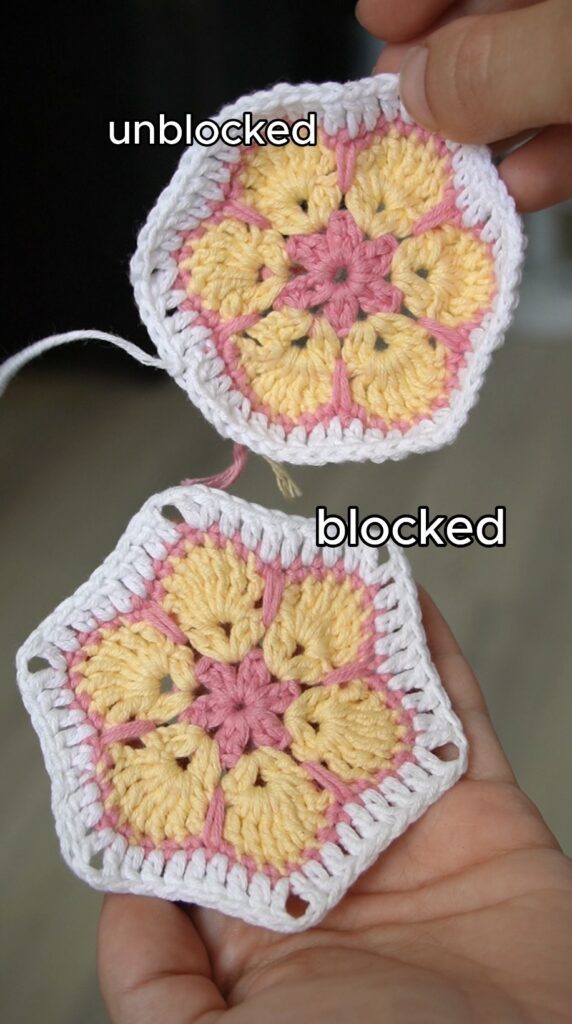
Why Blocking Your Crochet Squares and Hexagons Is So Important
Before we build anything, here’s why this step is worth your time:
- Even sizing. Hand-crocheted motifs are never perfectly uniform straight off the hook. Blocking gently stretches each one to the same target size, so they all match.
- Easier joining. When every piece is the same dimensions, seaming or joining them together is far quicker and the finished seams sit flat.
- A professional finish. Blocking opens up the stitches, evens out tension, and gives the whole piece that crisp, intentional look, exactly what you want in wearable, elegant clothing.
- Defined shape. Hexagons get their proper six-sided shape and squares get genuinely square corners, instead of slightly rounded or wonky ones.
For motif-heavy garments especially, blocking each piece before assembly saves you a huge amount of frustration later.
What You’ll Need to Make a DIY Blocking Board
Everything on this list is probably already in your home:
- A shallow box. Shallow is better so the pegs don’t disappear inside it.
- Pegs (knitting needles, pencils, chopsticks, or wooden skewers all work, more on choosing these in Step 4).
- A drawing compass (or a printed template, alternative method given in Step 2).
- A pencil and ruler.
- A piece of flat cardboard for the top alignment layer.
- A sharp tool like an awl, skewer tip, or thick needle to poke the holes.
Once you’ve gathered those, you’re ready to build. Follow the steps in order.
Step 1: Decide What Size to Make Your Hexagons or Squares
Grab your shallow box, but before you draw anything, sort out your size. This is the step most people skip, and it causes problems later. Your blocking board holes should match your target finished size, not the size your motif happens to be right now.
If you already know your target size (for example, from a pattern that tells you each hexagon should measure 8 cm side to side), use that number directly. Mine need to be 8 cm side to side.
If you don’t know your target size, here’s how to find it:
- Make one motif, wet it and lay it flat.
- Gently stretch it out until it looks the way you want it to look in the finished piece, opened up and even, but not distorted or strained.
- Measure it in that stretched position. That measurement is your target.
Write that number down, because you’ll use it in the next step. One realistic note: a blocking board encourages a motif into shape, it can’t stretch a piece dramatically beyond its natural size without warping the stitches.
Step 2: Draw Your Shape on the Box
Now take your box and draw your shape in the center of the bottom of it. How you do this depends on whether you’re making hexagons or squares.
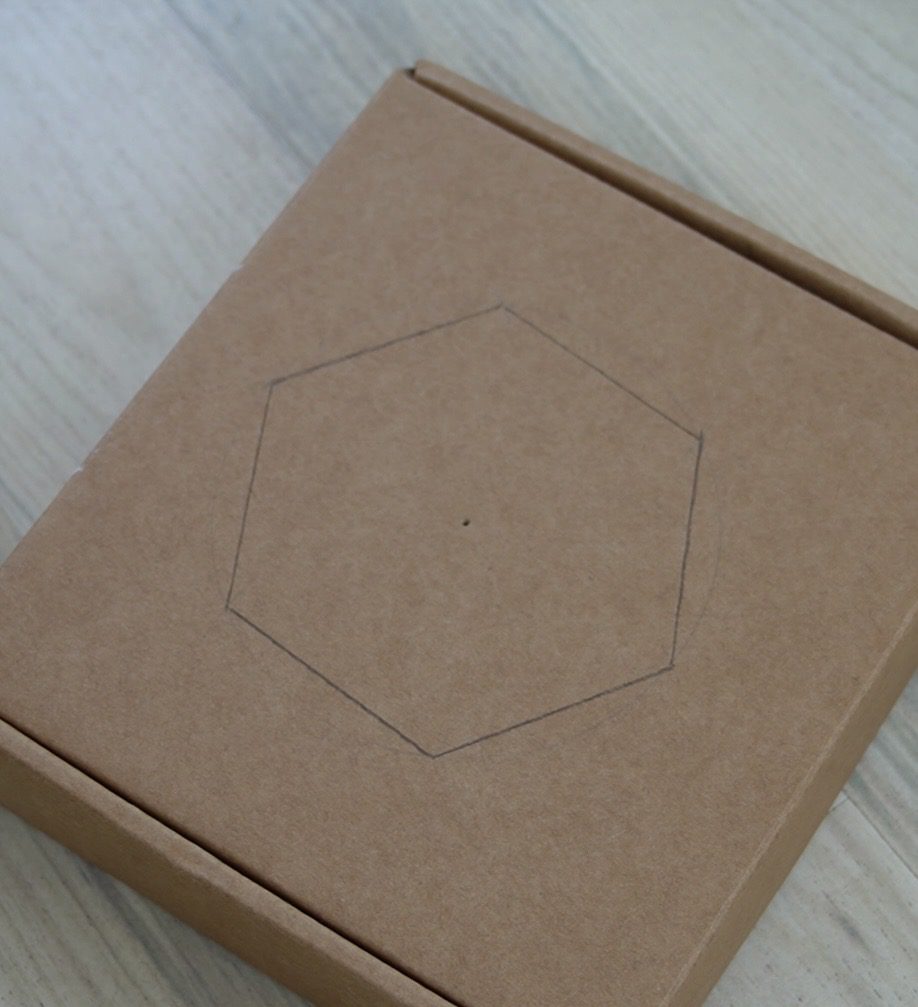
How to Draw a Perfect Hexagon
I needed my hexagons to be 8 cm from side to side, so I used a drawing compass. First I worked out the compass setting: for a hexagon measured flat-side to flat-side (across the flats), set your compass to roughly 0.577 × (width ÷ 2). For my 8 cm width that came to about 4.6 cm. (If you instead measure your hexagon point-to-point, the compass radius is simply half that point-to-point distance.)
Then draw the hexagon like this:
- Set your drawing compass to your radius, 4.6 cm in my case, and draw a full circle in the center of your box.
- Place the compass tip anywhere on the edge of that circle and make a small mark.
- Move the compass tip to that new mark and make another mark along the circle.
- Repeat all the way around. Because the radius and the spacing are mathematically the same, you’ll land on exactly six evenly spaced points.
- Connect the six points with a ruler and you have a perfect hexagon. Those six points are where your pegs will go.
No compass? Use one of these instead:
- Print a hexagon template. Search for a “hexagon template” generator online like this one, set your size, print it, and trace it onto your box.
- Use a protractor. Trace any round object the right size to make your circle, then mark a point every 60° around the center (6 × 60° = 360°), and connect them.
- Trace an existing object. Any hexagonal object the right size, such as a jar lid, a tile, or a coaster, can be traced directly.
How to Draw a Perfect Square
Making yours for squares instead? It’s even easier:
- Decide your target size (say, 10 cm).
- Using a ruler and a set square (or the corner of the box, which is already a perfect 90°), draw a square of that size in the center.
- Mark your peg points: the four corners at minimum, and for larger motifs add points along each side too, for example every 2 cm, so the edges get pulled straight and not just the corners.
Pro tip for both shapes: if you want one board that handles several sizes, skip the single shape and instead draw a 1 cm grid across the whole bottom of the box with a ruler. Poke a hole at every intersection and you’ve got a flexible pegboard-style board you can block 8 cm, 10 cm, or 12 cm motifs on. Just count the holes each time to keep things even.
Step 3: Poke Holes at Your Points
Take your sharp tool, an awl, a skewer tip, or a thick needle, and poke a hole straight through the box at each marked point (the six hexagon points, or your square’s corners and edge marks). Press firmly enough to make a clean hole through the bottom layer of the box. These holes are what hold your pegs upright, so try to keep them neat and right on your marks.
Step 4: Choose and Insert Your Pegs
What you can use for pegs
Almost anything thin and rigid works. Here are the options, roughly from sturdiest to flimsiest:
- Knitting needles are my pick. I used my grandma’s old long needles (honestly, I don’t know how she made anything with them, they’re enormous, but they’re perfect for this). Double-pointed needles are great because both ends are usable.
- Pencils are sturdy and easy to find, though a bit thick for fine stitches.
- Chopsticks are a popular, free choice if you have takeaway ones lying around.
- Wooden skewers or kebab sticks are cheap and thin, but they bend easily, so they’re best for gentle blocking rather than hard stretching.
Putting the pegs in straight
- Push each peg through a hole and down through the bottom of the box, so it passes through both the top and the bottom layer. Going through two layers is what keeps the pegs standing upright instead of flopping over.
- If your needles have stoppers or caps on one end (like mine did), turn them upside down so the cap sits underneath and stops them sliding all the way through.
- Aim to keep each peg straight and vertical as you push it in. Do your best, but don’t stress if they lean, mine came out completely crooked, and Step 5 fixes exactly that.
Step 5: Straighten the Pegs with a Cardboard Top Layer
If your pegs ended up leaning (mine did), this is the trick that makes the whole board look professional:
- Take your flat piece of cardboard.
- Draw the exact same shape and the same hole positions onto it, copying the layout from your box.
- Poke holes at those points.
- Slide this cardboard down over the tops of the pegs so it sits a little above the box like a second layer.
Because the top holes are correctly spaced, sliding the card down forces every peg into the right vertical position. The result is an almost perfectly straight DIY blocking board, even if your first attempt was wonky. Your board is now finished and ready to use.
Step 6: How to Actually Block Your Crochet on the Board
You’ve built the board, now here’s how to use it. This is wet blocking, the most common method:
- Dampen your motif. Either submerge it in cool water and gently press out the excess (don’t wring or twist), or mist it thoroughly with a spray bottle until evenly damp. Natural fibers like wool and cotton block beautifully; acrylic responds less to water and may need steam instead.
- Slide the motif down over the pegs. Position the pegs in the gaps between stitches, not through the middle of a stitch, so you don’t distort the fabric. Ease it all the way down to the base of the board so the edges sit against the pegs.
- Check the shape. Make sure every side is caught evenly and the motif is sitting at its full target size. Smooth out any creases with your fingers.
- Stack if you like. One of the best things about this method is that you can slide several same-size motifs onto the same pegs and block a whole batch at once.
- Let it dry completely. Leave everything to air dry fully before removing. Rushing this is the number one reason blocked pieces spring back to their old shape.
- Remove and admire. Slide the dry motifs off the pegs. They’ll hold their crisp new shape, and they’ll all match.
A few extra blocking tips
- Always check your yarn’s care guidance before wetting it, especially with hand-dyed yarns that might bleed.
- For acrylic, hold a steamer or steam iron just above the surface (never pressing down) to set the shape, but test on a swatch first, as too much heat can flatten or “kill” the fabric permanently.
- Block before you join, always. Matching motifs assemble so much faster.
- Bigger projects like a finished garment panel or a blanket may outgrow a small board. For those, lay the piece flat on a towel and pin it into shape instead.
Final Thoughts
A DIY blocking board costs almost nothing, takes about half an hour to make, and completely transforms how your motif-based projects turn out. For something like the hexagon top and bucket hat I’m working on, it’s the small step that makes all the difference between pieces that almost match and pieces that line up perfectly.
If you make one, I’d love to see it, so tag me so I can cheer you on. And if you’re ready to put your new blocking board to use, take a look at my hexagon and square-based patterns in the shop. Happy blocking!