You have a bag of leftover sock yarn and a pattern that calls for worsted. Or a single ball of mohair you want to stretch. Or two colours you cannot choose between. So you hold them together and work with both at once, and then the question arrives: what weight of yarn is this now, and which hook do I use?
Most people guess, swatch, and adjust. That works, but there is an exact answer. This post explains how held strands actually combine, gives you a table for the combinations that come up most often, and points you at a calculator that will do it for any yarns you own.
If you only read one box
The short version
- Two strands of the same yarn give you half the metres per 100 g, which is roughly two weight categories heavier.
- You cannot average the two ball bands. That answer is always wrong.
- Two DK strands make a chunky yarn, not an aran one.
- You need the full length of every strand, not half of each.
- Mohair adds almost no weight but a lot of halo, so treat the hook as a guess.
- Whatever the numbers say, swatch it.
What holding strands together actually means
Holding strands together means working with two or more separate yarns at the same time, treating them as one. You pull from both balls, catch both strands with the hook, and every stitch contains all of them. You are not twisting or plying them. They simply sit side by side inside the stitch.
Crocheters do it for four main reasons. To make a heavier fabric from yarn they already own. To use up leftovers that are individually too small for anything. To blend colours in a way no single ball can give you. And to add a mohair halo over a smooth yarn, which is where most people meet the technique for the first time.
The technique is easy. The only genuinely tricky part is working out what you have made.
Why you cannot just average the two yarns
Here is the mistake almost everyone makes, and it is a reasonable one. You hold a 200 m per 100 g yarn together with a 300 m per 100 g yarn, you average them, and you get 250. Something around DK. That feels sensible.
The real answer is 120 m per 100 g, which is a chunky yarn. Not close.
The reason is that yarn weight is not a quantity you can average. What a ball band gives you is grist: length divided by mass. When you hold two strands together, they run alongside each other, so the length stays the same while the mass of every metre adds up. One metre of held yarn contains one metre of the first yarn and one metre of the second. It is heavier than either, and it is heavier than both of their averages.
Put simply: holding strands together always gives you a yarn heavier than the heaviest strand in your hand. If that sentence had been on the ball band, none of us would have got it wrong.
The formula
Because lengths stay the same and masses add, the metres per 100 g combine as a reciprocal sum. In words: turn each yarn upside down, add them up, then turn the result back over.
combined = 1 / ( 1/yarn1 + 1/yarn2 + 1/yarn3 ... )
Working through that 200 and 300 example one step at a time:
- 1 divided by 200 is 0.005
- 1 divided by 300 is 0.00333
- Added together, 0.00833
- 1 divided by 0.00833 is 120 m per 100 g
There is one shortcut worth memorising, because it covers the most common case. Two strands of the same yarn halve the metreage. Three strands divide it by three. So a 400 m per 100 g sock yarn held double is 200, and held triple is 133. No calculator needed for that one.
For anything mixed, the sums get annoying quickly, which is exactly why I built the calculator.
Let it do the maths
Put in your ball bands and it gives you the combined weight, a hook range and a gauge estimate. Grams or ounces, metres or yards, up to eight yarns. Free, and it runs entirely in your browser.
Common combinations at a glance
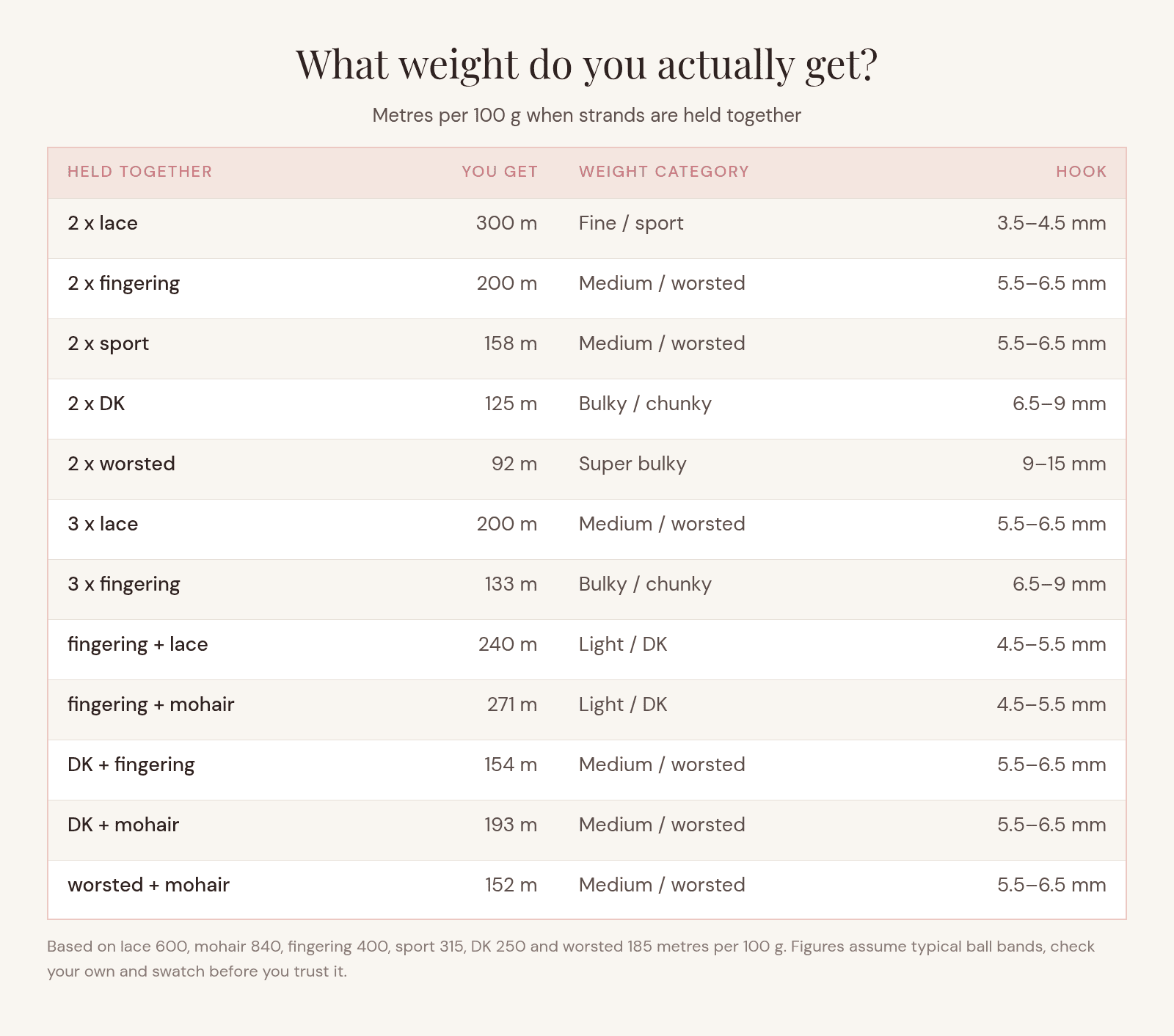
These are the combinations that come up again and again. The figures assume a typical ball band for each weight, so treat them as a starting point and check your own yarn. Save the image if it is useful.
| Held together | You get | Weight category | Hook |
|---|---|---|---|
| 2 × lace | 300 m | Fine / sport | 3.5–4.5 mm |
| 2 × fingering | 200 m | Medium / worsted | 5.5–6.5 mm |
| 2 × sport | 158 m | Medium / worsted | 5.5–6.5 mm |
| 2 × DK | 125 m | Bulky / chunky | 6.5–9 mm |
| 2 × worsted | 92 m | Super bulky | 9–15 mm |
| 3 × lace | 200 m | Medium / worsted | 5.5–6.5 mm |
| 3 × fingering | 133 m | Bulky / chunky | 6.5–9 mm |
| fingering + lace | 240 m | Light / DK | 4.5–5.5 mm |
| fingering + mohair | 271 m | Light / DK | 4.5–5.5 mm |
| DK + fingering | 154 m | Medium / worsted | 5.5–6.5 mm |
| DK + mohair | 193 m | Medium / worsted | 5.5–6.5 mm |
| worsted + mohair | 152 m | Medium / worsted | 5.5–6.5 mm |
Two rows are worth pausing on. Two strands of DK give you a chunky yarn, not the aran most people expect, which is why so many held-double sweaters come out stiffer and heavier than planned. And two strands of lace give you sport, which is a genuinely useful way to turn an awkward cone of lace into something wearable.
Which hook should you use?
Once you know the combined metreage, look up the matching weight category and use its hook range as your starting point. The ranges in the table above come from the Craft Yarn Council standard yarn weight system, which is the closest thing crochet has to an agreed reference.
Two adjustments are worth making on top of that.
- Held yarn wants a slightly bigger hook than its category suggests. Separate strands take up more room in a stitch than a single plied yarn of the same mass, because they do not pack together as neatly. Starting at the top of the range rather than the middle usually works.
- Taller stitches want more room again. A double crochet fabric worked at the same hook as single crochet comes out stiff. Going up one size for double crochet, and one or two for trebles, keeps the fabric moving.
The calculator does both of these for you. Pick your stitch and it shifts the hook range accordingly, then gives you a gauge estimate for that stitch rather than making you convert from single crochet in your head.
What about mohair?
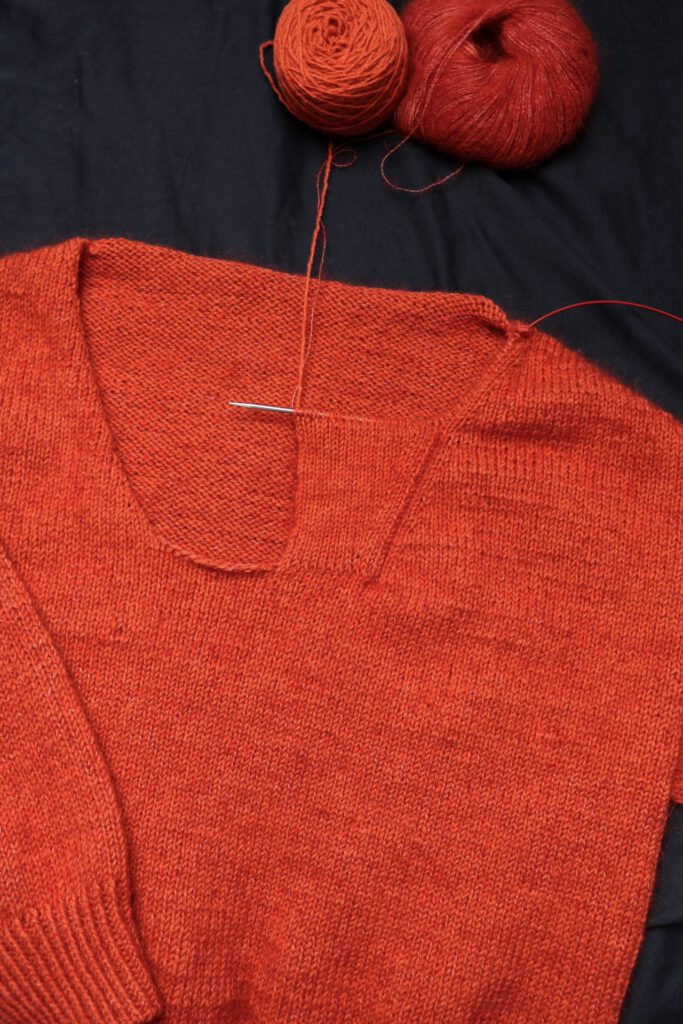
Mohair held with a smooth yarn is the most popular version of this technique, and it is also the one where the numbers are least helpful.
The maths still works. A brushed lace mohair at 840 m per 100 g held with a DK gives you 193 m per 100 g, comfortably a worsted. But that number describes the mass of the yarn, and mohair’s whole personality is that it takes up far more space than it weighs. The halo fills gaps, softens edges and makes the fabric feel thicker than the figure suggests, without adding meaningful grams.
So use the combined weight to choose your yarn quantities, which is a mass question and the maths handles it perfectly. Then treat the hook as a starting point rather than an answer, and expect to go up a size. Swatching matters more here than anywhere else.
One more thing about mohair specifically: it is very difficult to frog. Test your hook choice on a small swatch you are happy to throw away, rather than on the first twenty rows of a sweater.
How much yarn will you actually need?
This is where people run out of yarn halfway through, so it is worth being precise.
If a pattern asks for 500 m of worsted, and you are making that worsted from two strands of fingering, you need 500 m of each strand. Not 250 m of each. Every metre you crochet uses a metre from both balls at once, so both balls run down at the same speed.
The mass works out exactly as you would expect, which is a nice check that you have it right. 500 m of a 200 m per 100 g yarn weighs 250 g. And 500 m of a 400 m per 100 g fingering weighs 125 g, so two of those is also 250 g. The grams match, the metres do not, and it is the metres that catch people out.
Maki’s tip
Wind the strands into one ball before you start, using a ball winder or just winding by hand with both yarns held together. It takes ten minutes and it removes the single most annoying part of the technique, which is two balls rolling in opposite directions and twisting around each other every few rows.
Five things worth knowing before you start
- Keep the tension even between strands. If one runs tighter than the other, the loose one loops out on the surface. Winding them together first largely solves this.
- Watch that you catch every strand. Splitting a strand and leaving it behind is easy to do and very visible. Check your stitch count at the end of each row for the first few rows.
- Mixed fibres mean mixed care. A superwash merino held with a hand-wash mohair makes a hand-wash fabric. The most delicate strand sets the rules.
- Different fibres shrink differently. Wash and dry your swatch before you trust it, especially with a cotton and wool combination.
- Colours blend, they do not stripe. Two strands of different colours read as a single heathered shade from a distance, closer to a tweed than to stripes.
Questions I get asked
What weight do I get if I hold two DK strands together?
Roughly 125 m per 100 g, which is a bulky or chunky yarn on a 6.5 to 9 mm hook. It is not aran, which is what most people assume. If you want aran from DK, hold one DK strand with something much finer such as a lace or a mohair instead.
Can I substitute held strands for a single yarn in any pattern?
Usually yes, as long as you match the gauge rather than the label. Held yarn behaves slightly differently from a single plied yarn at the same weight: it is a little softer, a little less defined in the stitch, and it drapes a bit more. For a garment that is normally fine. For something that needs to hold a rigid shape, work a proper swatch first.
Do I need the same number of metres of each yarn?
Yes. Each strand contributes its full length to every stitch, so you need the same metreage of all of them. Two strands means twice the total length, even though the total weight matches what a single yarn of the combined weight would need.
Can I hold more than two strands?
Yes, and three is common with fine yarns. The formula extends to as many as you like, and the calculator takes up to eight. Past three or four strands it does get physically awkward to keep them even, so wind them together first.
Does the calculator work with yards and ounces?
Yes, and you can mix them. A 25 g / 210 m European mohair can sit next to a 100 g / 220 yd American worsted in the same calculation, and the conversion happens for you.
Why does my ball band not show metres per 100 g?
Most do not, because balls come in 25, 50 and 100 g. Divide the length by the weight and multiply by 100. A 50 g ball with 125 m is 250 m per 100 g. The calculator does this step for you as well, so you can type the ball band in as it is written.
Is holding two strands the same as using a plied yarn of that weight?
Close, but not identical. A plied yarn is twisted, which makes it rounder and more compact. Held strands sit loosely side by side, so they spread a little wider in the stitch and give a softer, slightly hazier fabric. This is why the hook usually needs to go up a size compared with what the category alone would suggest.
Try it with your own yarn
The table covers the usual combinations, but the interesting ones are always the yarns already in your basket. The calculator takes whatever you have, in whatever units the ball band uses, and gives you the combined weight, a hook range and a gauge estimate for the stitch you plan to use.
It runs entirely in your browser. Nothing is sent anywhere, nothing is stored, and there is no sign-up.
Held Together
The yarn weight calculator for held strands. Up to eight yarns, any units, hook and gauge included.