Frogging means pulling your work back out because something in it is wrong. On a smooth cotton it takes a minute. On mohair the fabric does not want to come apart at all, and the usual response, which is to pull harder, is the thing that snaps the strand.
Mohair can be frogged. It cannot be frogged the way cotton is frogged. The method below is cold, slow, worked in short pulls, and it includes a point at which the right answer is to cut instead.
If you only read one box
The short version
- Frog it before you wash it. The halo lies flat on a new ball and lifts on the first wash, so an unwashed piece is the easiest this will ever be.
- Put it in a sealed bag and freeze it. 10 minutes to overnight.
- You get a short window out of the freezer. 10 to 15 minutes. Put it back in the bag rather than pull harder.
- Pull short. 10 to 20 cm (4 to 8 in) at a time, away from the fabric, and stop the moment the strand goes tight.
- Open anything that sticks with the hook, one size smaller than you worked with. Never pull through a stuck spot.
- Cut before it breaks. A cut costs you a few centimetres. A break costs you the same plus a thin place you did not choose.
- Mohair held with a smooth yarn is much easier than mohair on its own. Wind the two strands onto separate balls as they come off.
Why mohair is hard to frog
The halo holds the stitches together. Mohair yarn is brushed after spinning so that fibre ends stand out from the strand, and those ends reach across from one stitch into the next and sit there like loose tacking thread. Pull on the fabric and you are pulling against all of them at once.
The halo is the fuzz standing off the strand. Blooming is what it does when the yarn is first washed, which is to lift and spread. Both words come up a lot below.

Does freezing mohair before frogging work?
Most people who try it say yes, and nobody has measured it. The published freeze times run from 10 minutes to overnight, which is a wide enough spread to tell you the advice is being passed along rather than tested.
iMake says 30 minutes in a sealable bag, still on the needles. Knitting-and.com says overnight. The Secret Yarnery says 30 to 60 minutes and adds the figure that actually changes how you work, which is that the effect lasts about 10 to 15 minutes once the piece is out. A widely shared TikTok reports overnight as the best result, on two strands of mohair held together. A Knitting Paradise thread has people using 10 to 20 minutes and re-freezing between sittings.
The explanations given for it are weaker than the advice. iMake says the cold shrinks the fibres, which I do not believe: a few degrees of cooling will not shrink keratin by anything a hand could feel. The Secret Yarnery says the cold stiffens the fibres so they cling less, which at least fits what a fibre does when it is cold, because a stiffer fibre springs out of a tangle instead of folding into it. I cannot tell you which is right and neither can the sources.
What I can give you is a way to settle it for the yarn in your hands. It costs about 20 g of mohair and twenty minutes.
- Make two swatches the same, about 10 x 10 cm (4 x 4 in), in the yarn and on the hook you are planning to use.
- Leave one on the table. Put the other in a sealed bag in the freezer for 30 minutes, with the air squeezed out so it lies flat.
- Frog the room temperature one and time it. Note how often it stuck and whether the strand broke.
- Take the cold one straight out of the bag and frog it exactly the same way.
- Lay the two strands side by side afterwards and look for thin places and lost halo.
Twenty grams is a real cost on a mohair. If it is more than you want to spend, do the test on the tail end of a ball you have already finished with.

On whether the cold does any harm, I could find no source saying freezing hurts mohair, and nothing about the fibre suggests it would. A dry yarn in a sealed bag at freezer temperature is a long way from anything that damages wool or hair.
How to frog mohair step by step
Work cold, pull in short lengths, and use the hook to open anything that catches rather than pulling through it. In crochet you undo from the live loop backwards, so there are no loops to drop and nothing to catch on a needle. That part is easier than it is for knitters.
- Mark where you are stopping. Put a stitch marker or a loop of smooth contrast yarn through the stitch you mean to keep, and count the rows above it. Mohair hides its own stitches, so finding that line again by eye once you have started is hard.
- Bag it and freeze it. The whole piece, sealed, air squeezed out, 30 minutes as a starting point.
- Take the hook out and pull the loop free. From there the yarn comes back on its own for as far as it is willing to go.
- Pull 10 to 20 cm (4 to 8 in) at a time, straight up and away from the fabric rather than sideways across it. Stop as soon as the strand tightens.
- Open the stuck spot with the hook. Slide the tip under the loop that is caught and lift. The Secret Yarnery suggests a hook one size smaller than the one you worked with, or a blunt tapestry needle, which is less likely to split the strand.
- Re-freeze when it starts gripping again. Ten to fifteen minutes of working time is the figure to plan around. Going back in the bag is always better than pulling harder.
- Wind as you go, loosely. Over your hand or around two fingers. A ball wound tight puts the yarn under tension for however long it sits there.
- Cut rather than break. If a place has not opened after a few seconds of work with the hook, snip the strand there and pick it up on the far side.
If you only need to come back a few stitches, do not pull at all. Put the hook into the stitch below the loop and let each one out singly, undoing the stitch in reverse. Nothing is under tension that way, so nothing can snap. It is slow, and over a few stitches it is the safest thing on this page.

Speed is what breaks mohair, more than force is. When I ran a thin angora through an electric sweater unraveler, the strand snapped before I could reach the switch, and that was on the slowest setting the machine had. Angora and mohair fail the same way. The halo catches, the pull does not stop, and the strand is the thinnest thing in the chain. By hand you feel the catch coming a moment before it matters, and that is why fuzzy yarns get done by hand here.
How to frog mohair held with another yarn
It is easier than frogging mohair on its own, which catches people out. The smooth strand carries most of the pull, so the mohair is never the only thing under tension, and the smooth strand is the one that would have to break first.
This is how most crochet mohair gets used anyway. A lace mohair worked alone on a hook big enough to give it drape makes a fabric with very little body, so it usually goes in alongside a fingering or a DK. If you want the arithmetic for what the two of them come out as, that is in the post on holding strands together and in the calculator.

- Pull both strands as one. Do not try to separate them while they are still in the fabric.
- Wind them onto two separate balls as they come off, one strand each. Wound together, they have to stay together next time and at the same tension, and neither can be used on its own.
- Expect them to look different afterwards. The mohair comes off thinner and the smooth yarn comes off with mohair fibres stuck to it. Both are normal and neither is damage.
- If one strand breaks, cut the other at the same place. Two joins sitting together are easier to work around than two joins half a metre apart.
Winding two strands onto two balls at once is fiddly with two hands. A second person helps, and so does parking one strand around the back of a chair while you deal with the other.
When to cut mohair instead of frogging it
Cut when a spot has not opened after a few seconds of working at it with the hook, and cut before the strand breaks rather than after. A cut costs you a few centimetres and a join you chose the position of. A break costs you the same centimetres, plus a thinned place either side where the twist has pulled open.

There is also a case for not frogging at all. A mohair garment you have worn and washed several times is the hardest version of this job, and the yarn that comes back has the least halo left. If the piece still works as it is, and the yarn was only going to become something small, leaving it alone is a real answer rather than a failure.
How to use mohair yarn after frogging it
Wind it loosely, let it rest, and swatch it again before you commit it to anything. Frogged mohair comes back kinked and with less halo where the stitches were, and both of those change the gauge you get out of it.
The standard fix for kinks is to wind the yarn into a loose hank, tie it in three or four places, soak it, roll it in a towel and hang it to dry with no weight on it. On mohair that does a second job: it blooms the halo, so the yarn you wind back will be fuzzier than the yarn you bought.
If you would rather not wet it, the Secret Yarnery suggests holding the strand above a steaming kettle without letting it get wet, brushing it with a soft toothbrush and leaving it overnight. They also suggest letting frogged yarn rest a few hours before you use it again.
That advice looks like it contradicts the warning further up about not steaming mohair, so here is the distinction. Steam is a problem while the yarn is still a fabric, because heat and moisture press fibres that are already touching into each other. Once the yarn is a single strand hanging in the air there is nothing beside it to bond with, and steam only relaxes the twist.

Then swatch it. I would make a fresh 10 x 10 cm (4 x 4 in) square rather than trust the gauge you had before, especially if the yarn has been wet since. The gauge post has the arithmetic for getting to the right hook in one jump if the new number misses.
You will lose some halo where the stitches were. Nobody publishes a figure for how much, and I do not have one either. What I would check for instead is thin places along the strand, where the twist has opened and the fibre has thinned out. Those are the spots that break next time.
Maki’s tip
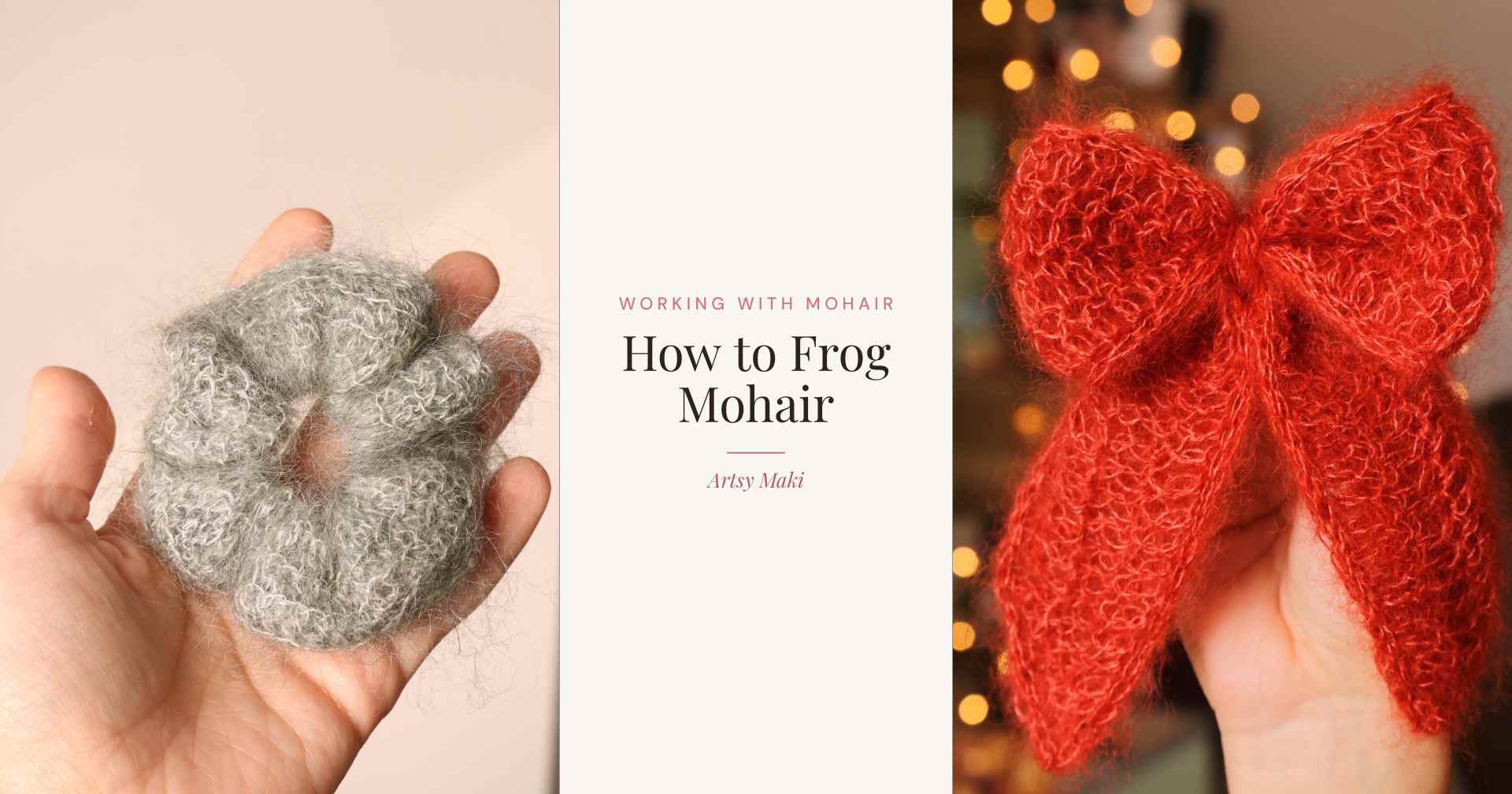
Before you commit a new mohair to something large, work 10 g of it into something small and then frog it on purpose. Ten grams is the whole of my Mohair Bow, so you get a finished thing out of it rather than a swatch, and by the end you know how that particular yarn behaves when it is pulled back. I would far rather find that out on a bow than halfway up a sleeve.
Questions I get asked
Can you frog mohair at all?
Yes, slowly and cold. Mohair has its reputation because the usual method, which is to pull the yarn and let the row run out behind it, stops after a few centimetres. Once you stop expecting that and work in short pulls with a hook to hand, it comes back.
Does freezing mohair damage it?
I could not find a source saying it does, and nothing in the fibre suggests it would. A dry yarn sealed in a bag at freezer temperature is not being wetted, heated or agitated, which are the three things that change wool and hair. Squeeze the air out so no frost forms on the fabric.
How long can mohair sit before I frog it?
No source gives a number. The sense of the advice is that the longer it sits the more the fibres settle into each other. Washing is the change that matters most, because the halo lifts on the first wash, so frog before you wash rather than after.
Can I use a lifeline in crochet?
Yes, though it does a different job from a knitter’s. Thread a length of smooth contrast yarn through a whole row of stitches with a tapestry needle. It will not hold live loops the way it does on needles, but it marks the row, and finding a row again through a halo is the hard part.
What hook should I use to pick out mohair stitches?
One size smaller than the one you worked with, which is the Secret Yarnery’s suggestion and the one I would follow. A blunt tapestry needle works too and is less likely to split the strand. For reference, I crochet a lace mohair on a 5 mm hook, so I would pick out with a 4.5 mm.
Does mohair felt in the fabric while I am working on it?
Not in normal use. Felting wants heat, moisture and agitation at the same time, and mohair’s scales are not fully developed, so it resists felting more than wool does. What locks the stitches is the halo tangling. That is also why a dry, cool piece still refuses to come apart.
My frogged mohair looks thinner than the ball did. Have I ruined it?
Probably not. What you have lost is halo, and a good part of it comes back when the yarn is washed or steamed. Run the strand through your fingers and look for places where the twist has opened and the core has thinned. Those are worth cutting out. General fuzz loss is not.
Where to go next
If the reason you are frogging is that the fabric came out stiff and small, that is a hook problem rather than a mistake, and the gauge post is the more useful one. If you are holding mohair with something else and want to know what weight the pair makes, the post on holding strands and the calculator do that arithmetic. And if you want somewhere small to practise all of this, the mohair scrunchie is free and takes an evening.
Ten grams of mohair, start to finish
The Mohair Bow is 10 g of lace mohair on a 5 mm hook, finishing at 10 x 13 cm (4 x 5 in). One size, adjustable, instant PDF download. Small enough to frog on purpose and learn what your yarn does.