Every autumn I get the same question in my messages. Someone wants to crochet a sweater they can wear through winter, they have been told to use a dense stitch, and the swatch they made in that dense stitch feels like a doormat. They want to know which stitch gives them warmth without ending up with something stiff and heavy.
The honest answer is that warmth and bulk are close to the same thing in a fabric, so you cannot simply pick a stitch and be done. But they are not identical, and the gap between them is where the good choices live. This post covers what actually makes a crochet fabric warm, which warm crochet stitches close the gaps without adding weight, which ones belong on a bag instead of a body, and how to check your own swatch before you commit two hundred grams of yarn to it.
If you only read one box
The short version
- A fabric is warm because it holds still air, and because there are no holes for that air to blow out of.
- Open stitches lose most of their warmth outdoors.
- Weighed on 10 x 10 cm swatches in the same DK yarn: single crochet 8 g, moss stitch 7 g, double crochet 6 g, knitted stockinette 5 g. The short dense stitches cost the most weight per square of fabric.
- So the stitches worth trying first are the ones that are solid without being short: moss stitch, half double crochet, linked half double, herringbone half double.
- The yarn changes more than the stitch does. DROPS Air and DROPS Nepal are both sold as aran and both knit to 17 stitches over 10 cm, but Air gives 150 m per 50 g against Nepal’s 75 m. Same thickness of fabric, half the weight.
- Leave honeycomb, waffle and thermal stitch for bags and cowls. They are warm because they are thick, which is the thing you were trying to avoid.
What makes a crochet fabric warm?
Still air. Wool, alpaca and acrylic are all poor conductors of heat, but air is worse, and a fabric is mostly air. What a sweater does is hold a layer of air next to you and stop it moving. In a 2025 review of how clothing actually insulates, Garcia Torres and colleagues put more than 60% of a garment’s total insulation down to trapped air layers, and in some cases up to 80%.
Two things follow from that.
Thicker is warmer. A thicker fabric holds more air. Studies of knitted fabric keep arriving at the same relationship: in a 2025 paper in Materials, Vasile and colleagues report that thicker materials tend to have higher thermal resistance. This is the part everyone already knows, and it is why the usual advice is to use a chunky yarn and a tight stitch.
Denser is not warmer. The same paper found that denser materials show lower thermal resistance. Density here means how much fibre is packed into a given volume. Squash the air out and you are left with more fibre touching more fibre, and fibre carries heat away better than air does. So a stitch that makes a hard, compressed fabric is not buying you as much warmth as its weight suggests.
And then there is wind, which is what actually decides whether an open stitch works outdoors. Air permeability, meaning how easily air passes straight through the cloth, promotes convective cooling. The same 2025 review measured wind stripping the still air layer away: at 1.1 m/s, which is slower than most people walk, insulation dropped by as much as 60%.
That is the reason a mesh top feels fine on a still evening and useless the moment you step outside. The holes are not just letting warm air out. They are letting cold air in, and doing it faster the harder the wind blows.
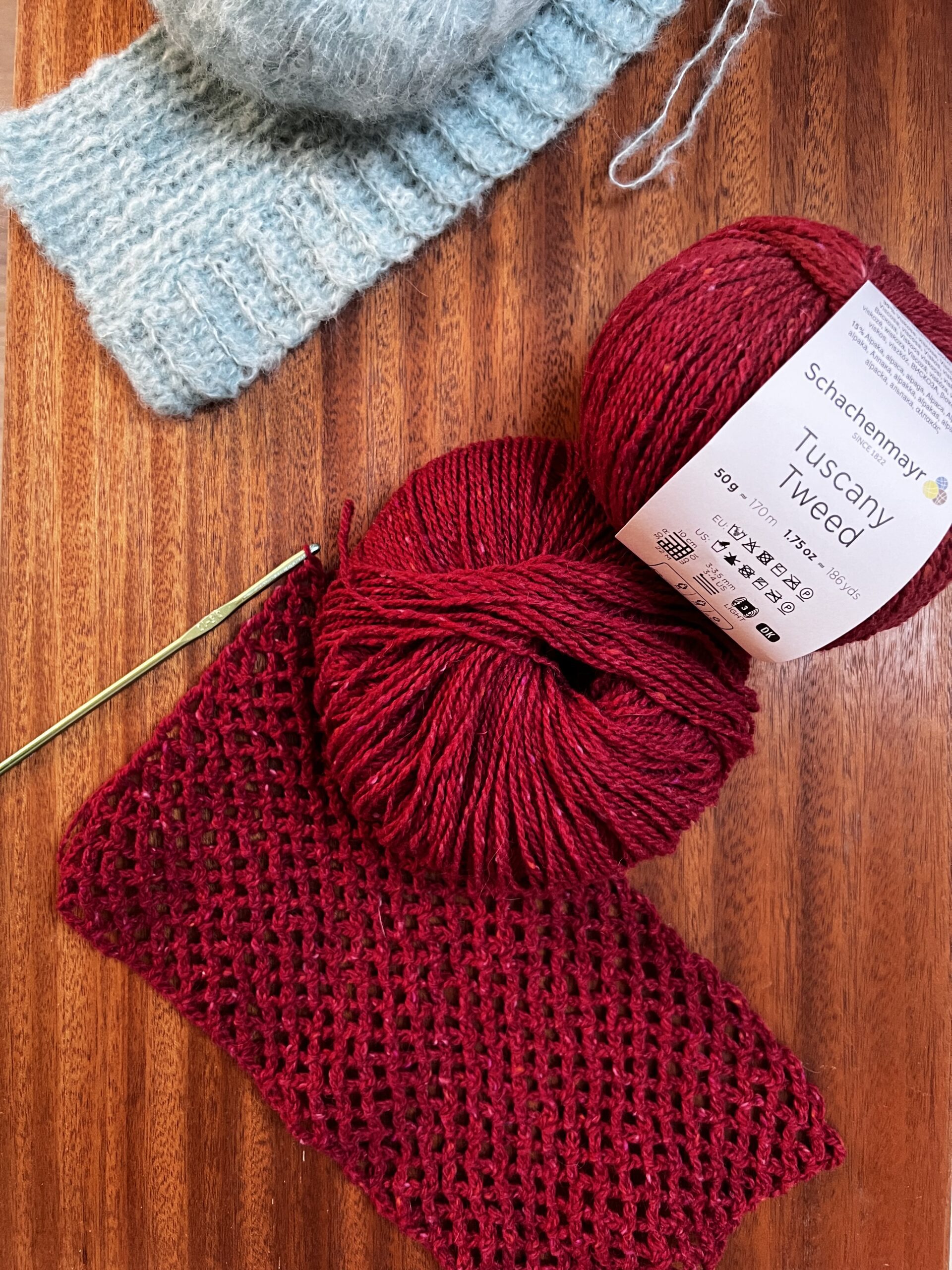
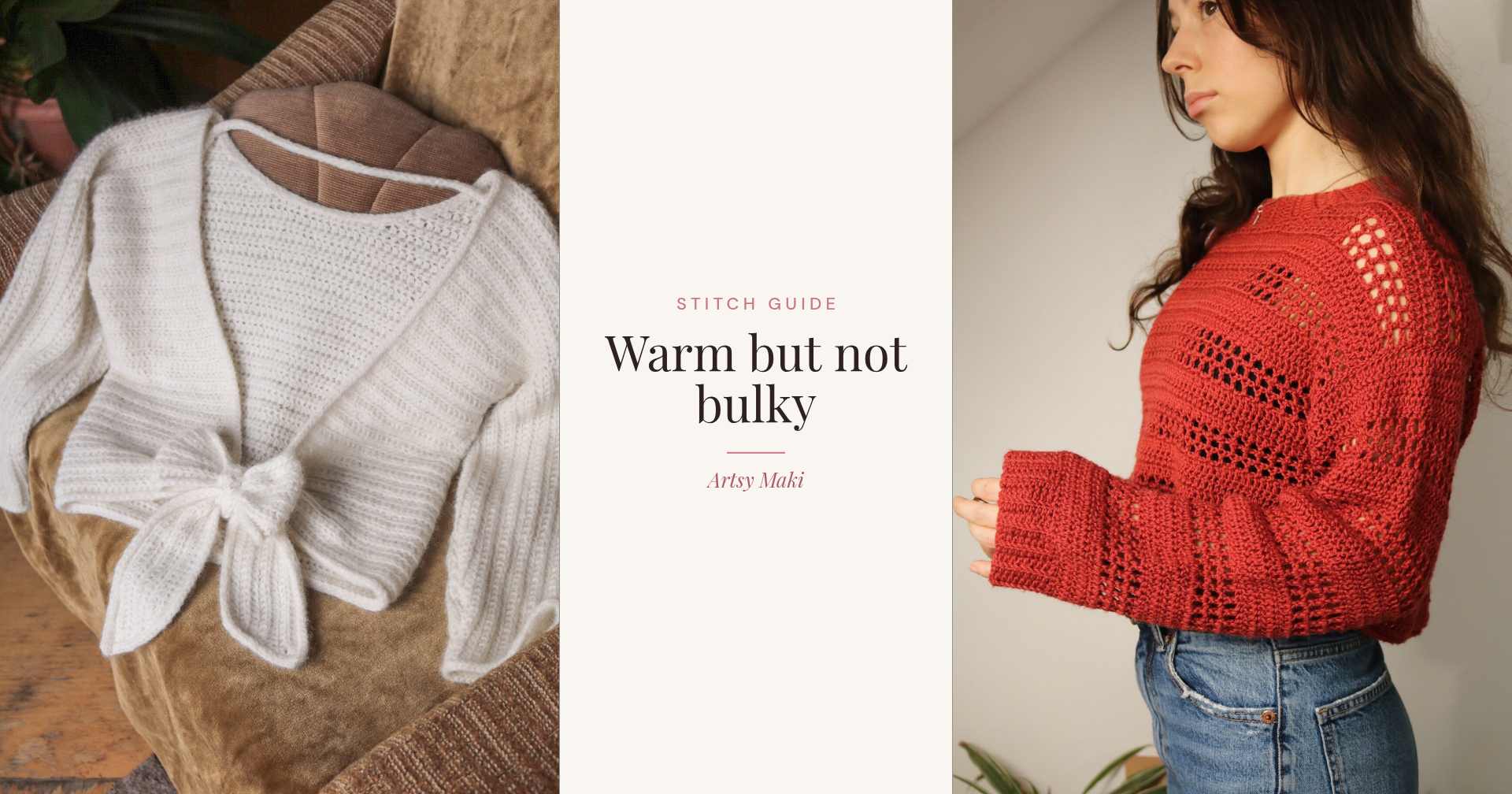
Two of my own swatches, and you can see the difference without touching them. The red tweed is worked in mesh, so it is full of square holes. The blue mohair has no gaps at all and is barely thicker. The mohair one is the warm fabric, and it is the lighter of the two.
Put those three findings together and you get a target that is more specific than “use a dense stitch”. What you want is a fabric with no holes in it, made of yarn that has air inside the yarn itself, worked at a tension that does not crush that air out. That is a different instruction from making the tightest fabric you can, and it points at different stitches.
Why crochet sweaters come out bulky
Because crochet fabric uses more yarn per square than knitted fabric does, and because the stitches recommended for warmth are the short ones, which use the most of all. The weight ends up on your shoulders.
Somebody has actually measured this properly. The Fairythorn made a set of 10 x 10 cm (4 x 4 in) swatches, all from the same ball of DROPS Karisma, all on a 4 mm hook or 4 mm needles, then weighed each one and unravelled it to measure the yarn. In US terms, which is what I use and what her UK names convert to:
- Knitted stockinette: 5 g, 11.25 m (12.3 yd)
- Double crochet, her UK treble: 6 g, 13.02 m (14.2 yd)
- Moss stitch: 7 g, 15.84 m (17.3 yd)
- Knitted garter: 7 g, length not stated
- Single crochet, her UK double: 8 g, 16.39 m (17.9 yd)
Single crochet costs a third more yarn than double crochet for the same square of fabric, and 60% more than knitting. On a sweater that needs roughly a square metre of fabric, a third more is a couple of hundred grams you are wearing around all day.
These are one person’s swatches at one person’s tension, so treat the exact grams as hers rather than yours. The order is what matters, and the order is confirmed by the other published tests I could find. Where those tests disagree is worth knowing about, because it trips people up: several posts say half double crochet uses more yarn than single crochet, which is true per stitch and false per square of fabric. A half double is taller, so each one costs more yarn but covers more ground, and fewer of them fill the same space. When you are planning a sweater it is the square of fabric you care about.
So there is a real tension in the question this post is answering. The stitches that close the holes are short, and short stitches are heavy per square. Which is why the stitch is only half the answer, and the yarn is the other half.
Best crochet stitches for a warm sweater that isn’t bulky
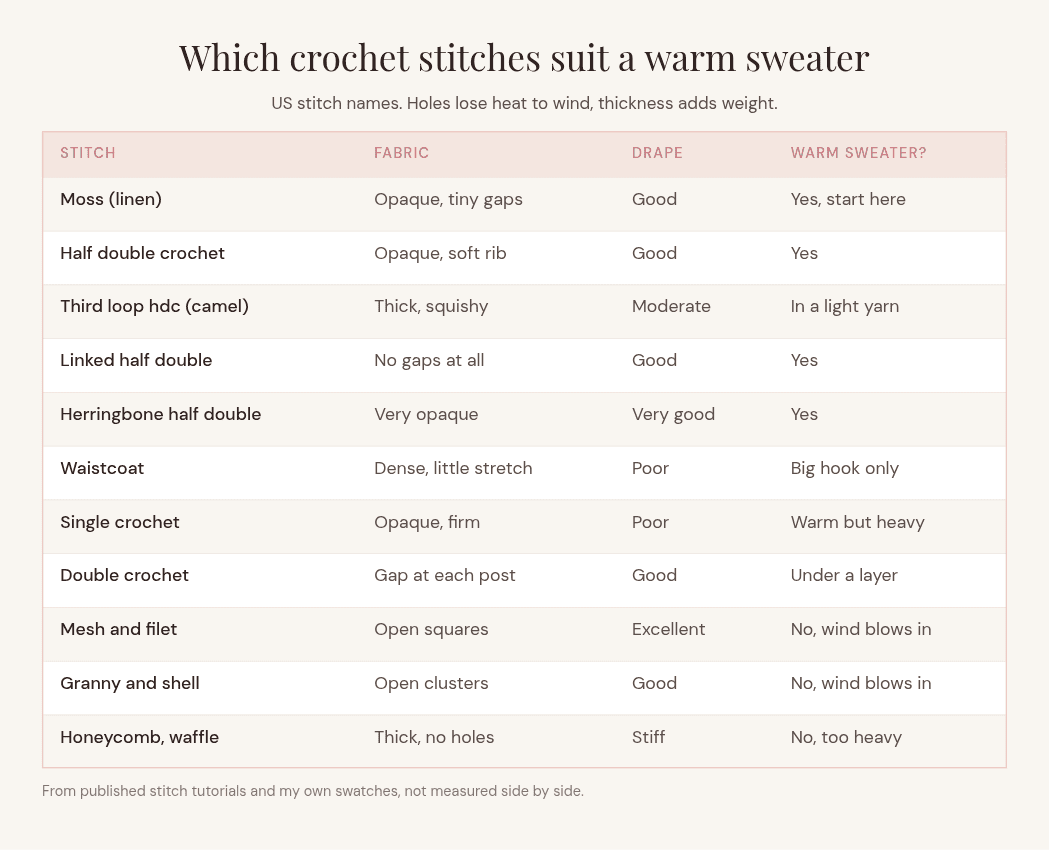
The ones that produce a solid fabric without being short: moss stitch, plain half double crochet, linked half double crochet and herringbone half double crochet. All four give you an opaque fabric with movement in it, and none of them are as heavy per square as single crochet.
One honest note before the list. The stitch I have written patterns in is half double crochet, both plain and in the alternating front and back loop version the Claire collection uses. Moss, linked and herringbone are not stitches I have built a garment from, so what I say about those comes from the tutorials I link to rather than from something of mine you can go and look at.
Here is what each one actually does.
Moss stitch, also called linen stitch
Single crochet and chain 1, alternating, one row repeat over an odd number of stitches. Every row you work into the chain spaces of the row below.
It sounds like it should be full of holes and it is not. The chain spaces are small enough that the fabric stays opaque, but big enough that the fabric moves. That is the combination this post is looking for, and the swatch numbers above back it up: 7 g against single crochet’s 8 g for the same square, while still closing the gaps.
Start here if you are only going to try one.
Half double crochet
The plain one, and it is underrated for this. A half double is short enough that the gaps between posts stay small, tall enough that you are not paying single crochet’s weight, and it has a subtle rib in it that hides uneven tension.
It also takes variations. Working into the third loop, the horizontal bar that sits behind the usual two, gives you the camel stitch: a thicker, squishier fabric that reads as knitting. Raffamusa Designs has the clearest tutorial for it. Worth knowing that this one is genuinely thicker, so it is a good choice in a light yarn and a bad one in an aran.
My own version is alternating front loop and back loop half double crochet, which is what the whole Claire collection is built on. On a 5 mm hook in aran weight it gives me 15 hdc and 10 rows to 10 cm, and a fabric with a soft vertical texture that has no holes in it anywhere.
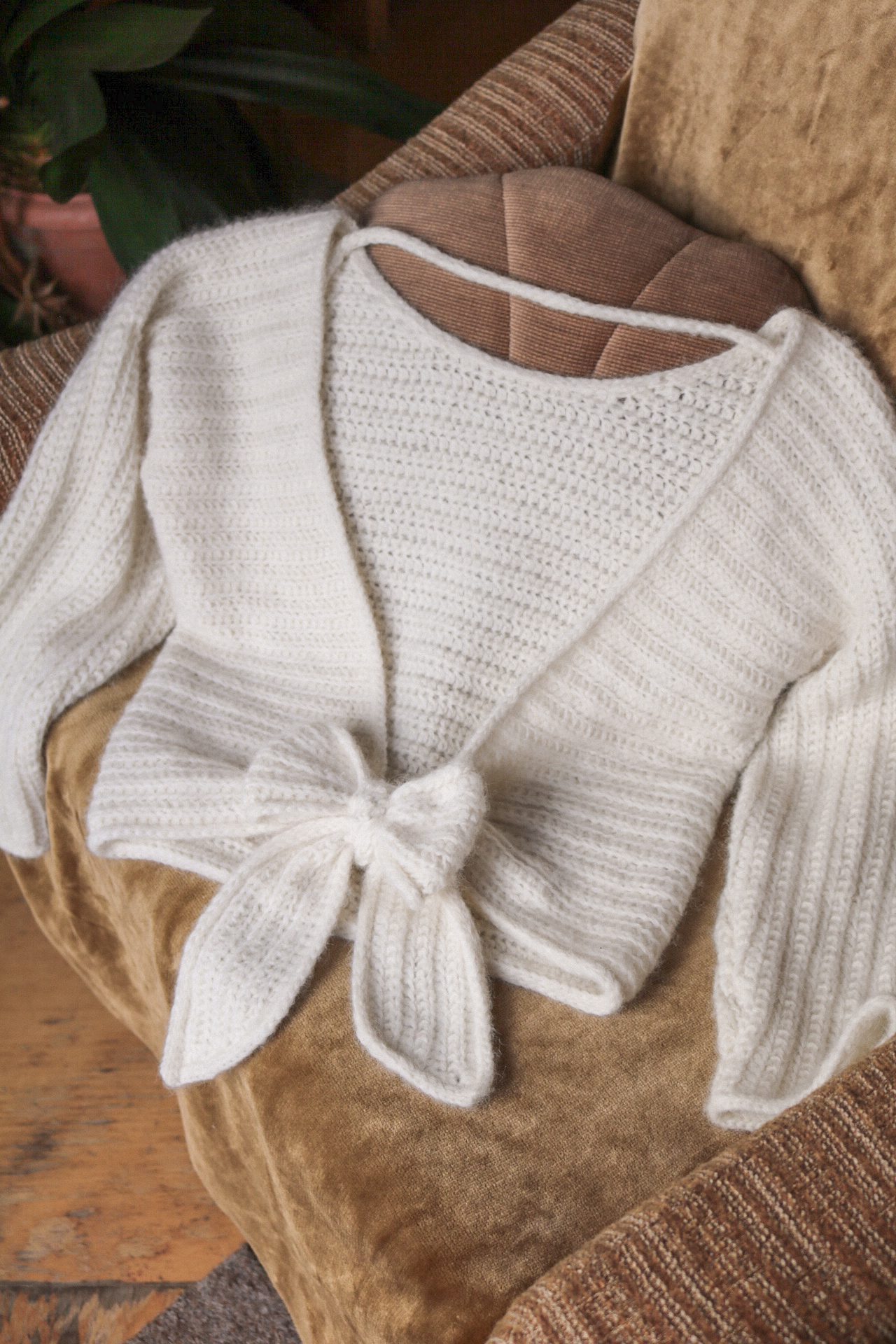
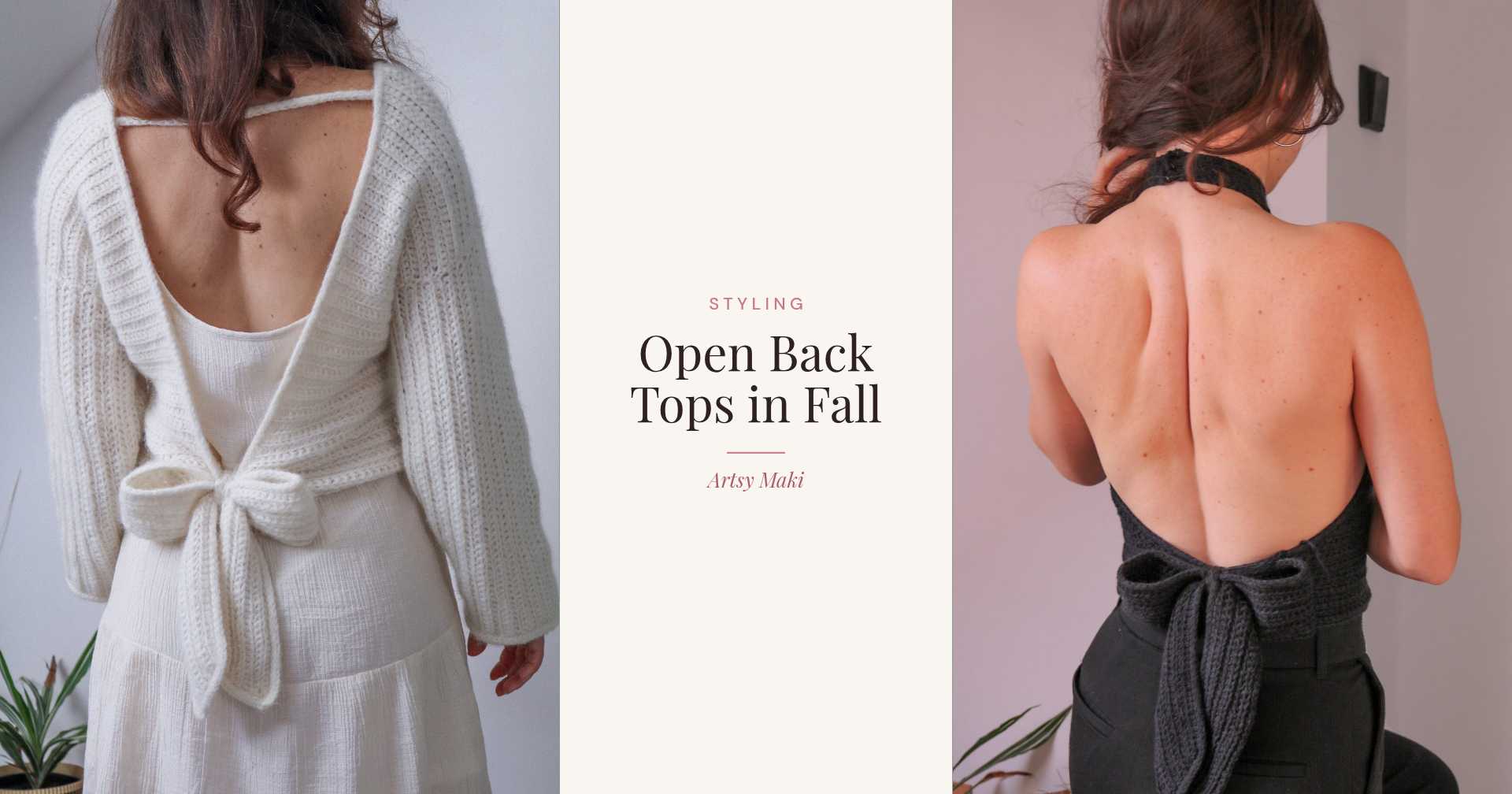
That is the Claire Sweater. The fabric is completely closed, and the whole thing in a size M takes 1050 m of DROPS Air, which is 350 g. I will come back to why that number is so low.
Linked half double crochet
Before you make the stitch, you pull up a loop through the horizontal bar on the side of the previous stitch. That joins the two together down their length, so the gap that normally sits between the posts is not there at all.
Dora Does, in her roundup of opaque crochet stitches, describes the result as having no space between the stitches, and it is the closest crochet gets to a knitted surface without changing technique. It is slower than plain half double because of the extra loop on every stitch, and it is worth going up a hook size, because linking pulls the fabric in.
Herringbone half double crochet
A half double where you pull the first loop straight through the loop already on your hook before finishing the stitch. It leans the stitches over into a herringbone slant.
Dora Does calls the drape on it, worked at a relaxed tension, a pure delight, and rates the half double version as tighter than the herringbone double. If you want something that looks less like standard crochet without being difficult, this is the one I would pick.
Waistcoat stitch
Single crochet worked into the middle of the stitch below, splitting the post, which produces rows of little V shapes that look properly knitted. It is the closest crochet comes to looking knitted.
It is also single crochet, so it carries single crochet’s weight, and it comes out stiff. Dora Does advises going up at least two hook sizes before using it on anything that has to drape. I would only choose it for a sweater in a light yarn, on a big hook, and I would swatch it before believing any of that.
Crochet stitches to avoid for a winter sweater
Two groups, for opposite reasons. Mesh, filet, granny and shell stitches leave holes, so the wind goes through them. Honeycomb, waffle, thermal and jasmine stitches are warm, but they get there by being thick and heavy, which is the problem you were trying to solve.
Stitches that leave holes
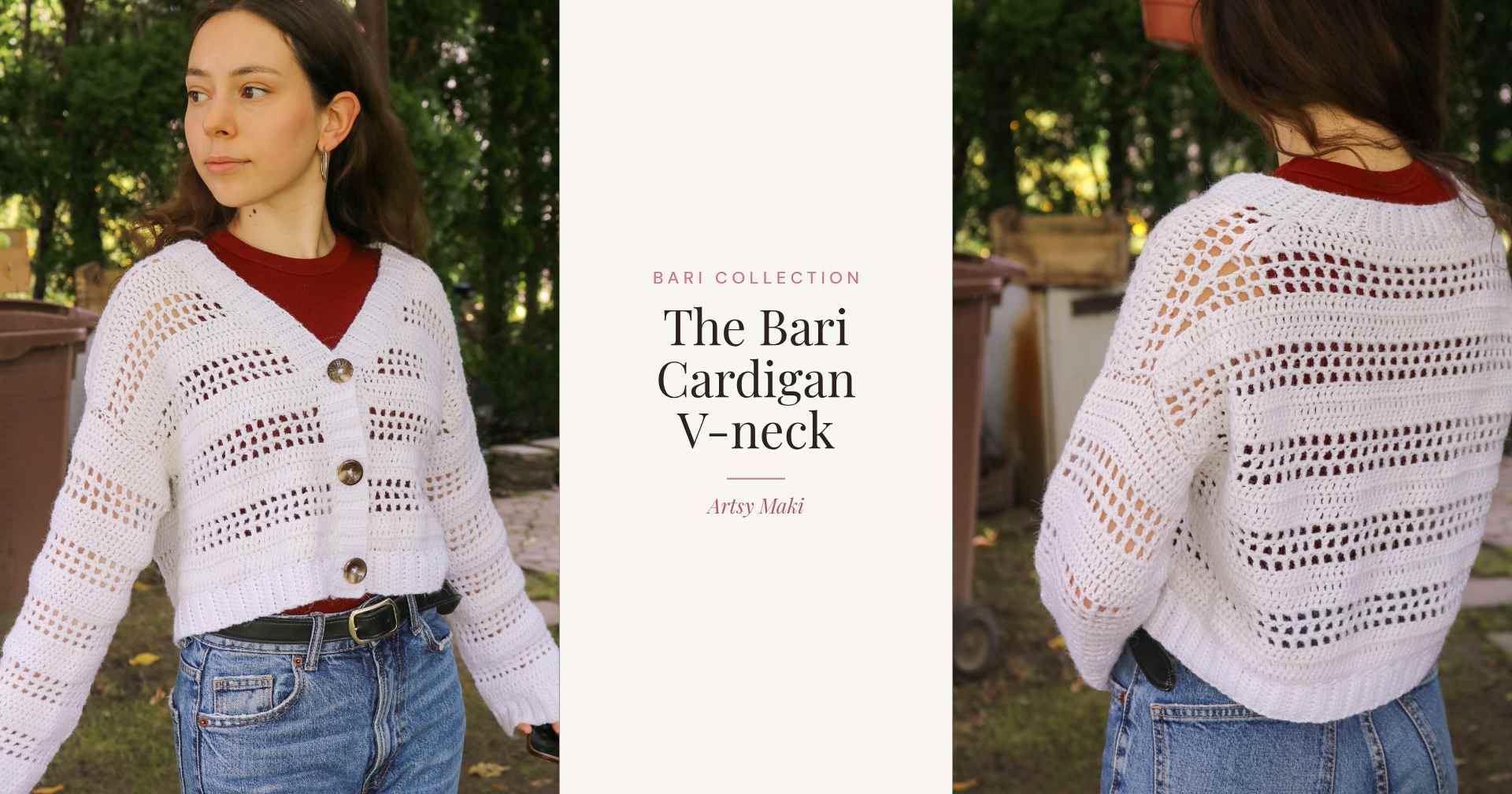
I can put a number on how much fabric a mesh actually gives you, because my Bari Sweater uses mesh stripes alongside solid double crochet sections, in the same yarn on the same 5 mm hook. The pattern gives both gauges: 19 double crochet to 10 cm, and 9 mesh squares to 10 cm. The mesh row covers the same width with fewer than half the stitches, and the rest of it is air.
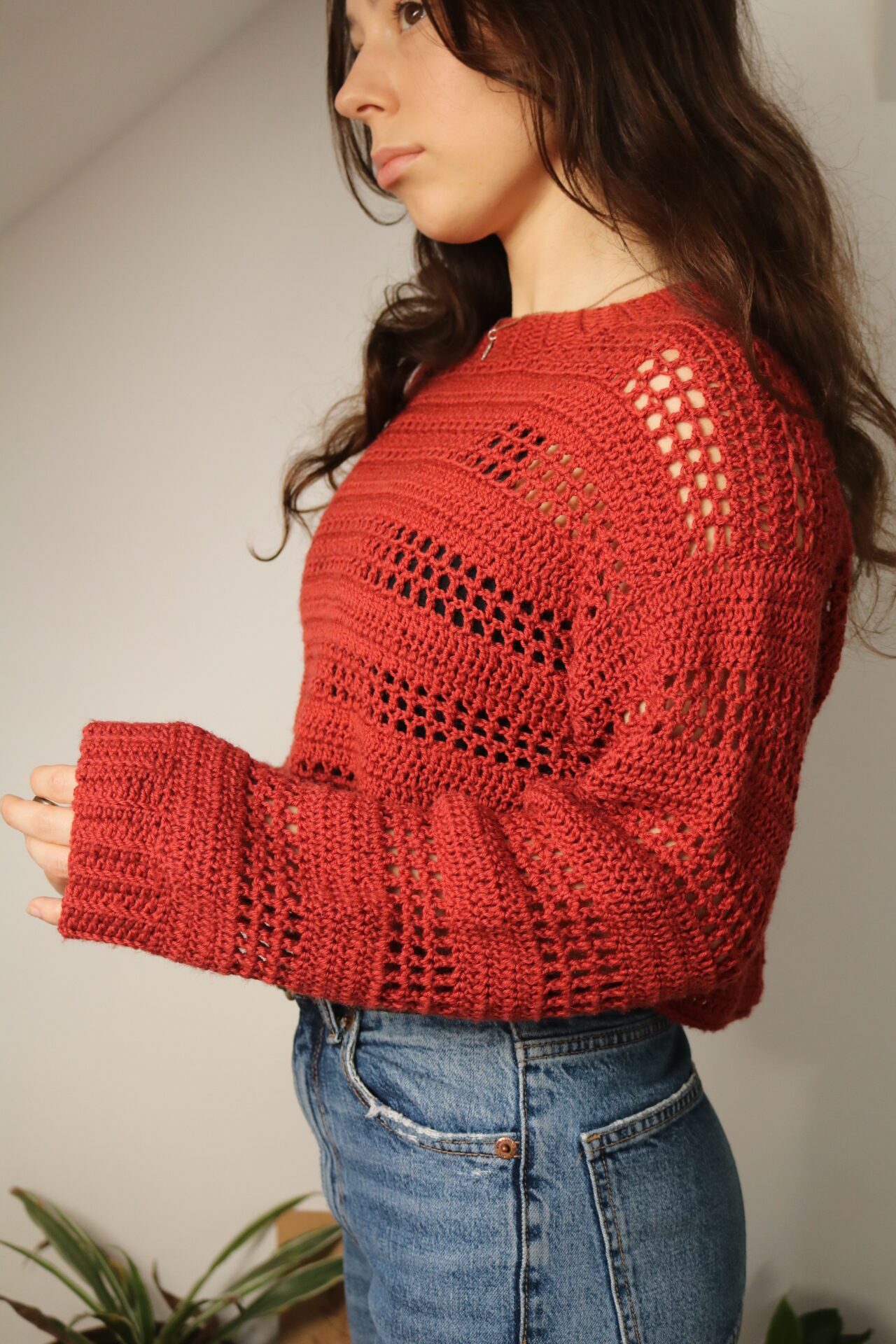
You can see it in the photo. That sweater is lovely in September and I wear mine constantly, but the mesh bands are see-through, and see-through means the wind goes straight in. If you love a mesh stripe, the fix is to put it where it will be covered or where it does not matter: the upper back, the yoke under a coat, the sleeves rather than the body.
Stitches that are too thick
Honeycomb stitch, also called smock stitch, is the clearest example, and I say this as someone who wrote the tutorial for it because I could not find one. It is a beautiful fabric. It is also, in my own words from that post, incredibly dense, squishy and structured, with virtually no holes.
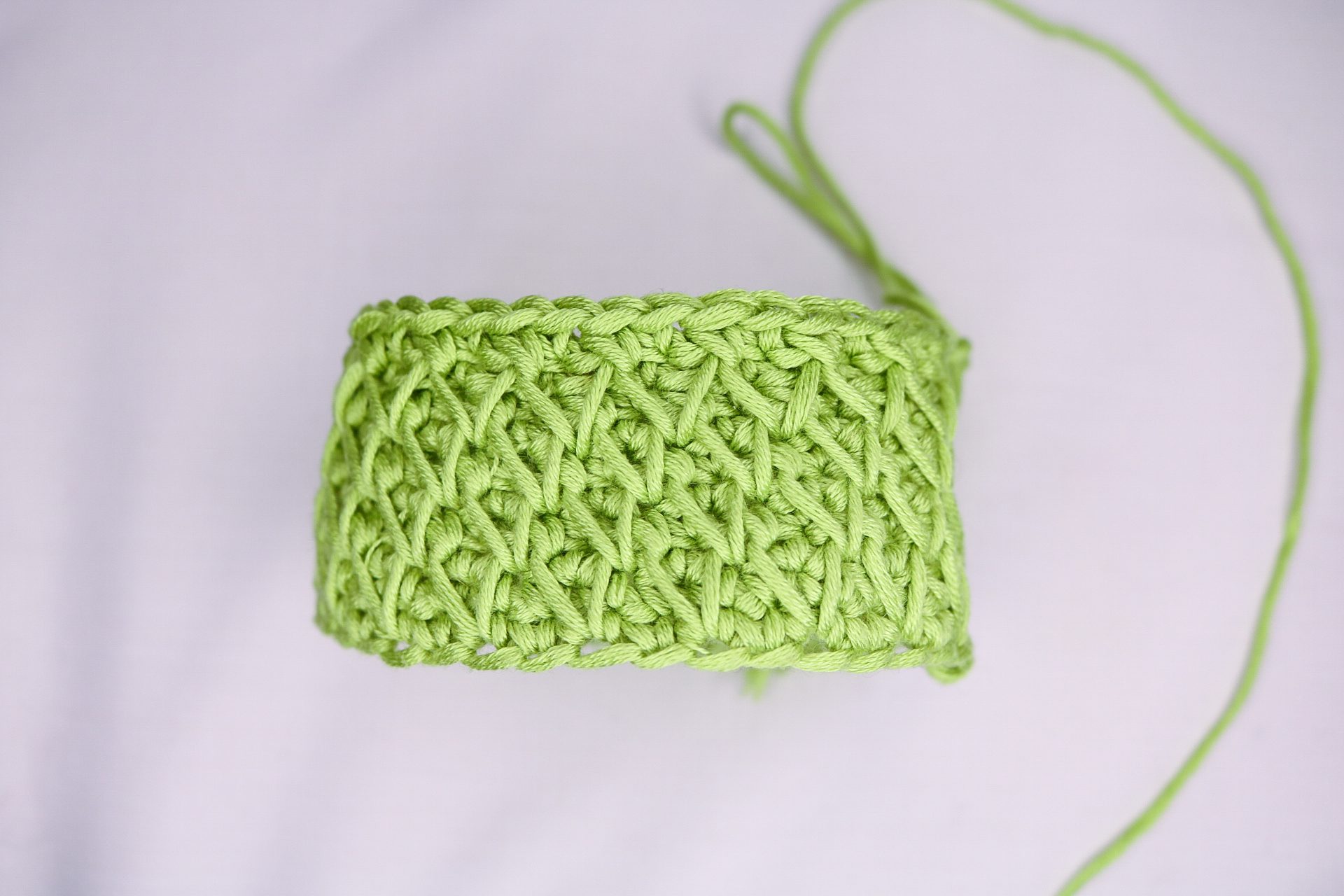
Look at the depth of that edge. Every one of those long spikes is a stitch carried up from two rounds below, so the fabric is two layers of yarn in places. Two things I wrote in that tutorial tell you it is wrong for a sweater. It is a yarn eater because of its density, so buy extra. And it is naturally very tight, so you need a hook at least 1 mm bigger than the ball band says or the fabric will be stiff and hard to work into.
Which is why I recommended it for bags, thick winter cowls and sturdy baskets, and not for anything you put your arms through. The same reasoning applies to waffle stitch, which stands the posts up in front of the fabric, to jasmine stitch, and to thermal stitch, which is warm precisely because it is worked double.
None of these are bad stitches. A honeycomb cowl is a lovely thing to make, and the weight that rules it out for a sweater is fine round your neck.
Does the yarn matter more than the stitch?
For bulk, yes, and it is not close. Changing stitch moves the weight of your fabric by about a third. Changing to a lofty yarn can halve it, with no change to how thick the fabric is or how it looks.
Here is the comparison that made this obvious to me. Two DROPS yarns, both sold as aran, both recommending a 5 mm needle and both knitting to 17 stitches over 10 cm:
- DROPS Nepal, 65% wool and 35% alpaca, spun in the ordinary way: 75 m (82 yd) per 50 g.
- DROPS Air, 65% baby alpaca, 28% polyamide and 7% merino: 150 m (164 yd) per 50 g.
Exactly twice the length in the same weight of ball, at the same thickness. Air is a blown yarn, which means the fibres are not twisted into a strand at all. They are blown into a hollow tube of fine netting, so most of what you are holding is air held in place.
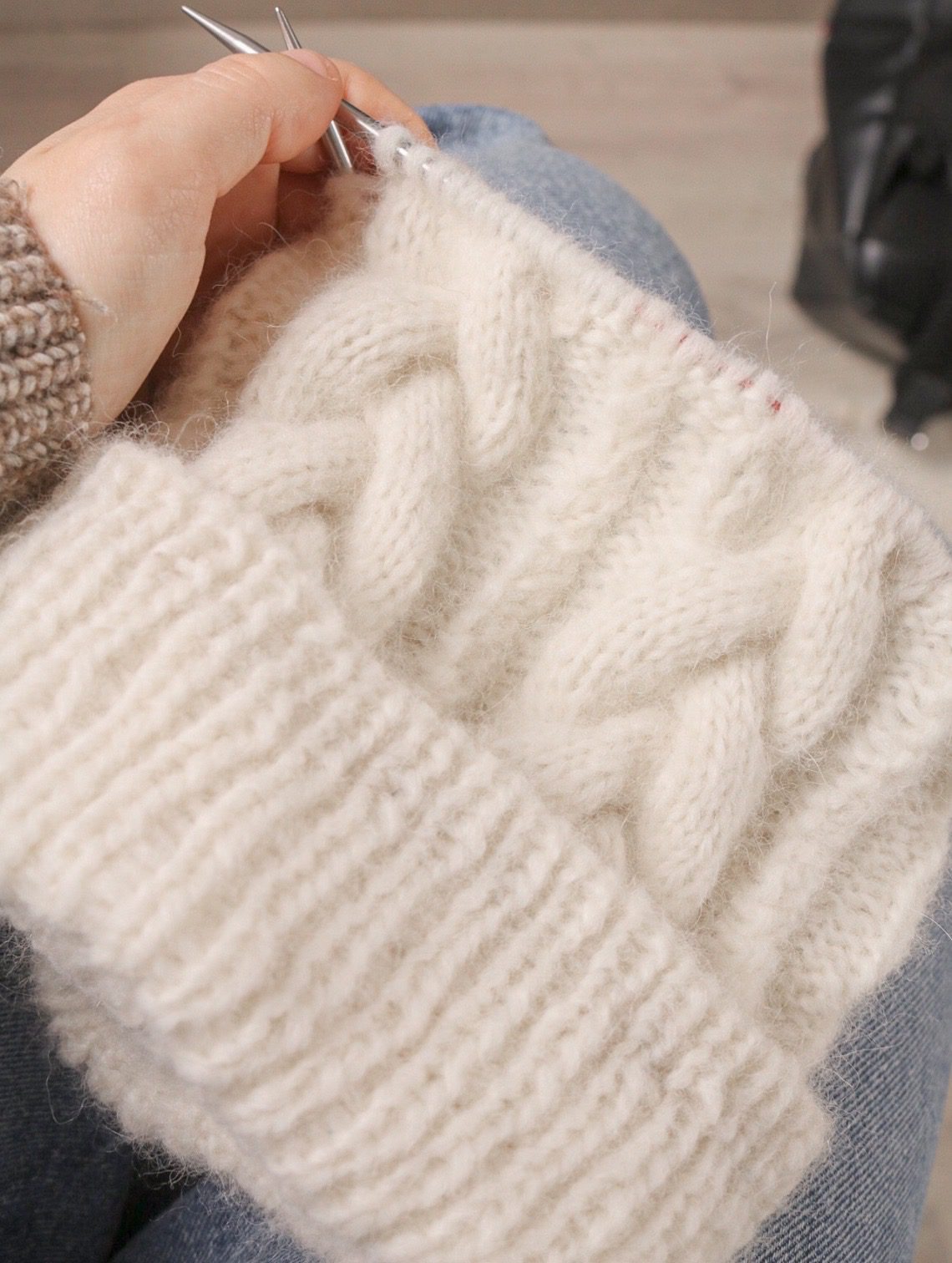
That is a hat rather than a sweater, and I am knitting it rather than crocheting, but it shows the yarn better than anything in my crochet photos. The stitches are far bigger than the weight of yarn sitting in them.
Run it through my own pattern and the effect is easy to see. The Claire Sweater in a size M takes 1050 m. In DROPS Air that is 350 g on the hanger. The same 1050 m in DROPS Nepal, which is the same weight class at the same gauge, would be 700 g. The fabric would be the same thickness and the same warmth, at twice the weight on your shoulders.
One honest caveat about that figure. DROPS themselves claim garments in Air come out around 30 to 35% lighter than conventional spun yarns of the same thickness, not 50%. I cannot reconcile the two numbers and I have not weighed a pair of identical sweaters, so take the metreage as the arithmetic and their figure as the tested one. Either way the direction is the same and the size of the effect is larger than any stitch choice.
Blown yarns are not the only option here. Brushed mohair and brushed alpaca do something similar: a thin core with a halo of loose fibre around it, so the fabric closes up and traps air while weighing almost nothing. Both are worth swatching if you want a light winter sweater.
What you cannot do is trust the word on the ball band. When I went through this for the yarn substitution post, five yarns all sold as aran ran from 150 to 300 m per 100 g. The metres per gram is the number that tells you how heavy your sweater will be, and it is printed on every band.
How to test a swatch before you make the whole sweater
Make one 10 x 10 cm (4 x 4 in) square in the stitch and yarn you are considering, then run three checks on it. It takes about twenty minutes and it settles the question for your yarn and your hands rather than in general.
- Hold it up to a window. If you can see daylight through the fabric, wind goes through it too. Some light at the very edges of the stitches is normal. Clear holes you can see shapes through are not, for a winter garment.
- Weigh it. Any kitchen scale that reads to 1 g will do. Multiply the grams by 100 and you have a rough weight in grams for a square metre of that fabric, which is close enough to what a plain size M sweater takes. For scale, my own size M sweaters run from 350 g in a blown aran to 700 g in sport weight cotton, and the single crochet swatch above works out at 800 g.
- Hang it over your hand and let it fall. If it stands out stiffly rather than folding, go up a hook size and make it again. A stiff fabric is a compressed one, and compressed fabric is not buying you the warmth its weight implies.
Wash and dry the swatch before you judge any of it. Blocking opens a fabric up and relaxes the tension, and a lot of swatches that feel like cardboard at first are fine afterwards. My blocking board post covers the setup if you want to pin it properly.
No swatch will be both the lightest and the most closed. You are picking a point between the two, so decide before you start which one you care about more for this particular sweater.
Maki’s tip
If a swatch is close but slightly too open, try the same stitch one hook size down before you change stitch entirely. Half a millimetre closes the gaps more than people expect, and it costs you one evening instead of restarting the design. Changing hook does move your gauge, so remeasure and check it against the pattern afterwards. I wrote about getting to the right hook in one jump if your numbers are a long way out.
Questions I get asked
What is the warmest crochet stitch?
The thickest one you are willing to wear. Thermal stitch, honeycomb and waffle all produce a fabric with more depth to it than a plain stitch, and depth is what holds air. The catch is that all three are heavy and stiff, so they suit cowls, hats and bags far better than sweaters. For a garment, a closed fabric in a lofty yarn beats a thick fabric in a dense one.
Is single crochet or double crochet warmer?
Single crochet, because it leaves smaller gaps. It also costs about a third more yarn for the same square of fabric, so the warmth comes with weight. Half double crochet sits between the two and is the better starting point for a sweater.
Does crochet use more yarn than knitting?
Usually yes, for the same area. In the swatch test quoted above, single crochet came out at 8 g per 10 x 10 cm against 5 g for knitted stockinette in the same yarn. Some crochet stitches close the gap: double crochet was 6 g. Lacy stitches in either craft change the picture completely.
Which yarn weight should I use for a warm crochet sweater?
DK or aran is the usual range, but the weight on the band tells you thickness, not warmth. Two aran yarns can differ by a factor of two in metres per gram, which is the number that decides how heavy your sweater ends up. Check the metres per 50 g and compare that instead. If you are holding two thinner yarns together to get there, my yarn weight calculator works out what the combination actually comes to.
Can I make a mesh sweater warm enough for winter?
Not on its own, because the holes let wind straight through. What works is layering: a mesh sweater over a long sleeved top is a genuinely warm combination, because the layer underneath supplies the closed surface and the mesh supplies the thickness. It is also why mesh panels work on a yoke or a sleeve where a coat covers them.
Is wool warmer than acrylic for a crochet sweater?
For a dry fabric of the same thickness the difference is smaller than people assume, because most of the insulation is the air in the fabric rather than the fibre itself. Wool pulls ahead when it gets damp, since it holds warmth while wet and acrylic stops helping. Wool and alpaca also spin up loftier at the same thickness, which is a bulk advantage rather than a warmth one.
How much yarn does a warm crochet sweater take?
My own patterns in a size M run from about 350 g in a blown aran to 700 g in sport weight cotton, which shows how much the yarn decides it. For a planning figure across the whole range, and a way of checking it against real finished projects, I went through this properly in how much yarn you need to crochet a sweater.
Where to start
Make two swatches before you choose anything: moss stitch and half double crochet, in the lightest yarn that gives you the thickness you want. Weigh both, hold both to the window, and pick the one that passes both checks. That comparison takes an evening and it will tell you more about your own hands than any list of stitches can.
A closed fabric in a light yarn
The Claire Sweater is alternating front and back loop half double crochet in a blown aran, eight sizes, worked from the top down. Instant PDF download.