For a plain adult pullover in a size M, plan on roughly 1,000 to 1,500 metres (1,100 to 1,650 yards) in a worsted or aran weight, 1,300 to 1,900 metres (1,400 to 2,100 yards) in DK, and 2,000 metres (2,200 yards) or more if you are working in fingering. Add about 10 percent for a cardigan, and 15 to 20 percent for a heavily textured stitch like bobbles or cables.
That is the planning answer, and it is enough to know roughly what to put in your basket. But I want to be straight with you about how soft those numbers are, because I went looking for a definitive chart while writing this and there is not one.
If you only read one box
The short version
- Plan on about 1,000 to 1,500 m for a size M pullover in worsted or aran, 1,300 to 1,900 m in DK, 2,000 m or more in fingering. Cardigans need roughly 10 percent more.
- Treat any chart, including that one, as a shopping estimate and nothing more. Published charts disagree with each other by a factor of three.
- The most reliable number you can get without crocheting anything is on Ravelry: look at finished projects of the pattern you want, in your size, and read what people actually used.
- Grams and metres do not move together. A finer yarn needs far more metres for the same weight in grams, because it takes many more metres to add up to the same mass.
- Stitch pattern moves the number as much as yarn weight does. A mesh sweater and a solid one in the same yarn will not use the same amount.
- A specific pattern’s stated yardage always beats a general chart, mine included.
- If you have no pattern to go by, weigh a gauge swatch and scale it up. It is the only estimate that uses your actual yarn and your actual tension.
- Buy one ball more than the number says, always. Running out at row three from the end costs more than the extra ball ever will.
Why there is no chart you can just trust
The obvious place to look is the Craft Yarn Council, who set the standard yarn weight system the whole industry uses. They publish gauge ranges and recommended hook sizes for every weight category, and they deliberately do not publish garment yardage. Their own page says the categories are guidelines only and tells you to follow the gauge in your pattern.
So the charts you find are individual sites estimating, and they do not agree. While researching this I found one putting a worsted weight adult sweater at 450 to 550 yards and another putting the same thing at 1,125 to 1,625 yards. That is a threefold spread on the same question, and most of those pages are quoting each other rather than measuring anything.
Something similar has happened with the rule that crochet eats 20 to 30 percent more yarn than knitting. It gets repeated everywhere, but when Interweave actually swatched it they found the craft mattered less than the stitch: garter stitch used more yarn than several common crochet stitches. Dense fabric uses more yarn than open fabric, whichever tool makes it. So do not pad a knitting chart by 25 percent and call it a crochet number.
The most accurate answer, and it takes two minutes
If you know which pattern you want to make, stop reading charts and go and look at what other people actually used. Ravelry is the only place with real logged yardage from thousands of finished garments, and it beats every estimate on this page including mine.
- Find the pattern in the Ravelry pattern library and open its projects tab.
- Filter or skim for people who made your size. Most people record it, and the ones who do usually note their yarn as well.
- Read the yardage they logged. Ten projects gives you a real range, including the people who ran out, which is the number you actually want.
- Pay attention to anyone using your exact yarn. Same pattern, same size, same yarn is as close to a guarantee as this ever gets.
No pattern picked yet? The same trick works on yarn. Open the yarn’s own Ravelry page, look at the sweaters people have made with it, and you will see the real spread for that specific yarn rather than for its weight category. That distinction matters more than most charts admit, which is the whole point of the next section.
A worked example: what three of my own sweaters took
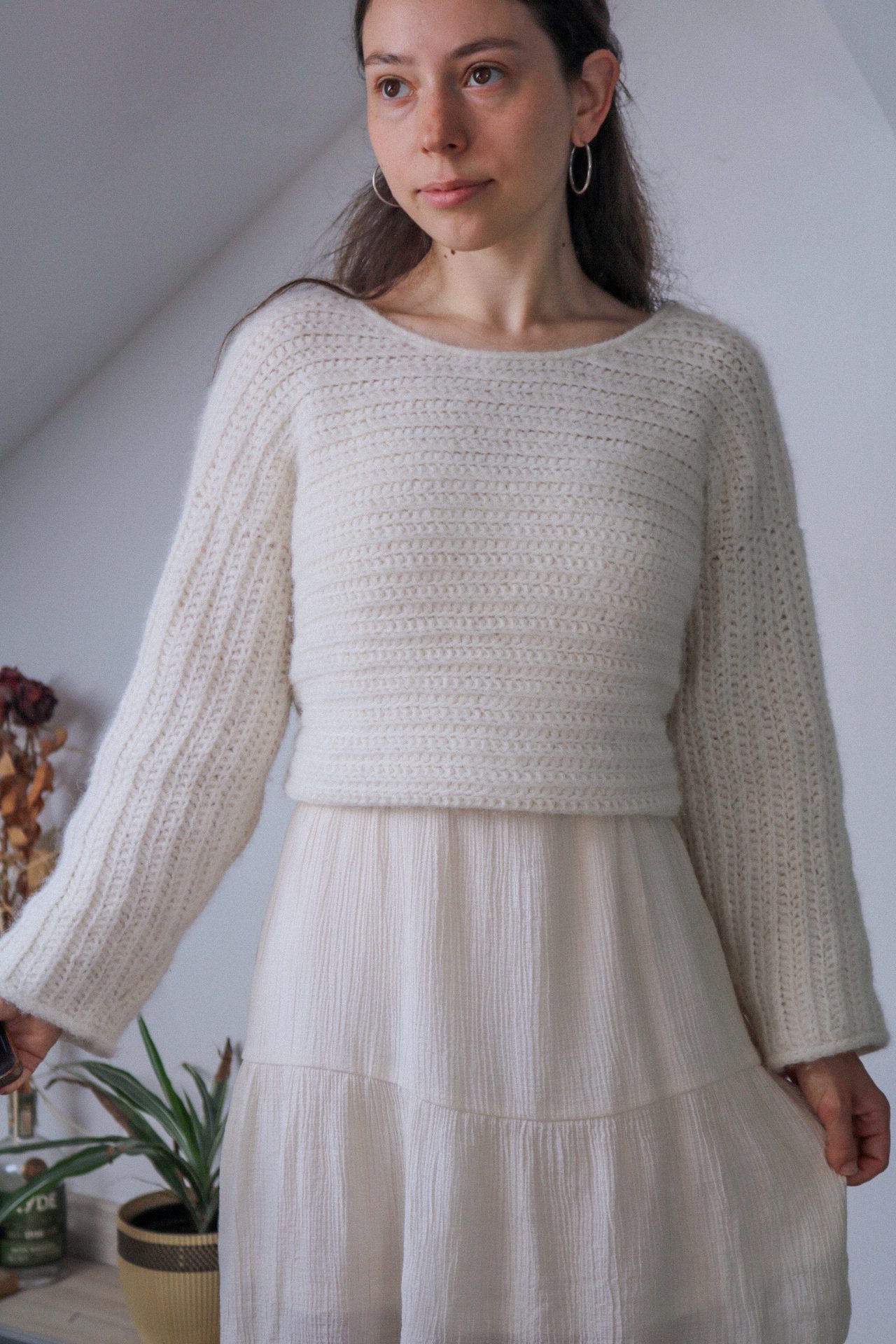
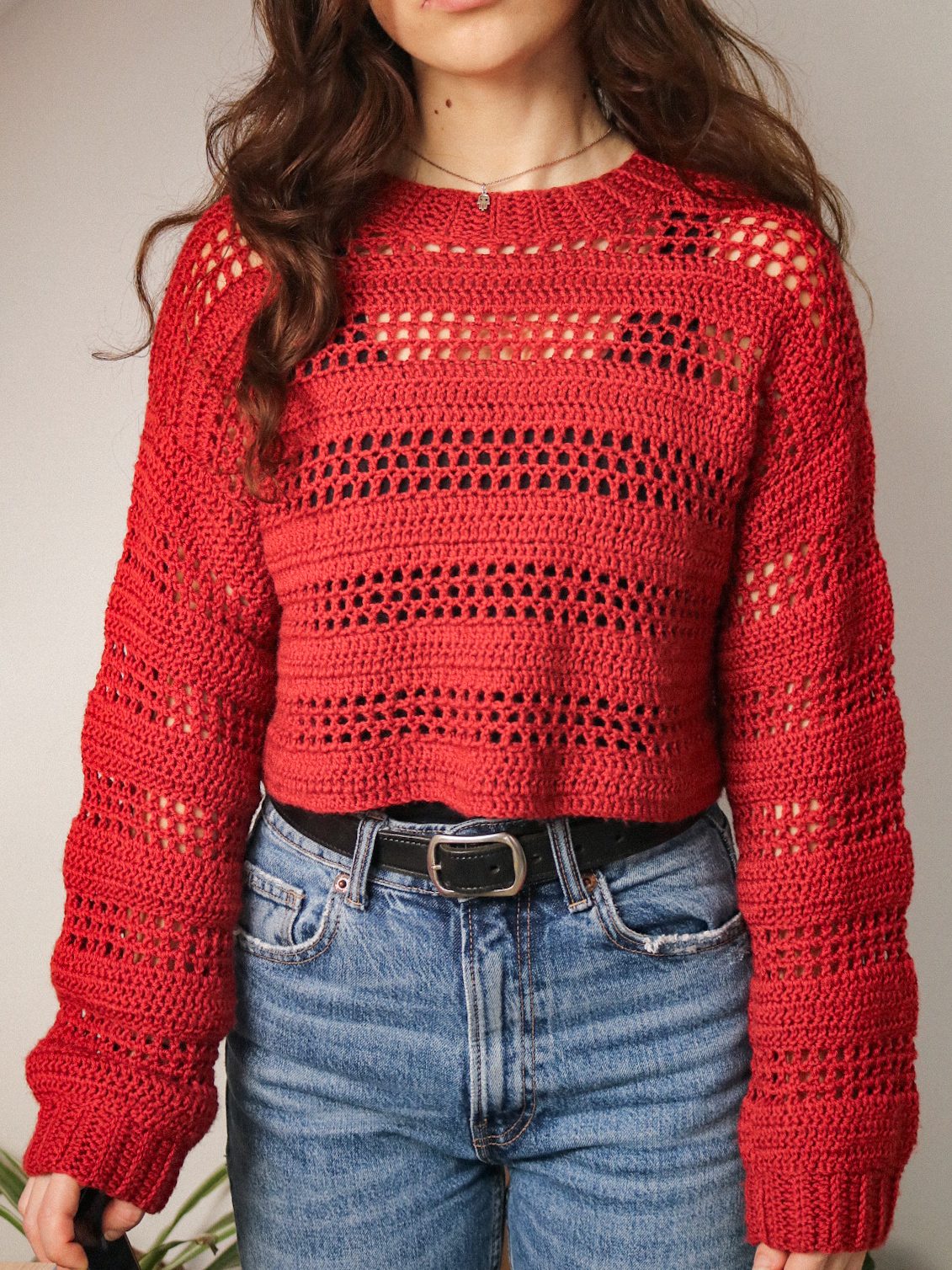
Rather than start from a generic chart, here is what three of my own designs genuinely need, straight from the materials list on each product page. All three are graded XS through 4XL, and these are the size M figures.
| Pattern | Yarn weight | Hook | Size M yardage | Size M weight |
|---|---|---|---|---|
| Claire Sweater | Aran (Drops Air, an airy blend) | 5 mm | about 1,050 m | 350 g, 7 balls |
| Bari Sweater | Light DK / sport | 5 mm | about 1,125 m | 450 g, 9 balls |
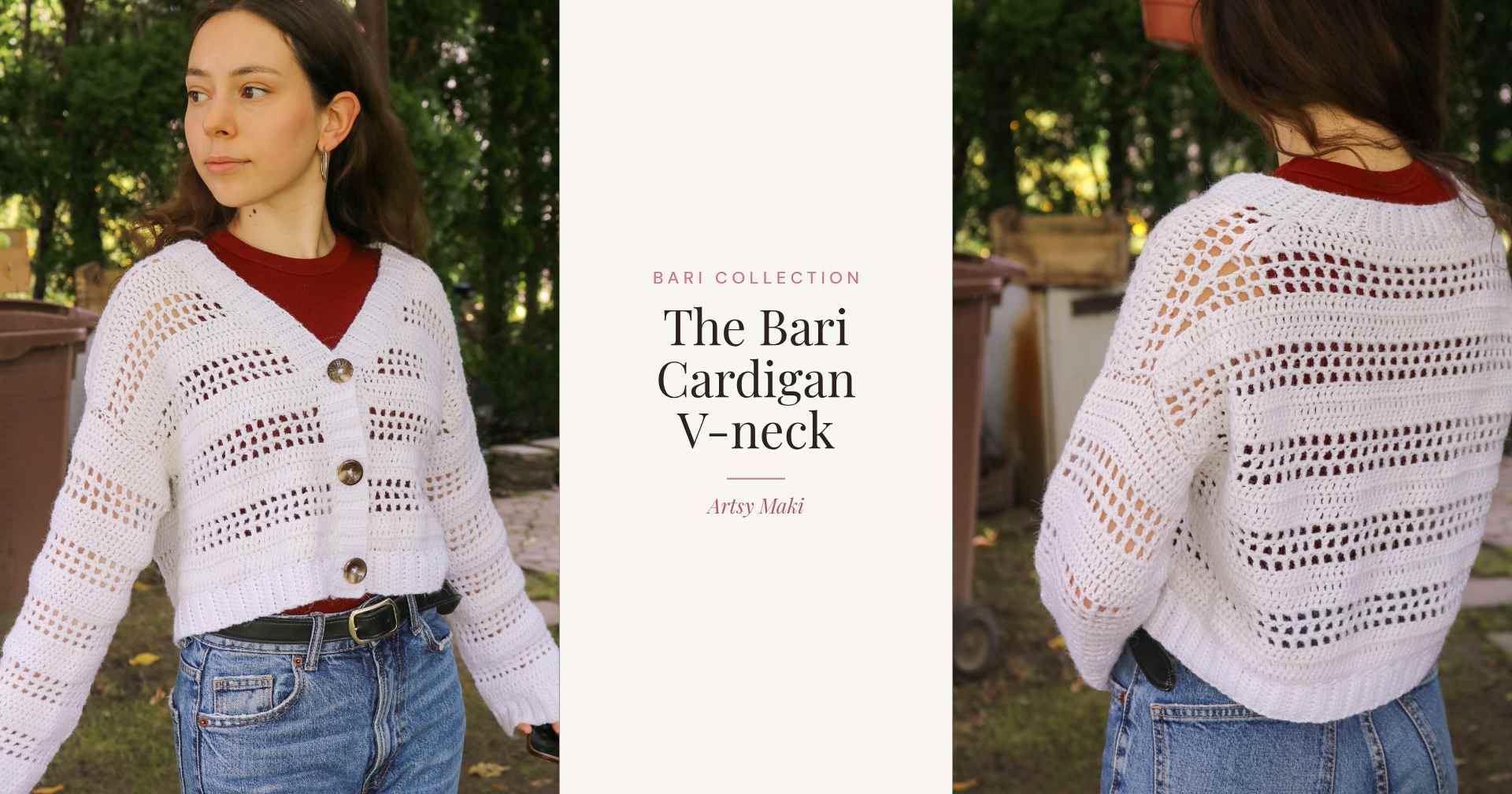
| Bari Cardigan Crewneck | DK | 5 mm | about 1,100 m | 550 g |
Look at that for a second, because it is not what I expected either. Claire is the heaviest yarn of the three and uses the fewest grams. Bari Sweater is a finer yarn than the cardigan and still uses fewer grams. The metres, meanwhile, barely move: 1,050, 1,100 and 1,125 across three different weights and three different garments. Weight category alone does not predict either number.
Why the numbers do not line up the way you would expect
Three things are working against each other in that table, and any one of them can outweigh what the yarn weight suggests on its own.
- The specific yarn, not just its category. Claire’s yarn, Drops Air, is a lofty mohair blend that is unusually light for how thick it looks and feels. It behaves closer to a chunky yarn on the hook, at closer to a fingering yarn’s actual weight per metre. A ball band inside the same weight category can vary by a wide margin, which is the exact trap I have written about before with holding two yarns together: you cannot treat a weight category as one fixed number.
- The stitch pattern. Bari Sweater and Bari Cardigan Crewneck share a family resemblance, mesh stripes over a double crochet body, but the cardigan is a longer, fuller silhouette with two front bands and buttons, which is exactly the kind of extra fabric and extra finishing that adds metres a plain pullover does not need.
- The silhouette and ease. A cropped, closely fitted piece like Claire uses less fabric than a relaxed, longer one, independent of yarn or stitch. Two sweaters in identical yarn can differ by several hundred metres purely on cut.
Worth naming here too: not every pattern states this on its product page. My Gelato Sweater is sport weight on a 3 mm hook, a notably tight gauge for that weight, but the page does not list a yardage figure for any size, only the PDF does. If a product page does not state it, the honest move is to say so rather than guess, which is exactly what I am doing here.
What changes if you use a different weight yarn
Grams and metres are different questions, and it is worth being precise about which one you are actually asking. Grams is roughly a question of how much fabric you are making, mass in, fabric out. Metres is a question of how that mass is packaged: a fine yarn needs far more metres to reach the same mass as a thick one, because a metre of fine yarn weighs so much less than a metre of thick yarn.
Using the same typical ball-band figures behind my yarn weight calculator, here is roughly what about 550 g of fibre, the amount my own DK cardigan uses, looks like converted into other weights.
| Yarn weight | Typical m per 100 g | For about 550 g |
|---|---|---|
| Lace | 600 | about 3,300 m |
| Fingering / 4 ply | 400 | about 2,200 m |
| Sport | 315 | about 1,730 m |
| DK | 250 | about 1,375 m |
| Worsted / Aran | 185 | about 1,020 m |
Notice that my actual cardigan, at 1,100 m for 550 g, sits below even the “typical DK” row in that table. That gap is entirely the ball band talking, not a mistake in the maths, and it is exactly why this table is a starting point rather than a shopping list.
Bulkier yarns keep going the same direction, roughly the same mass in far fewer metres, but I have left chunky and super bulky out of the numeric table on purpose. Ball bands at that end vary from each other more than fine yarns do, so a single typical figure would be more misleading than useful. Check the specific ball band once you have picked one.
The other things that move the number
- Size. All three of my own patterns grade from XS to 4XL, and the smallest and largest sizes are not a small percentage apart. On the Bari Cardigan the range runs from 900 m at XS to 1,800 m at 4XL, double the yarn across the size run. Always check the number for your own size, not the M column.
- Stitch density. Mesh and openwork sections use noticeably less yarn than the same area worked solid. A sweater that is mostly mesh, like Bari’s stripes, will not scale the same way as a sweater worked entirely in dense double crochet.
- Pieces versus seamless. A cardigan worked flat in pieces with front bands, like Bari Cardigan Crewneck, needs extra yarn for seaming allowance and edging that a seamless pullover does not.
- Length adjustments. Adding length at the body or sleeve is easy to do and easy to forget to budget for. A few extra centimetres across a whole garment adds up to real metres.
- Your own tension. A tighter crocheter uses more yarn for the same finished size than a looser one, because more yarn is going into the same stitch. This is the one no chart, mine included, can account for.
If you have no pattern to go by
Sometimes you are not buying a pattern at all, just working out whether the yarn on the shelf is enough. The most reliable thing you can do without a pattern in hand is work your gauge swatch, then weigh it.
- Crochet a swatch of a known size, say 15 by 15 cm, in the actual stitch pattern you plan to use, not just single crochet.
- Weigh the swatch on a kitchen scale.
- Work out the swatch’s area, and roughly estimate the total area of the finished garment from a similar pattern’s schematic or your own measurements.
- Scale the swatch’s weight up by that ratio to get an estimated total weight in grams, then use the yarn’s own ball band to convert that into metres.
It takes longer than reading a chart, and it is the only method that uses your actual yarn, your actual stitch and your actual tension, rather than someone else’s.
Maki’s tip
Buy one ball more than any estimate tells you, yours or mine. Dye lots run out, shops stop stocking a colour, and running out three rows from the end of a sleeve is a far worse afternoon than having one spare ball in a drawer. I have never once regretted the extra ball. I have regretted not having it more than once.
Questions I get asked
How much yarn does a basic size M crochet sweater need?
Plan on roughly 1,000 to 1,500 metres in worsted or aran, 1,300 to 1,900 metres in DK, and 2,000 metres or more in fingering, with about 10 percent extra for a cardigan. Those are shopping estimates rather than firm figures, because stitch pattern, silhouette and the specific yarn’s own ball band all move the number as much as the weight category does. For a real number, look up finished projects of your pattern in your size on Ravelry, or weigh a gauge swatch and scale it up.
Does a thicker yarn always mean less yardage?
For the same garment in the same stitch, yes, a thicker yarn needs fewer metres to reach the same mass. But two yarns in the same weight category can still have quite different metres per 100 g, which is why the same “aran” or “DK” label does not guarantee the same yardage.
What if the pattern does not state a yardage figure?
It happens, my own Gelato Sweater’s product page does not list one. In that case the figure lives inside the PDF itself, or you are working without a pattern and should use the gauge swatch method: crochet and weigh a swatch, estimate the garment’s total area, and scale up.
How much extra yarn should I buy, just in case?
One ball more than the pattern states, as a habit. It costs little compared with a project stalled because the exact dye lot has sold out.
Does a cardigan need more yarn than a pullover in the same size?
Often yes, if it is worked flat with front bands and buttons rather than seamlessly. My own Bari Cardigan Crewneck uses somewhat more yardage in a size M than the seamless Bari Sweater, even though the cardigan is the finer of the two yarn weights, largely because of the bands and finishing a cardigan needs that a pullover does not.
One more thing
A weight category is a starting point for choosing a hook, not a promise about how much yarn ends up in your basket. If you are working from one of my patterns, use the number on that pattern’s own page for your own size. If you are working from scratch, weigh a swatch and trust that over any table on the internet, including this one.
Browse the sweaters and cardigans
Every pattern lists its own yarn weight, hook and yardage by size on the product page, so you can shop against real numbers rather than a general chart.