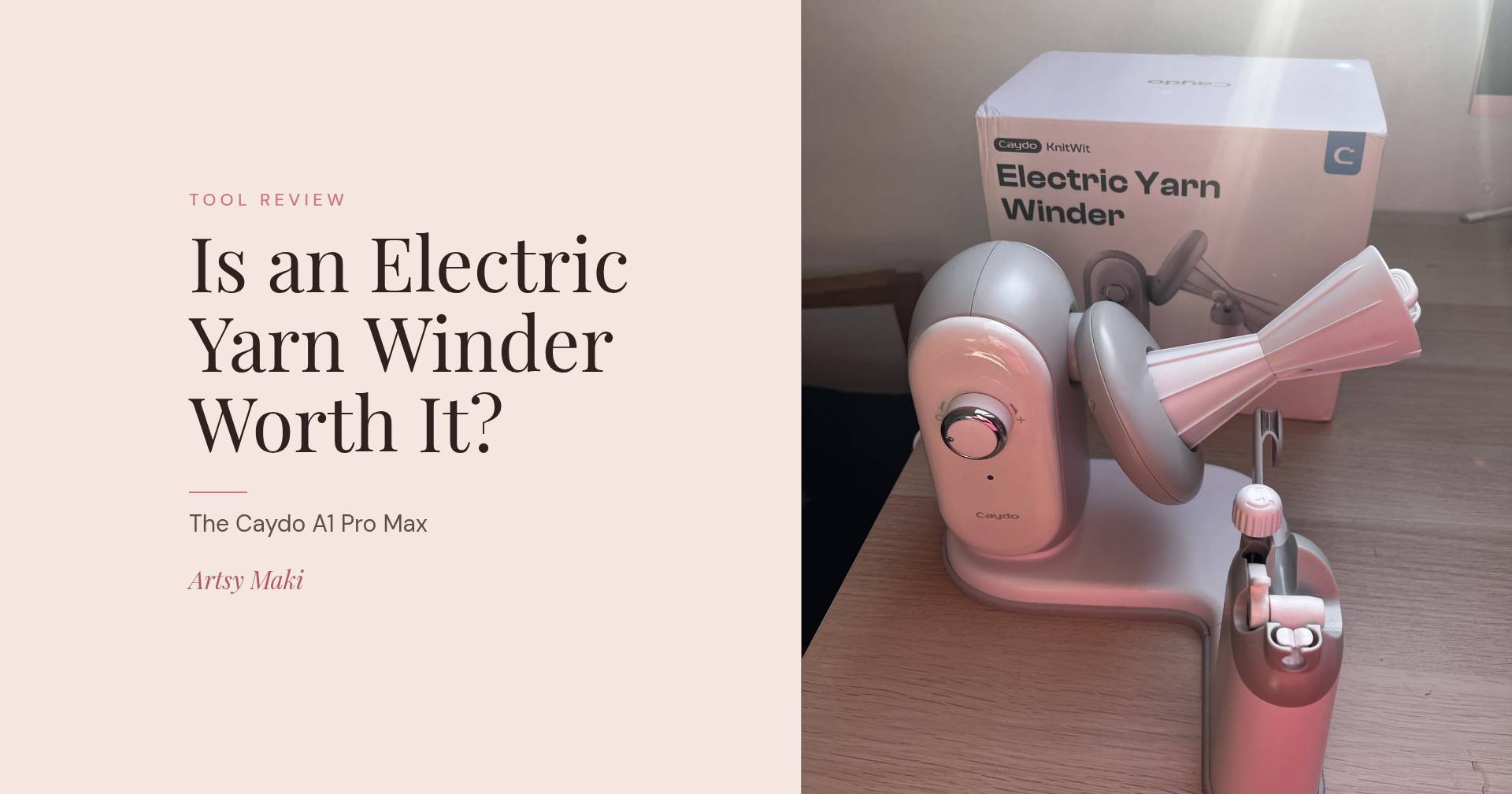
An electric yarn winder is worth it if you wind often or you wind big, and the Caydo A1 Pro Max is a genuinely good one. The number the whole decision turns on is its capacity: 16 oz, which is 454 g, in a single cake. If you wind two or three 50 g balls before a project and nothing else, your hand crank winder is already the right tool and this is a lovely machine solving a problem you do not have.
Two things to know before you read my opinion. Caydo sent me this winder in exchange for a reel, so I did not pay for it. The links to it below are affiliate links, which means I earn a small amount if you buy through one, at no extra cost to you. Neither of those buys a good review, and the two things that genuinely annoyed me are in here along with the parts I liked.
Would I buy one
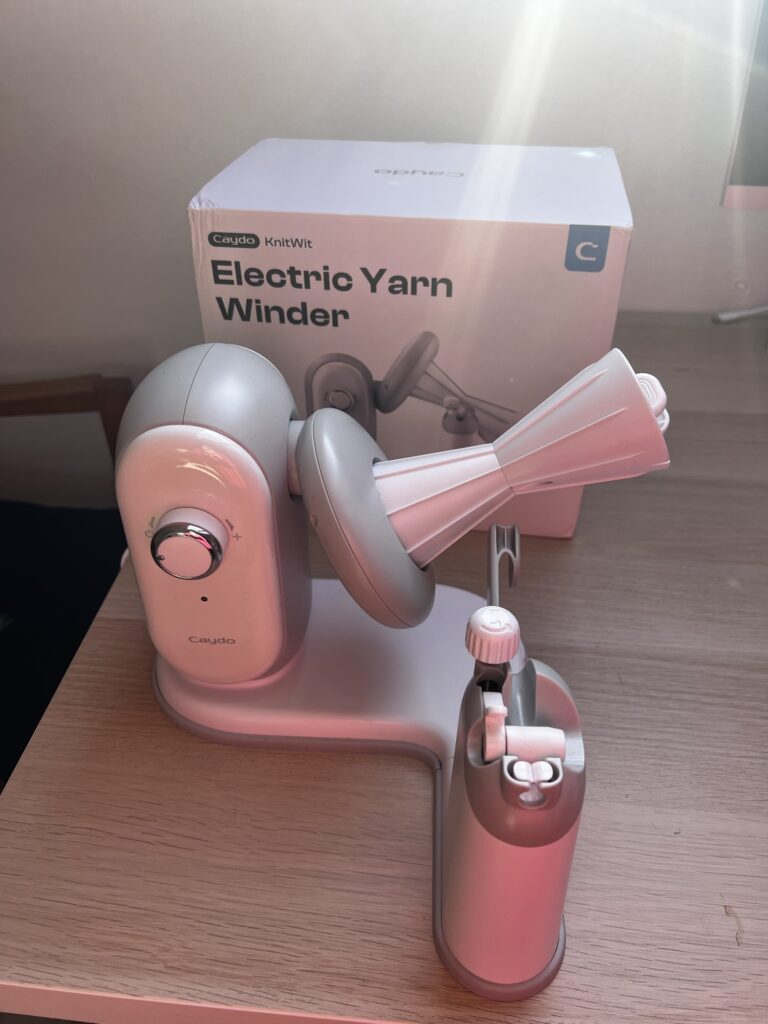
For what I use it for, yes. The build quality is better than I expected, the box had everything in it including the screwdriver and spares, setup was genuinely easy, and the cake it makes is better than the one I was getting before in a way I notice every time I put yarn away.
But the recommendation comes with its conditions attached, and they are not small. This is the most expensive winder Caydo make and it is much bigger than the hand crank it replaces. It will not stop for a knot. It does not come with anything to hold your yarn, which means you are buying a swift or a bowl as well. And if you are winding a couple of balls before you cast on, none of that is worth paying for: the machine you already have is fine and the neater cake is not worth the shelf.
Buy it for the pile of unravelled sweaters, the cones, the strands you want wound together. Not for the balls.
If you only read one box
The short version
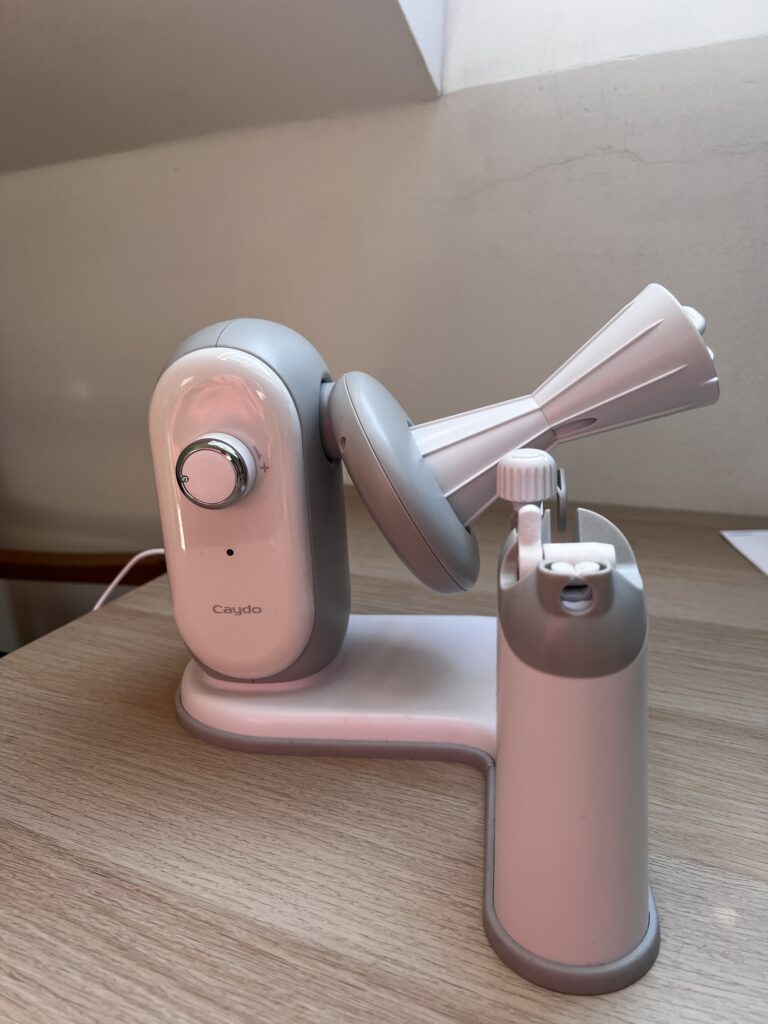
- Caydo state 16 oz (454 g) capacity and yarn up to 9 mm (0.35 in) thick, driven by a 36 W motor. For comparison, the standard hand crank winder holds 4 oz (113 g).
- The cake it makes is noticeably neater than the one my hand crank winder makes, and neat cakes stack.
- It sits on the table without a clamp, on an anti slip base. A clamp is in the box for uneven surfaces and for feeding from a swift.
- The real problem is that it is faster than your reflexes. When there is a knot coming, you will not catch it in time.
- No swift and no bowl included, so the ball or skein you are feeding from travels around the table on its own.
- Worth it if you unravel sweaters, buy on cones, or wind strands together. Not worth it for a few balls before a project.
How much yarn fits on it?
Every winder prints its capacity in ounces, which is almost never the unit you buy yarn in. So here is the conversion, because it turns a spec nobody can picture into the only question that matters: will the thing I want to wind fit in one go?
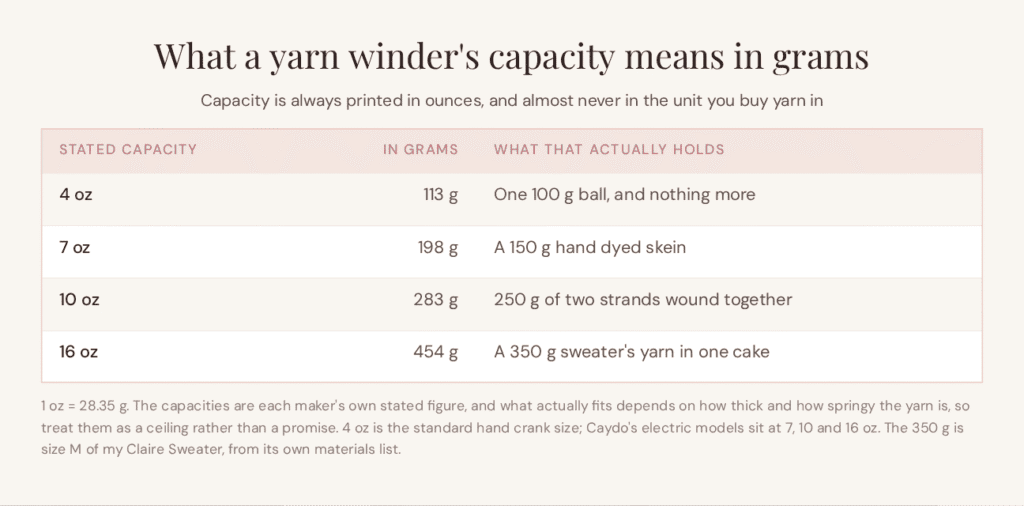
Now look at that 4 oz row, because it is where most people are starting from. Stanwood’s two compact hand winders are 4 oz, and 4 oz is the figure you will see on nearly every hand crank winder sold. That is 113 g. A 100 g (3.5 oz) ball fits. A 150 g (5.3 oz) hand dyed skein does not.
So who genuinely needs more than 113 g in one cake?
Four situations, and if none of them is yours the rest of this review is entertainment:
- Unravelling a sweater. What comes off is one continuous strand of several hundred grams, and it has to go somewhere. This is the use case the big capacity is really for.
- Buying on cones. Mill ends and cone yarn arrive in quantities that laugh at a 4 oz winder.
- Large hand dyed skeins. 150 g and 200 g skeins (5.3 oz and 7 oz) are normal now, and they are exactly the yarn you least want to wind by hand.
- Winding strands together. My own advice when you are holding two yarns together as one is to wind them into a single ball first, because the alternative is two balls rolling in opposite directions and twisting around each other every few rows. Two 125 g balls wound together is a 250 g (8.8 oz) cake, and that clears the 4 oz and the 7 oz machines in one step.
What the capacity is not mainly for, in my experience, is winding a sweater’s worth of new yarn. Size M of my Claire Sweater is 350 g (12.3 oz) and size M of my Bari Sweater is 450 g (15.9 oz), straight from their materials lists, and both fit inside 454 g on paper. But both of those arrive as 50 g balls, and you wind a ball at a time as you reach it. Capacity earns its place when the yarn comes to you in one long piece, not when you have nine tidy balls already.
The specs
Caydo put their three electric winders side by side on their own product page, which is the most useful thing on it, so here it is with the figures as they state them.
| Model | Capacity | Yarn up to | Setup |
|---|---|---|---|
| A1 Pro Max | 16 oz, 454 g | 9 mm, 0.35 in | Clamp free, clamp included |
| M1 Pro | 10 oz, 283 g | 8 mm, 0.31 in | Table clamp |
| M1 | 7 oz, 198 g | 8 mm, 0.31 in | Table clamp |
Two things in that table are worth translating. 36 W is a lot of motor for a craft tool: Caydo’s own electric i-cord machine, which I reviewed here, runs on 15 W. And 9 mm works out to under 3 wraps per inch, which is jumbo territory. In plain terms, nothing in a normal stash is too thick for this machine. Wraps per inch, or WPI, is how many times a yarn wraps round a ruler in 2.5 cm (1 in) without squashing or gapping, and the Craft Yarn Council sets the numbered weight categories that go with it.
Caydo publish no winding speed for this machine at all, and I have not timed mine with a stopwatch, so I am not going to give you a figure I cannot stand behind. You can adjust the speed and the fastest setting is pretty fast.
Setting it up, and the clamp you probably will not need
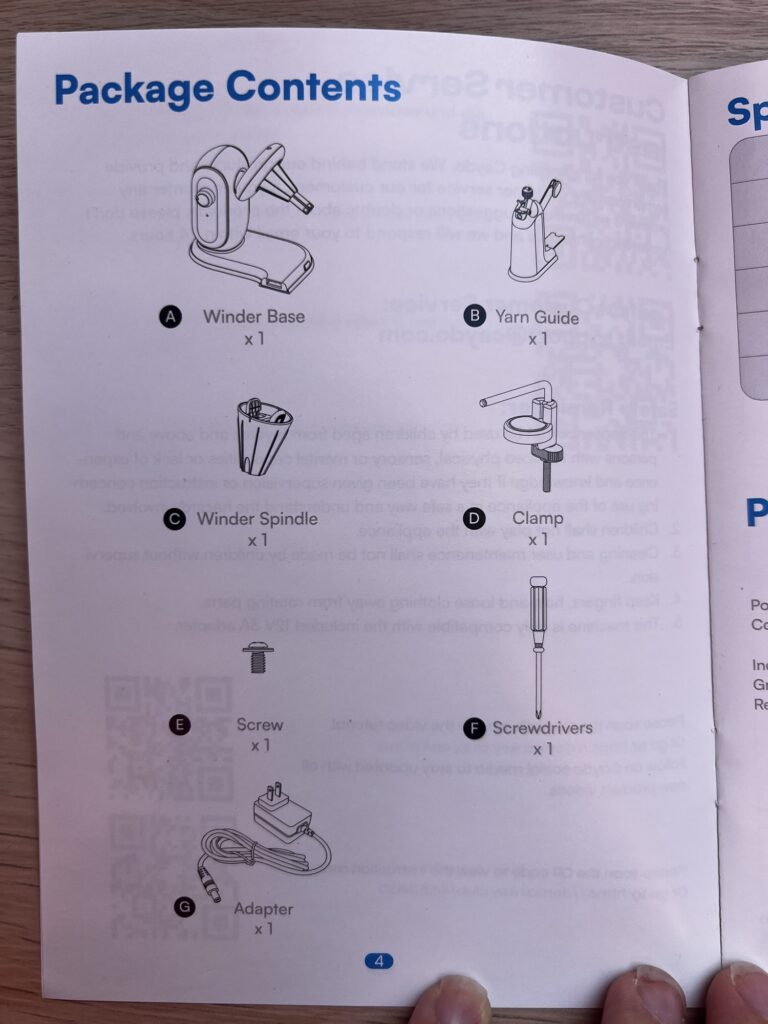
This part was easy, which I did not expect. It came with everything, including a screwdriver and a set of spare screws, and I had it together and running without a fight.
The thing I like most about the design is that it does not need to be clamped to anything. There is an anti slip pad underneath and on a normal table that is enough, which means it can live wherever there is a socket instead of wherever there is a table edge the right thickness. For comparison, that Stanwood jumbo hand winder wants a table edge no more than 2 1/8 in (5.4 cm) thick, and if you have ever tried to clamp a winder to a kitchen island you will know why this matters.
Caydo do include a clamp, and their own guidance is to use it “on uneven surfaces or when working with a yarn swift”. I fed it from a swift and it worked beautifully, even without the clamp.
It is faster than your reflexes
This is my main criticism and it is kinda a complimet as well. It goes fast, and fast is the wrong thing to be when there is a knot coming. A knot, a join, a felted patch in reclaimed yarn: on a hand crank you feel the resistance in your hand and stop. On this it has gone through.
I want to be clear that this is not a Caydo defect, because it is consistent complaint about electric winders generally. A machine knitter who tried one back in 2011 put it better than I can: “One little knot, loop, or twist and the machine jams. No time to catch it and fix it like a manual winder.” A reviewer testing a smaller Caydo winder found the same thing with an added detail worth knowing: “the enclosed part of the yarn feeder can trap knots, and you may need to cut the yarn to release it”.
Caydo’s own answer, when it happens, is to turn the machine off, straighten the yarn and restart once it feeds freely, and they note the machine may pause by itself when it meets excessive resistance. Which it does. But a small knot is not excessive resistance.
The cake is neater than my hand crank’s
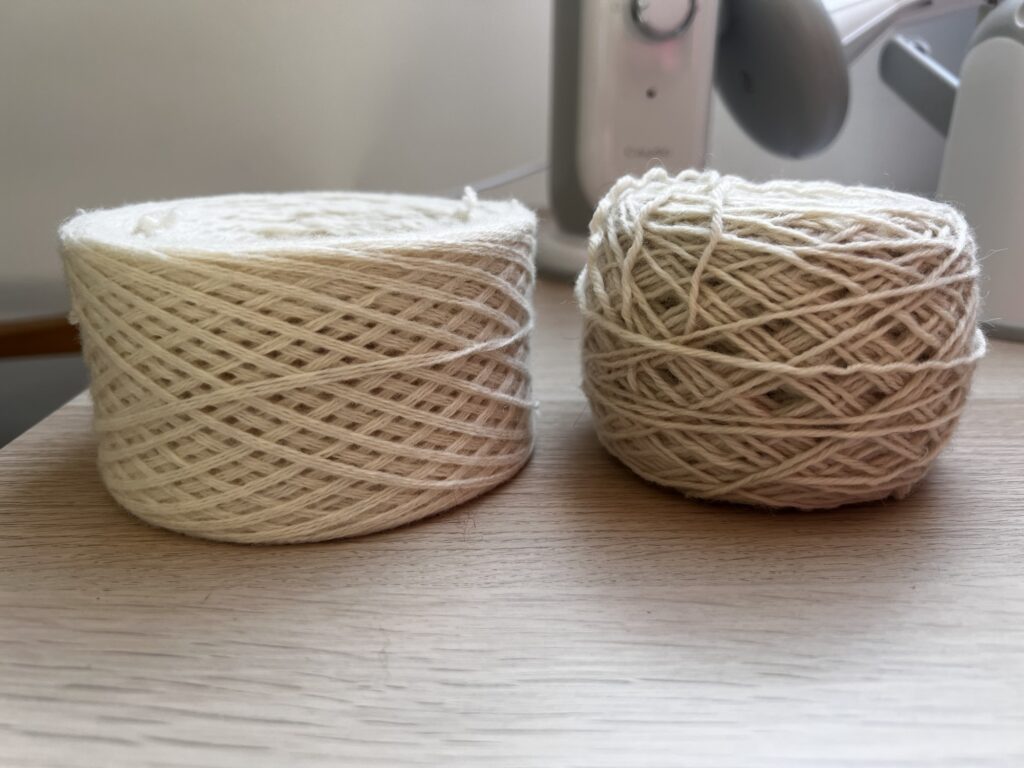
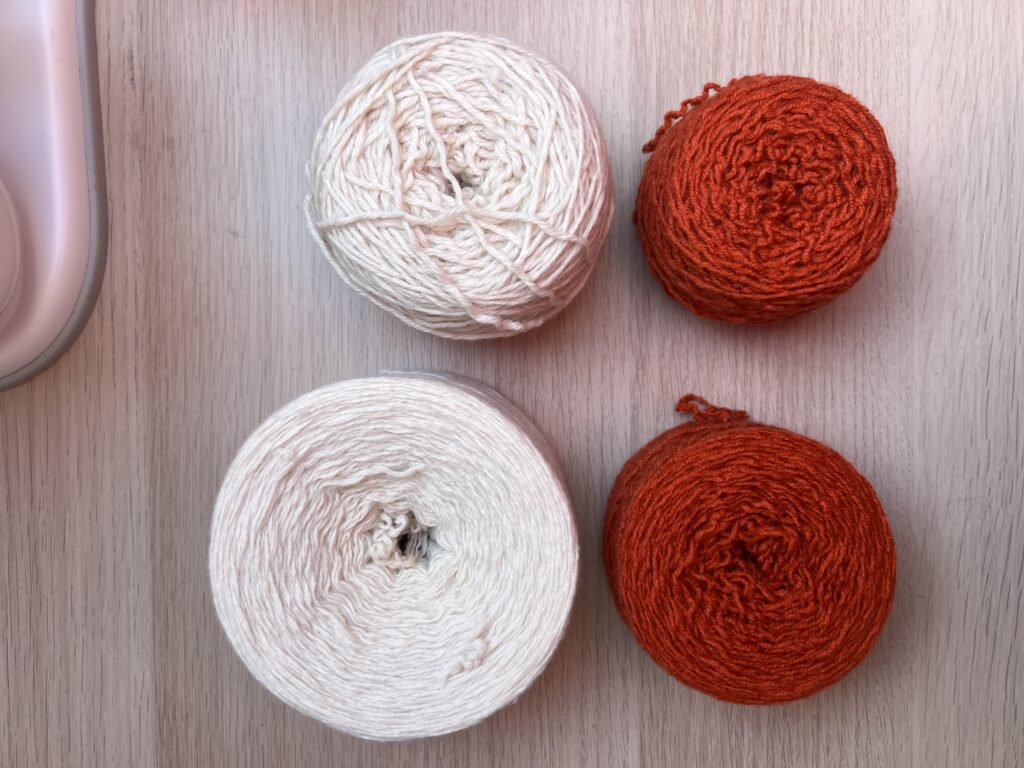
This is the thing that surprised me. The cake it produces is much neater than the one I get off my ordinary hand cranked winder, with flatter sides and even build up rather than a slightly domed, slightly loose lump. Caydo credit that to the yarn guide, stabilising arm, press roller and adjustable tension working together, and whatever the mechanism, the output is visibly different.
The practical payoff is storage. A cake with flat sides and square shoulders stacks on top of another one. A domed cake does not, it rolls, and a shelf of them slowly becomes a pile of them. If you keep a stash in boxes this is a genuine daily improvement rather than a nice photo.
There is a caveat here that I did not run into but that you should know about, because it is the best documented failing of the cheaper electric winders. Reviewers of the smaller Caydo model report the first cake coming out too tight, and a cake wound too tight is not a cosmetic problem. Too much tension stretches the yarn and holds it stretched, and it comes back when you wash the finished piece: as one knitter put it after losing the elasticity of a skein, “the yarn stays stretched out, but will return to its original state once you wash it. Which will mess up your gauge.” That is a gauge problem arriving several weeks late, which is the worst kind.
Her test for it is the best one I know and it takes two seconds: if you cannot easily get your fingers into the hole in the middle of a centre pull cake, it is wound too tight. Try it on the next one off any winder you own, electric or not.
Adjustable tension is the feature that answers this, and it is the best argument for the A1 Pro Max over its siblings, which have a fixed dual spring instead. Caydo’s instruction is straightforward: loosen it if bulky yarn feels too tight, tighten it if fine yarn feeds too loosely.
What is not in the box, and I think should be
Nothing to hold the yarn you are feeding it. This is my second real complaint.
A winder pulls yarn towards itself, and whatever is on the other end gets dragged. A ball walks across the table. A skein wanders off and finds a chair leg. So the machine is only as hands free as whatever is supplying it, and the honest version of “automatic” here is automatic at one end. In practice you want the ball in a bowl or a deep jar, and a skein on something that turns. For a machine at the top of Caydo’s winder range, a bowl or a simple yarn holder in the box would not have been much to ask.
Caydo’s answer is that you buy their Y1 Pro electric swift separately, which does solve it, and which is how I fed mine. A plain umbrella swift solves it too, and so does a heavy bowl. Whichever you pick, budget for something, because without it you are standing over the machine keeping the yarn out of trouble, which is not what you bought it for.
Two smaller things
The instructions give measurements in inches only. They are otherwise clear and well made, and then every figure in them assumes you think in inches. I do not, and most of my readers do not. Adding a second number in brackets would be great.
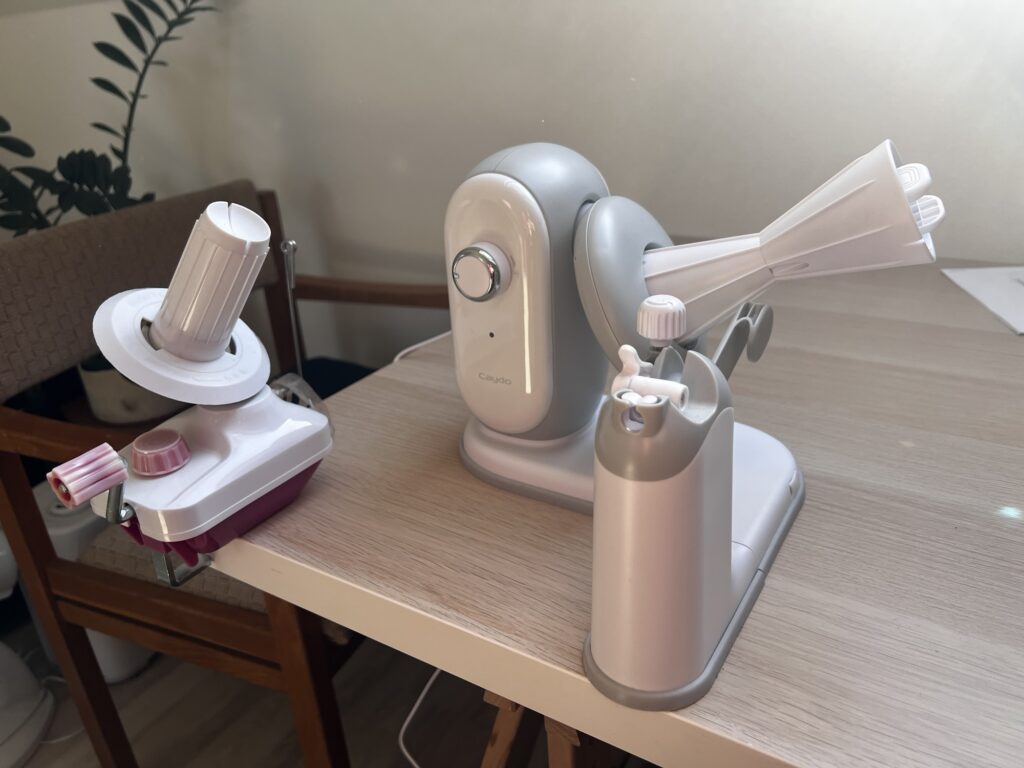
It is big. Roughly twice the footprint of an ordinary hand cranked winder, by eye. Caydo do not publish dimensions for it and I have not measured mine, so take that as an impression rather than a figure. If it is going to live on a shelf between uses, make sure you have the space.
Who should not buy this
I would rather talk you out of it than have you resent it, so:
- You wind a few balls before a project. Then you are buying a neater cake, and a hand crank winder makes a perfectly good cake. This is the big one.
- You have nowhere for it. It is large, it needs a socket, and it needs something holding the yarn beside it.
Buy it if you unravel sweaters regularly, buy on cones, wind strands together, or simply wind enough that cranking has stopped being neutral for your hands and shoulders. That last one is a real reason and it does not need justifying with arithmetic.
Questions I get asked
How much yarn does it actually hold?
Caydo state up to 16 oz, which is 454 g, “depending on the yarn type and thickness”. That caveat is doing real work: a lofty mohair blend takes up far more room per gram than a dense cotton, so treat 454 g as a ceiling for compact yarn rather than a promise for everything. If you want the headline number in the unit you shop in, it is a little under five 100 g balls.
Can it wind straight from a skein without a swift?
Not in any way you will enjoy. The winder needs the strand to come to it freely, and a skein lying on a table does the opposite: it tightens, catches and drags itself around. You need something that turns, whether that is an umbrella swift, an electric one, or a willing pair of hands. This is the single most common reason people find an electric winder disappointing and it is not the winder’s fault.
Can I slow it down if I am worried about knots?
Yes, you can!
Will it handle bulky and super bulky yarn?
Its stated limit is 9 mm (0.35 in) in diameter, which is under 3 wraps per inch and covers everything up to jumbo, so on paper yes. Worth knowing that reviewers of the smaller 8 mm Caydo winders report them struggling with bulky and super bulky yarns and the motor stopping on blanket yarn, which is presumably part of why this one has a 36 W drive. Bulky yarn also fills a cake fast, so expect the 454 g figure to feel optimistic there.
What about mohair, unspun or anything sticky?
I have not tried this machine on mohair or unspun yarn, so I am not going to guess. What I would watch for, based on how those yarns behave generally, is the halo catching on itself inside the feeder, which is the same problem as a knot and arrives without warning. If most of your stash is fluffy, wind a ball you do not love first.
Do I need to use the clamp?
On a flat, stable table, no. Caydo say it can sit directly on the tabletop, the anti slip base holds it, and mine does. Use the clamp on an uneven surface, or when you are feeding from a swift, which is when the sideways pull gets strong enough to walk the machine about.
Is a hand crank winder good enough?
For most people, yes, and I would rather say that plainly than pretend otherwise. A 4 oz (113 g) hand winder handles every standard ball of yarn sold, and a jumbo hand crank takes you to about 10 oz (283 g) in steel. What a hand crank cannot give you is not having to crank, which matters enormously if you wind in volume or if your hands object. Everything else is a preference.
Which plug version do I order?
Caydo list US, EU, UK and AU versions as separate options and explicitly ask you to confirm yours before buying, so pick deliberately rather than taking whatever is preselected. Ordering into Czechia or anywhere else in the EU, that is the EU option. It is easy to click past, and Caydo do not state a voltage range anywhere I can find, so I would not assume a travel adapter covers it.
The winder, and what to wind on it
Caydo sent me this machine in exchange for a reel. The first link is an affiliate link, so I earn a small amount if you buy through it, at no extra cost to you. The second goes to the technique the big capacity is genuinely useful for.