Every top in my Claire collection has an open back. I made the first one for summer, wore it all season, and then it got to October and I still wanted to wear it. That is where this question starts: does a backless top still work once the weather turns, or does it go in the drawer until May?
It works. The thing that decides it is what goes underneath, and that comes down to one measurement you can take in thirty seconds. This post covers the outfits that work in autumn, what to wear under an open back, how much warmth you really lose through a bare back, what to layer over the top, and which open back tops are worth making for the cold half of the year.
If you only read one box
The short version
- An open back is far easier to wear in cold weather than bare arms. Sleeves and a covered front do most of the work, so a long sleeved top with an open back is a genuine autumn garment.
- Find the lowest point of the opening on your own back. That one measurement decides every underwear option you have.
- A low back bra converter moves your existing band down by about 13 cm (5 in). That covers a back that opens to the bra line and no further.
- Deeper than that and you have three options: adhesive cups, something you have chosen to be seen, or a layer underneath.
- The layer is the version I wear most in October. Worn over a vest top or a slip dress, the opening frames the layer instead of skin, and the top keeps its shape and its bow.
- You do lose real warmth. In a 2019 study of 20 people, cooling the upper back changed whole body comfort more than cooling the chest, the abdomen or the lower back.
How to style a backless top in fall
Keep the open back and put the warmth everywhere else: sleeves, a high waist, closed shoes, and an outer layer you take off indoors. These five combinations are the ones I come back to, and they suit the kind of autumn day where you are moving between heated rooms rather than standing outside for an hour.
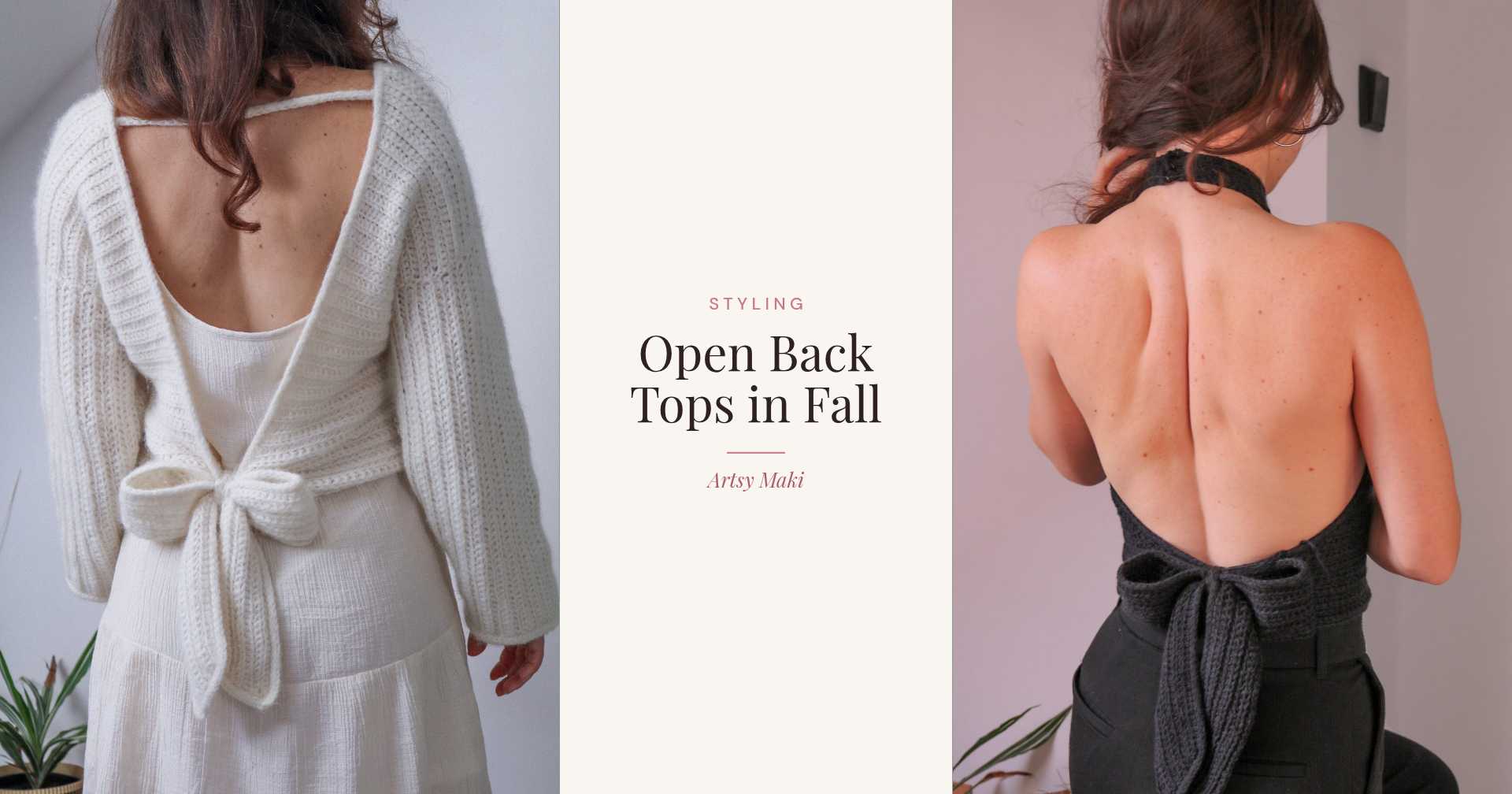
- Over a slip dress. A cropped open back sweater on top of a slip or a plain midi dress. The back opening becomes a window onto the dress, so you get the shape of the design without any bare skin. This is the outfit in the photo below and it is the one I wear most often in October.
- Over a fitted vest top. Same idea, less formal. A ribbed cotton vest in a colour close to your skin makes the top still read as backless from a distance. A contrast colour does the opposite and turns the opening into a deliberate detail. Both work, they just say different things.
- Bare, under a blazer. The blazer stays on outside and comes off when you sit down. High waisted wool trousers, boots, and the open back as the only skin in the outfit. Worth knowing that you are committing to the room being warm.
- Long sleeves, cropped, with a high waist. A cropped long sleeved open back top over high waisted jeans or trousers. The sleeves cover your arms, the high waist covers your middle, and the only thing exposed is the panel between your shoulder blades and your waistband.
- With a scarf, not a coat. A big wool scarf worn over the shoulders and knotted at the front sits across the open back and comes off in one movement. It also solves the problem of a coat collar sitting on bare skin.

The cream sweater over a white dress is the layered version. You still see the whole shape of the back opening and the bow, and there is no bare skin anywhere.
What to wear under an open back top
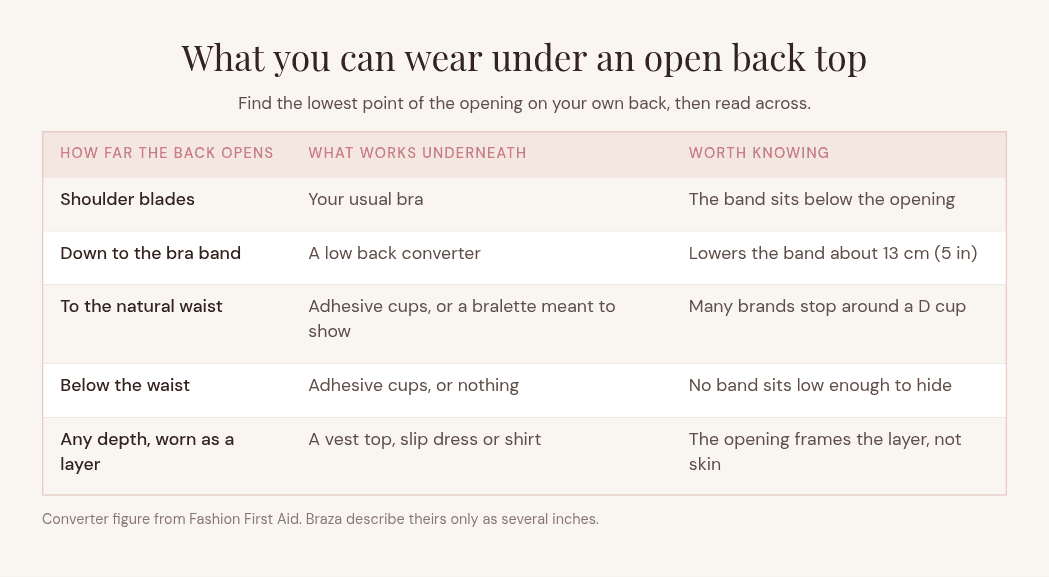
It depends entirely on how far down your back the opening goes. Stand with your back to a mirror, find the lowest point of the opening, and note whether it sits above your bra band, level with it, at your natural waist or below. Then read across the table further down.
If the opening stays above your bra band, wear your usual bra. Nothing shows, because the band is below the edge of the opening. This is the easiest case and it is also the rarest one in crochet.
If it opens to roughly the bra line, use a low back bra converter. It is a short strap with hooks on both ends: you unhook your bra, clip the converter between the two halves, and the band now runs around your ribs or your waist instead of across your back. Fashion First Aid say theirs lowers the band by approximately 5 inches, which is about 13 cm, and sell it in two lengths, one for band sizes 28 to 36 and one for 36 to 42. Braza describe their own version only as dropping the band “several inches” without giving a figure, so treat 13 cm as the one published number rather than a standard. Either way the cups keep doing their job, because you have moved the band and not the support.
If it opens to your waist or lower, no band will hide. That leaves adhesive cups, something you have chosen to be seen, or a layer underneath.
Adhesive cups are the option most guides reach for. On cup range, general fitting guides say stock adhesive cups often stop at around a D, while brands including NOOD sell sizes well past that. On wear time, one guide treats them as occasion wear with a 6 to 8 hour limit, while NOOD tell first time users to start at 2 to 3 hours and build up, and say theirs stays put until you take it off. The advice that everybody agrees on is the application: clean dry skin, no body lotion, no oil, no perfume where the cup will sit, and let the skin dry fully before the cup goes on.
The option that gets the least attention is choosing a bra you want to show. A bralette with a pretty back, or a plain bandeau in a colour that reads as part of the outfit, both work and neither involves adhesive. It only fails if the straps cut across the opening at an angle that fights the neckline, so try it in a mirror before you commit to the evening.
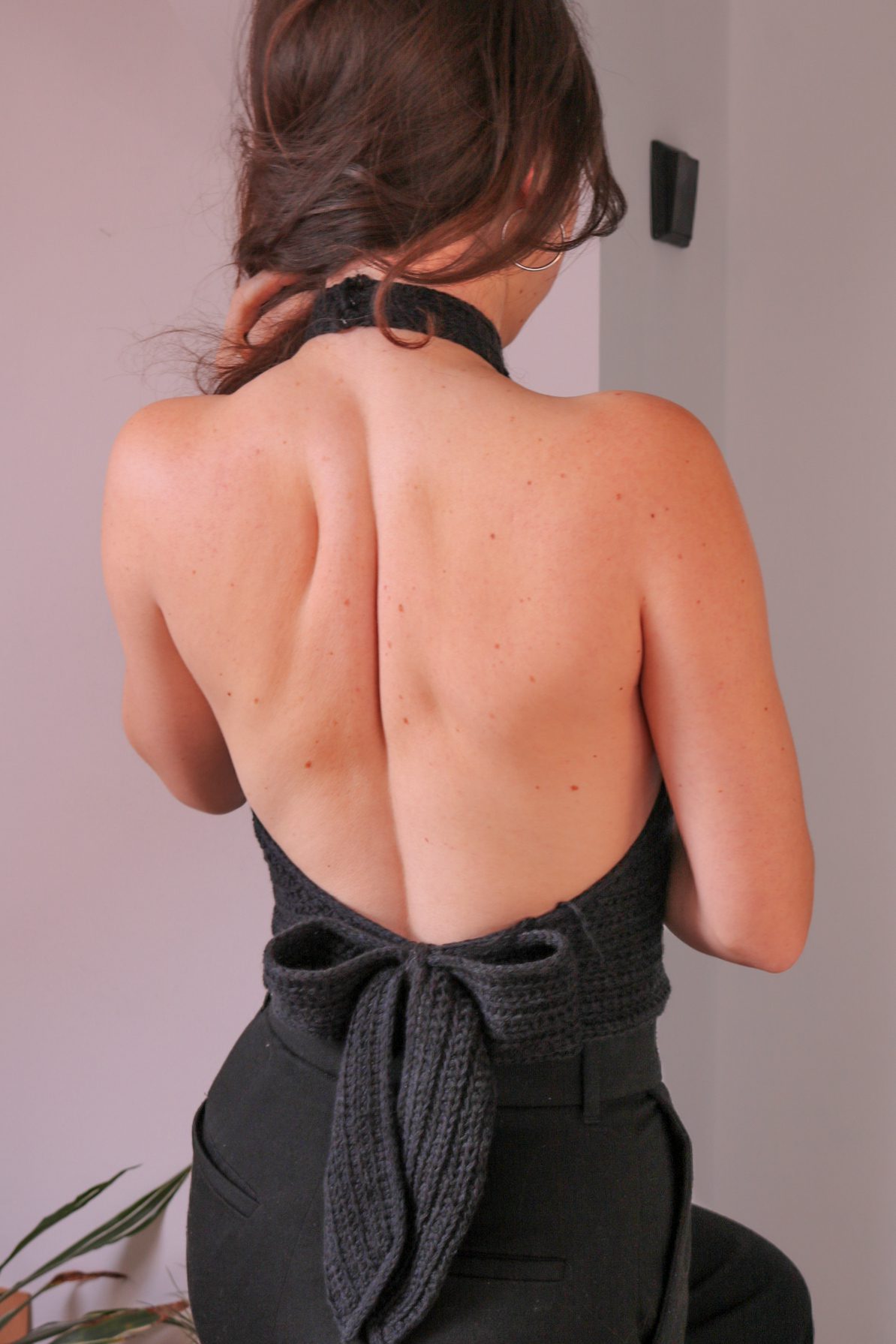
One thing worth saying about crochet specifically. All five Claire tops close with a tie across the back, and on four of the five that tie sits at the waist, well below where a bra band can go. If you are making one, plan for adhesive cups or a layer from the start rather than assuming a converter will cover it.
Does an open back actually make you colder?
Yes, and by more than the amount of missing fabric suggests. Of the four parts of the torso, the upper back is the one where a temperature change registers most strongly across the whole body.
The clearest measurement comes from a 2019 study in Energy and Buildings by Yang, Cao, Ju and Zhu. They cooled the chest, the abdomen, the upper back and the lower back of 20 people, ten men and ten women, in rooms at 28, 30 and 32 °C (82, 86 and 90 °F). Cooling the upper back improved overall comfort more than any of the other three. Cooling the chest helped least. Their subjects were trying to cool down rather than keep warm, but the mechanism runs both ways: the upper back is where your body notices the difference.
A second study points the same way with a useful twist. Schmidt, Schlee, Milani and Germano mapped how well 42 people could detect small changes in temperature at 11 places on the body, and published it in the Journal of Thermal Biology in 2020. The lower back came out consistently sensitive. The scapula, meaning the flat of the shoulder blade, came out consistently insensitive. Everyone detected cold more readily than warmth, and the women in the study tended to be more sensitive than the men. That is about noticing a change rather than about how much heat you lose, so read it as a comfort finding and not a physics one.

This one opens all the way to the waist, so it leaves both the upper back and the lower back bare. In practice that makes it an indoors top once the weather turns, or a layer worn over something else.
What to layer over an open back top
Anything that opens at the front, because you will want it off indoors and the back is the reason you made the top. A blazer, a denim jacket, an oversized shirt worn as a jacket, a wool coat, a cardigan you leave unbuttoned. What does not work is a jumper you have to pull over your head, because taking it off messes up your hair and unties the bow on the way past.
A backpack does not work with it. Straps on bare skin are uncomfortable after ten minutes and they flatten the bow. Carry a tote or a shoulder bag on the days you wear one of these.
One more thing about proportion. A cropped open back top under a long coat reads as nothing at all from behind, so pair a cropped one with a high waisted trouser or skirt. That gives a clean horizontal line at the waist and keeps the top from looking like it has gone missing.
Which open back tops work in cold weather
The ones with sleeves. Sleeve length and neckline decide whether a top is wearable in October far more than how much of the back is showing, because your arms and your chest are a much larger area than the panel between your shoulder blades.
Three things to look at before you cast on, in order of how much they matter:
- Sleeves. Long sleeves turn an open back from a summer top into an autumn one. This is the biggest difference between the patterns below.
- How far the back opens. This barely changes how warm you feel indoors, but it decides every underwear option you have, which is why the table above exists.
- The yarn. A cotton and viscose blend feels cool against bare skin, which is lovely in July and noticeable in October. Wool, alpaca and mohair feel warm at the same thickness.
My own five patterns line up along that scale, and they are the set I know best because they are in my wardrobe. Here they are in the order I stop wearing them as the year goes on.
The Claire Top is a bralette shape on thin straps that ties under the bust, so the whole back is open. It takes 250 to 400 m (273 to 437 yd) of DK yarn on a 3 mm hook, and it is sized by cup, XS to XL matching cups A to E. This one is summer only unless you wear it as a layer.
The Claire Tank has a high boat neck at the front and wide straps, with a deep scooped back that ties in a bow at the waist. DK yarn, 3 mm hook, XS to 4XL, 480 to 720 m (525 to 787 yd). The covered front and the wide straps buy you a few more weeks than the Claire Top does.
The Claire Halter has a high halter neck and adjustable back ties, in DROPS Belle on a 3 mm hook, XS to 2XL, 360 to 600 m (393 to 656 yd). It covers your neck and your front and nothing else, so under a blazer it works later into the year than the Tank does.
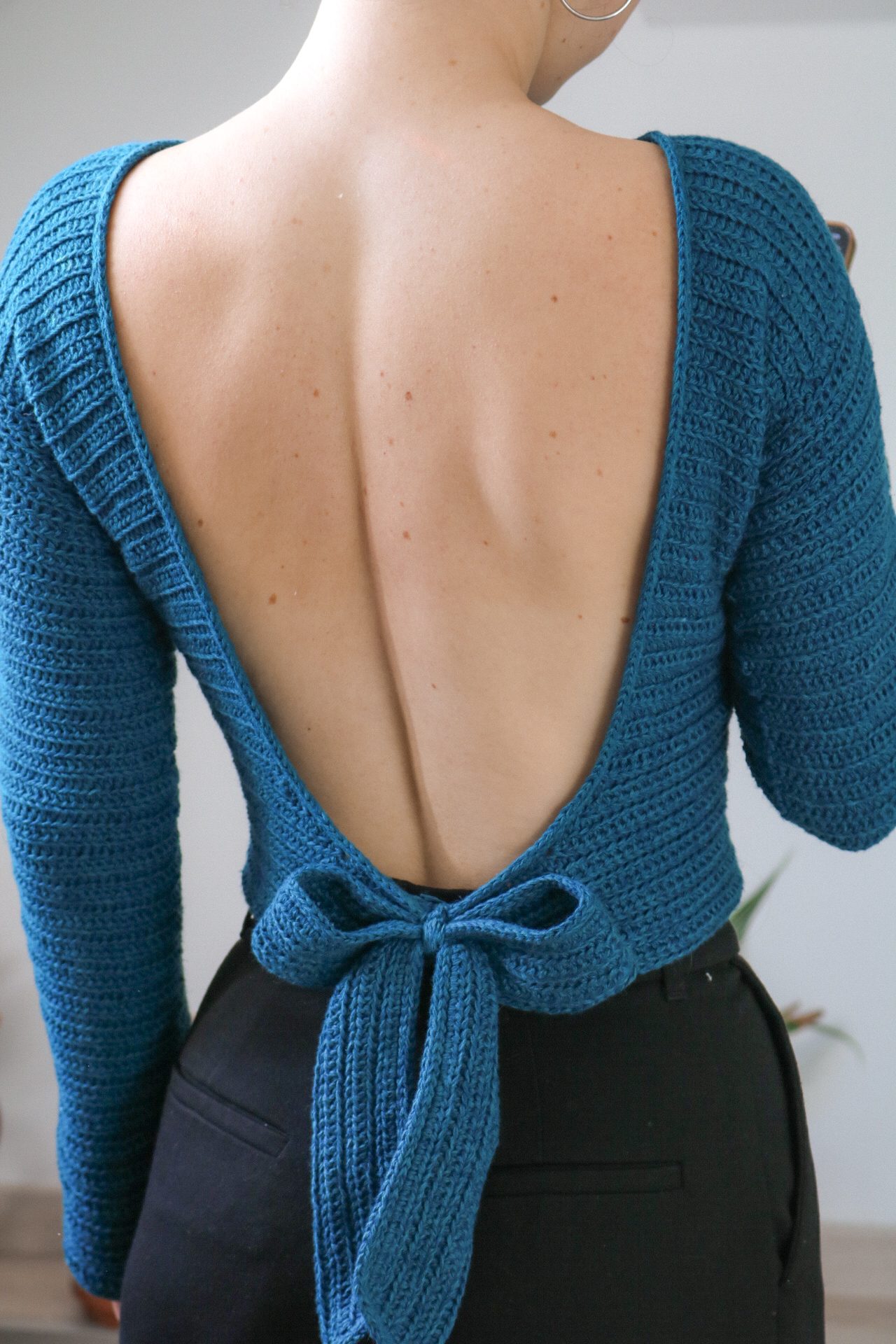
The Claire Blouse is the one that changes the answer. Long fitted sleeves, a deep U back that finishes in a bow at the waist, worked top down in DROPS Belle on a 3 mm hook. XS to 2XL, 1000 to 1600 m (1093 to 1750 yd), designed with about 5 cm (2 in) of negative ease, meaning it is cut slightly smaller than your bust measurement so it sits close. With sleeves that long, the open back is the only uncovered part of you above the waist.
The Claire Sweater goes furthest into the cold, because it adds the yarn to the sleeves. It is cropped, long sleeved, with a deep back and a wide tie, in DROPS Air on a 5 mm hook. XS to 4XL, 900 to 1500 m (984 to 1640 yd), about 10 cm (4 in) of positive ease.
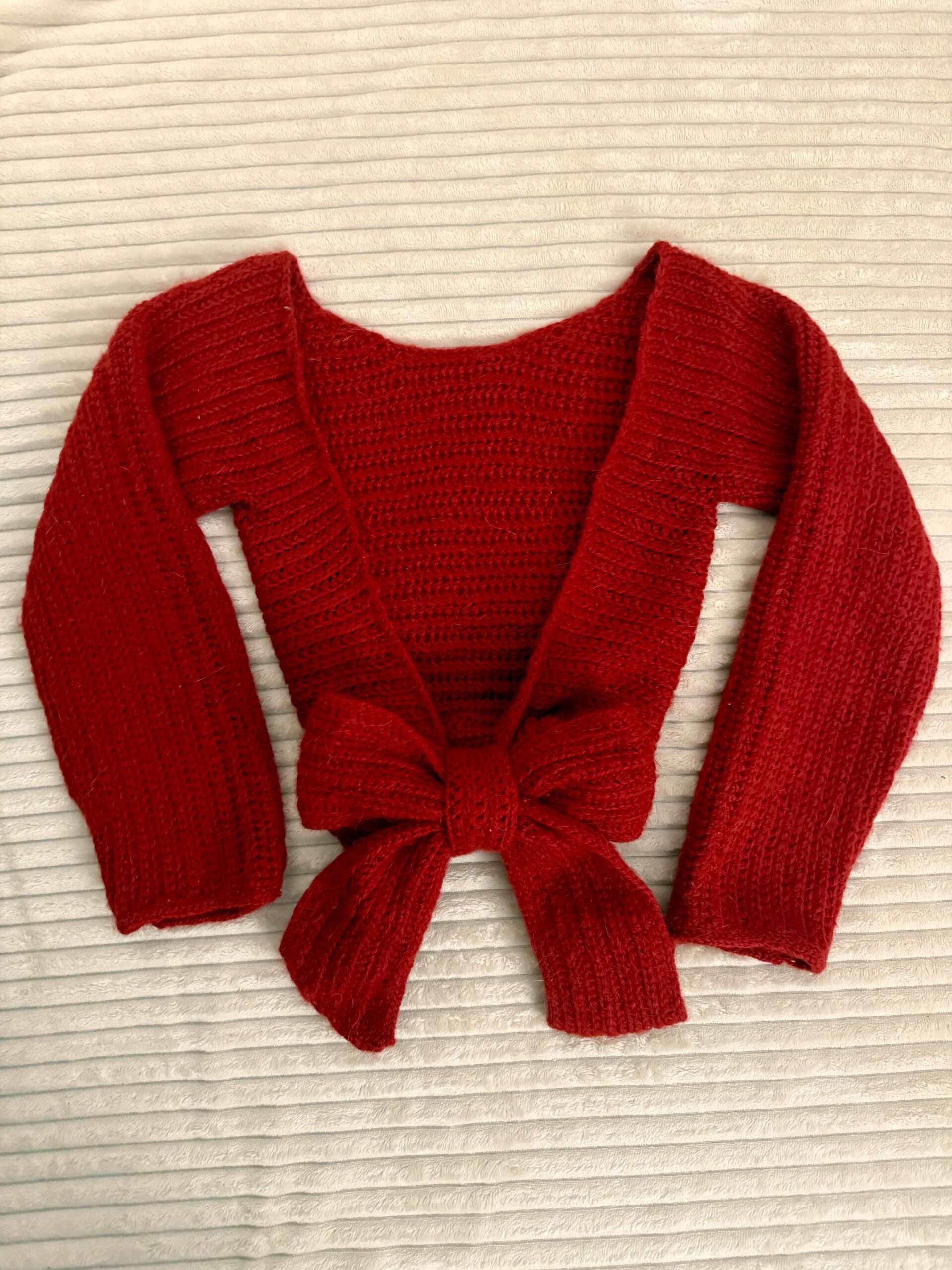
The yarn is doing real work in that last one, and it is worth spelling out because the two yarns are so different. DROPS Belle is 53% cotton, 33% viscose and 14% linen at 120 m (131 yd) per 50 g ball, a cool smooth yarn that DROPS describe as an all year yarn that breathes. DROPS Air is 65% alpaca, 28% polyamide and 7% merino wool at 150 m (164 yd) per 50 g, blown rather than spun, so it traps air inside the yarn itself. Both compositions are as listed by DROPS and confirmed on Ravelry. One feels cool against bare skin and the other does not, at the same thickness of fabric.
Maki’s tip
If you already know you will wear it over a vest top or a slip, crochet the back ties a little longer than the pattern gives. A layer underneath adds a few millimetres all the way round, and it is the ties that run out first. The Claire Halter, Top and Blouse all include made-to-measure instructions, so this is a matter of working a few more rows on each tie rather than resizing anything. Tie the bow before you drop your arms, not after, or it sits too loose across the shoulder blades.
Questions I get asked
Can you wear a backless top in winter?
Indoors, yes, and outdoors under a coat. What stops working in real cold is a backless top with no sleeves, because your arms are a much bigger area of skin than your back. A long sleeved one over a vest top, under a wool coat, is a normal winter outfit.
What bra do you wear with an open back crochet top?
It depends on where the opening stops. Above the bra band, your usual bra. At the band, a low back converter, which drops it by around 13 cm (5 in). At the waist or below, adhesive cups, a bralette you have picked to be seen, or a layer worn underneath. Most crochet open backs tie at the waist, so they fall into the last group.
How do you stop a backless top gaping at the shoulders?
Tie the ties firmly while your arms are still raised, and choose a size that is close through the underarm. Crochet fabric is heavier than jersey, so a loose fit sags away from the shoulder blades in a way a bought top would not. If yours still gapes, the ties are the first thing to shorten.
Can you wear an open back top to the office?
Worn over a vest top or a shirt, yes, because there is no bare skin. Worn bare, it depends entirely on your office. A blazer that stays on solves it either way, and a scarf across the shoulders solves it without the blazer.
Does an open back work on a larger bust?
The garment does, as long as it is graded properly and the front gives real support. The undergarment is the part that needs thought, since adhesive cup ranges vary a lot between brands and many stop around a D. Sizing a crochet top by cup rather than by bust circumference helps: the Claire Top is written that way, XS to XL matching cups A to E.
Which yarn is best for a top worn against bare skin?
For summer, cotton, viscose and linen blends, because they feel cool and they breathe. For autumn, alpaca, merino or mohair, which feel warm at the same thickness. Avoid anything scratchy on principle: you have no layer between the yarn and your back to soften it.
Will the ties show through a jumper worn over the top?
A crochet bow at the waist is bulky, so under a close fitting jumper it will read as a lump. Under a coat or a loose blazer it disappears. If you want the top under something fitted, the Claire Sweater pattern gives the option of sewing the back closed permanently instead of tying it, which removes the bulk.
Where to start
Take the top you already have, put a plain vest top on underneath, and look in the mirror. It takes a minute and it answers the question without buying anything. If it works, you have an autumn top. If it does not, the opening is probably wider than the vest straps, so try a narrower strap before you give up on it.
An open back with long sleeves
The Claire Blouse is worked top down in DK with fitted long sleeves and a deep tie back, in six sizes from XS to 2XL. Instant PDF download, English, US terms.