Get the pattern
Instant PDF download
9 sizes
XS to 5XL · English · US terms
Craft
Crochet · US terms
Skill level
Intermediate
Yarn & hook
Sport weight · 3 mm
Sizes
XS to 5XL
About this wavy stripe crochet sweater pattern
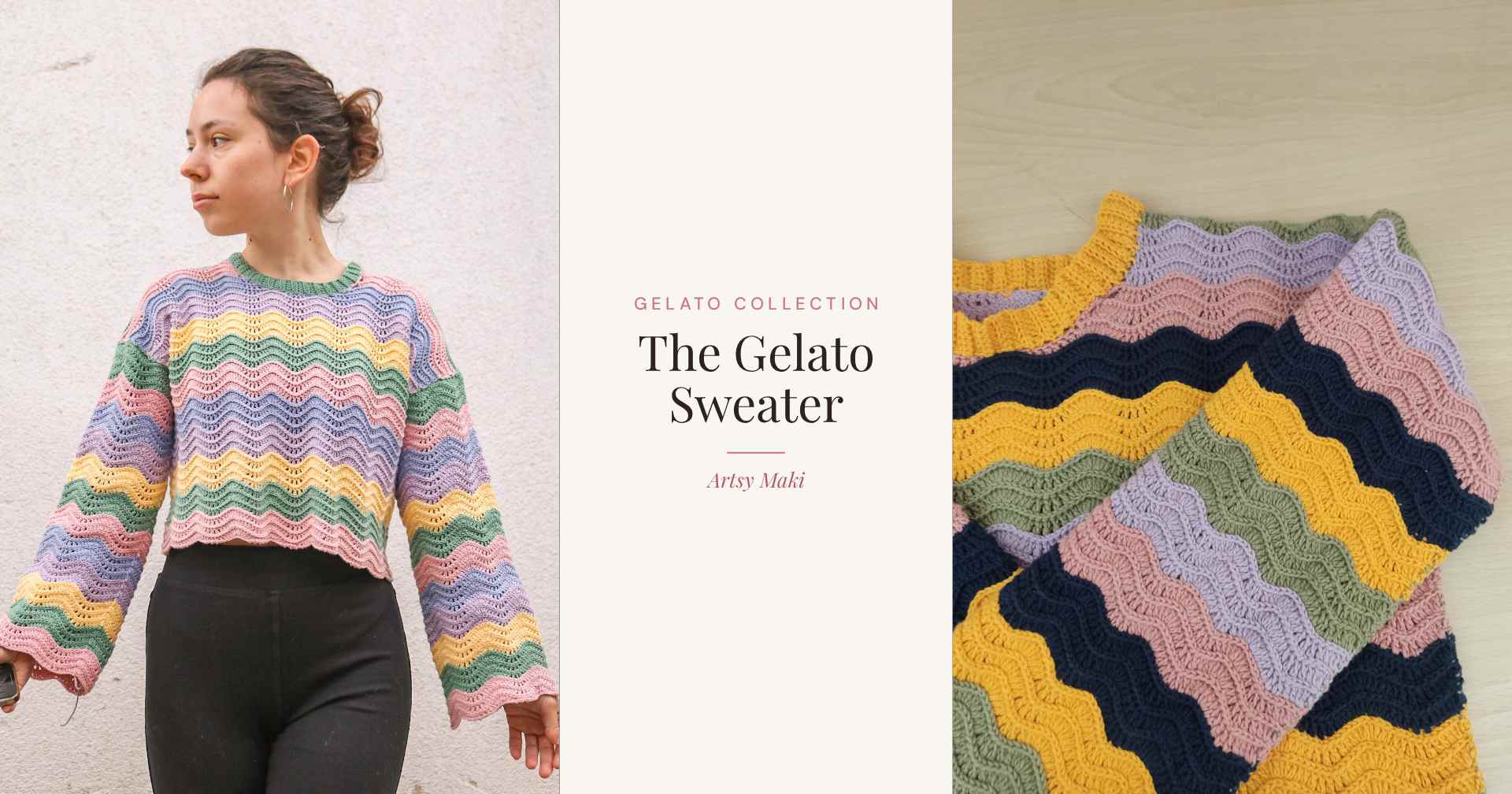
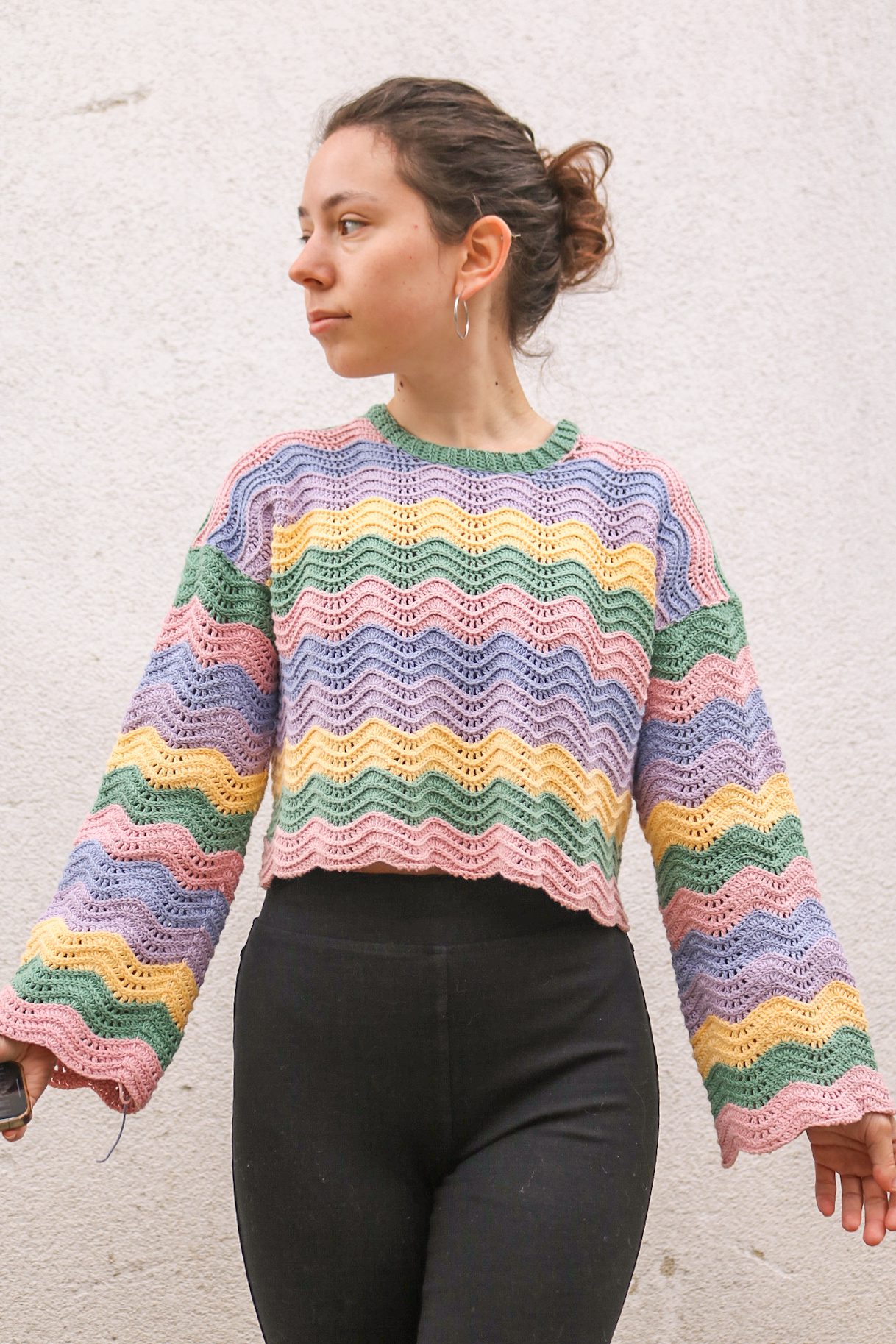
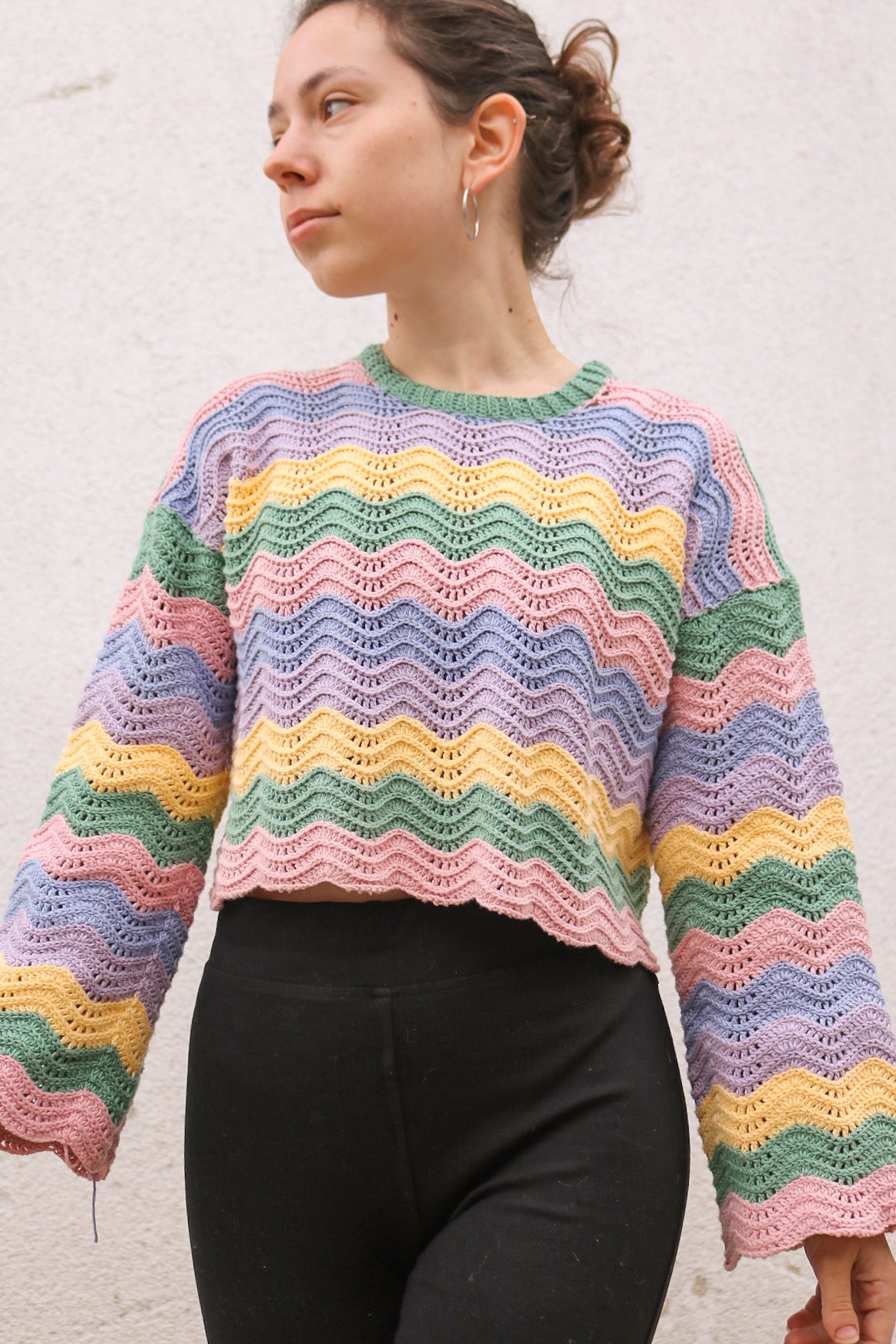
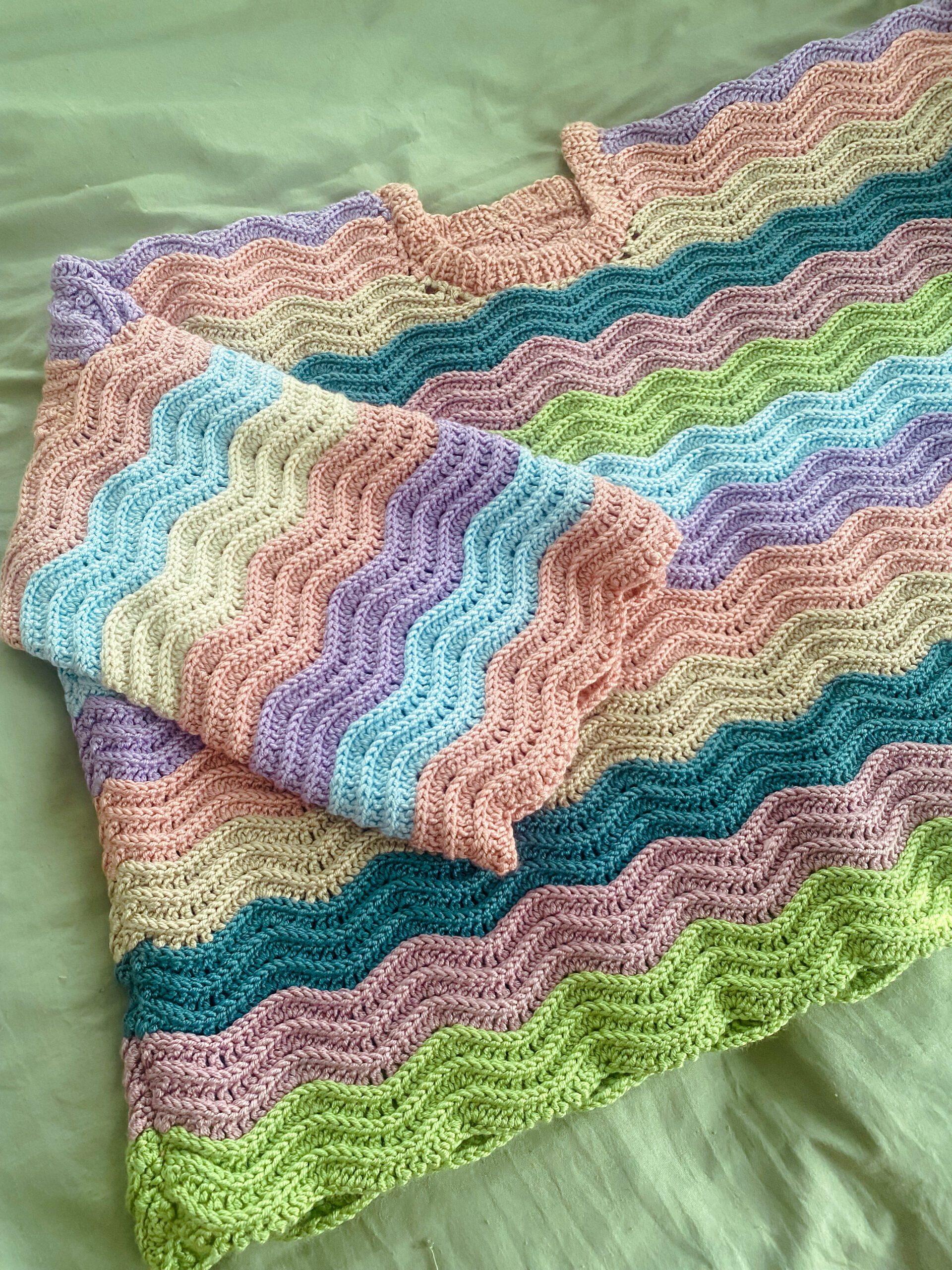
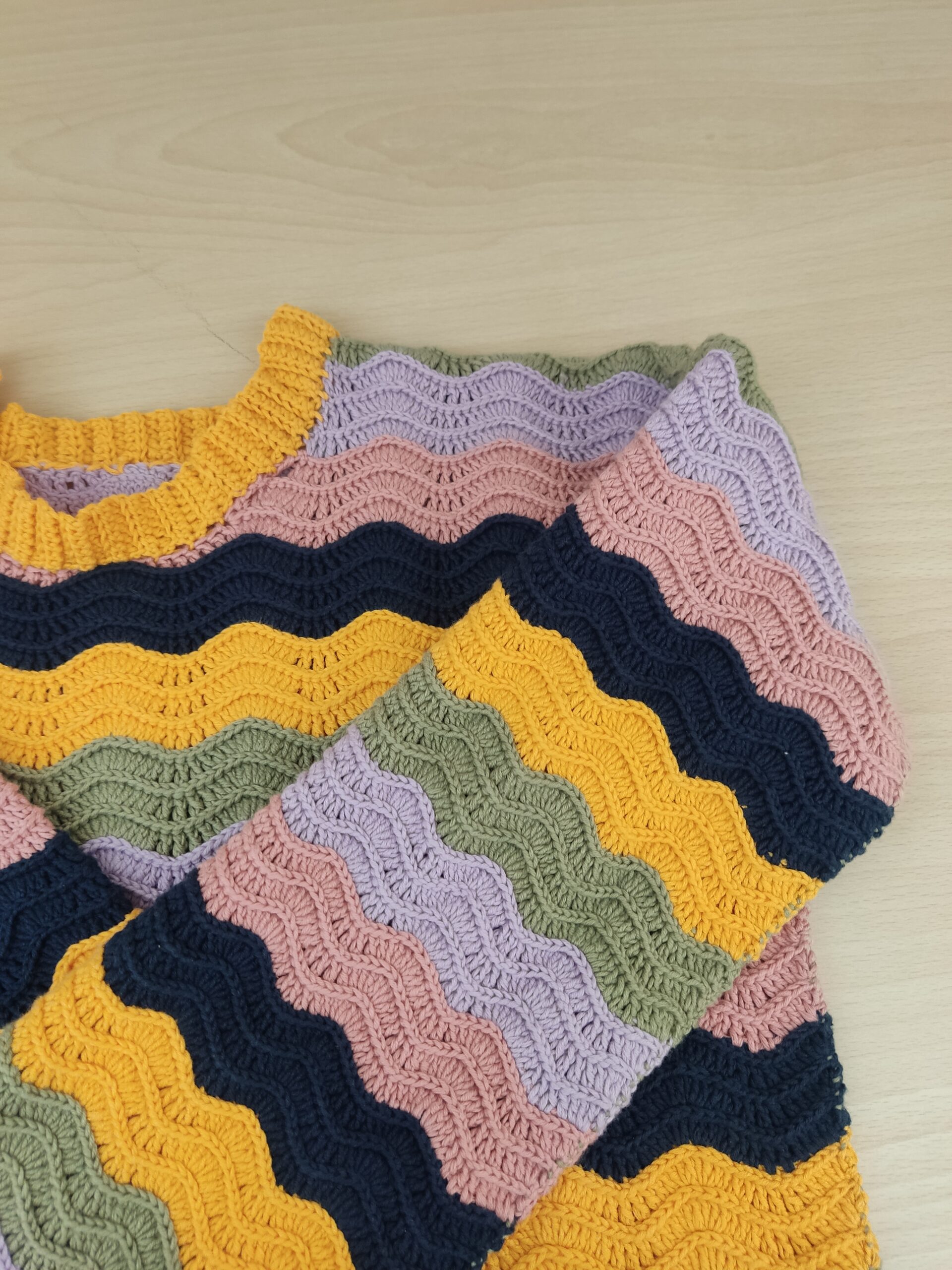
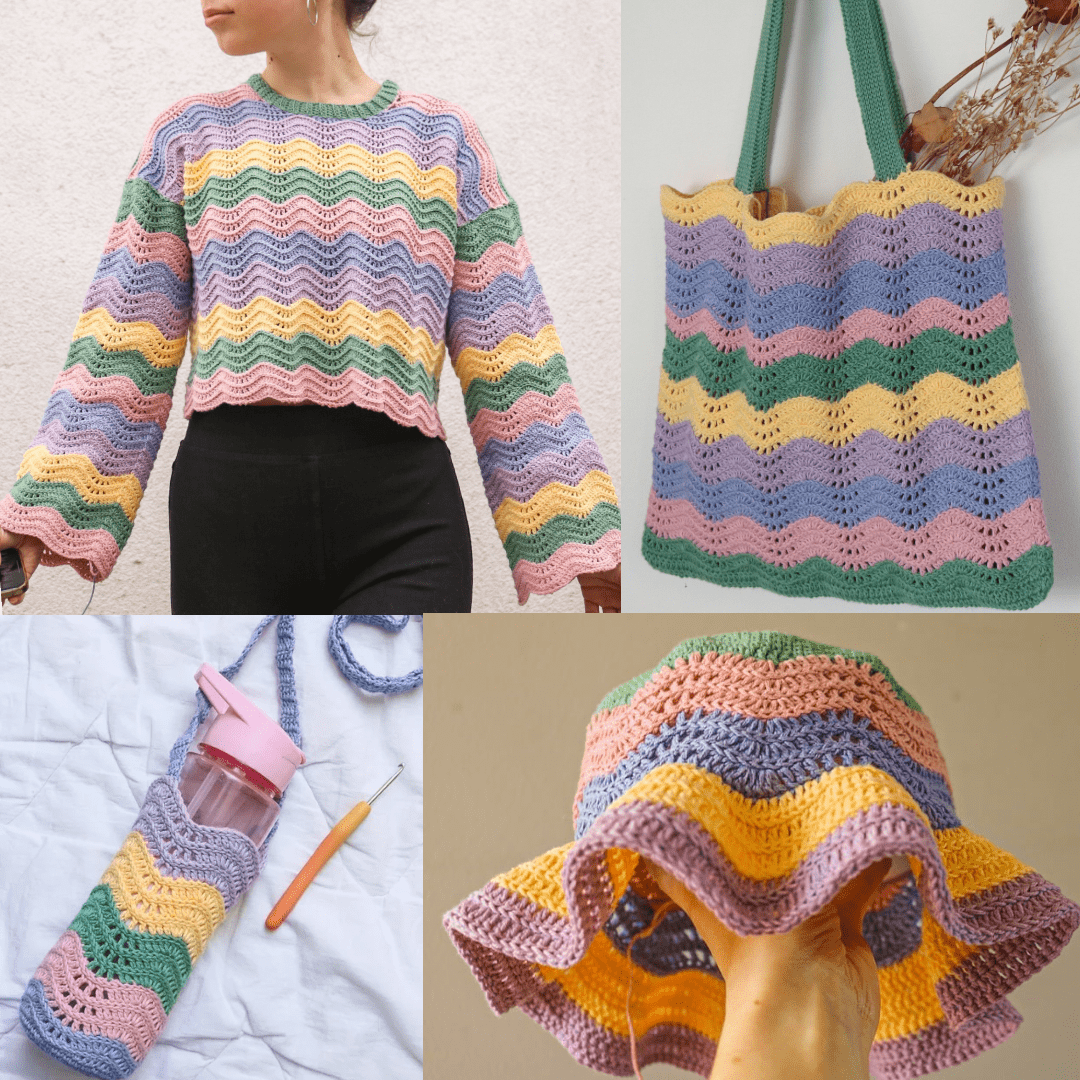
The Gelato Sweater is a cropped crewneck with wavy stripes, worked in sport weight yarn on a 3 mm hook. It comes in nine sizes, XS to 5XL, with finished chest circumferences from 100 cm to 188 cm (39 to 74 in).
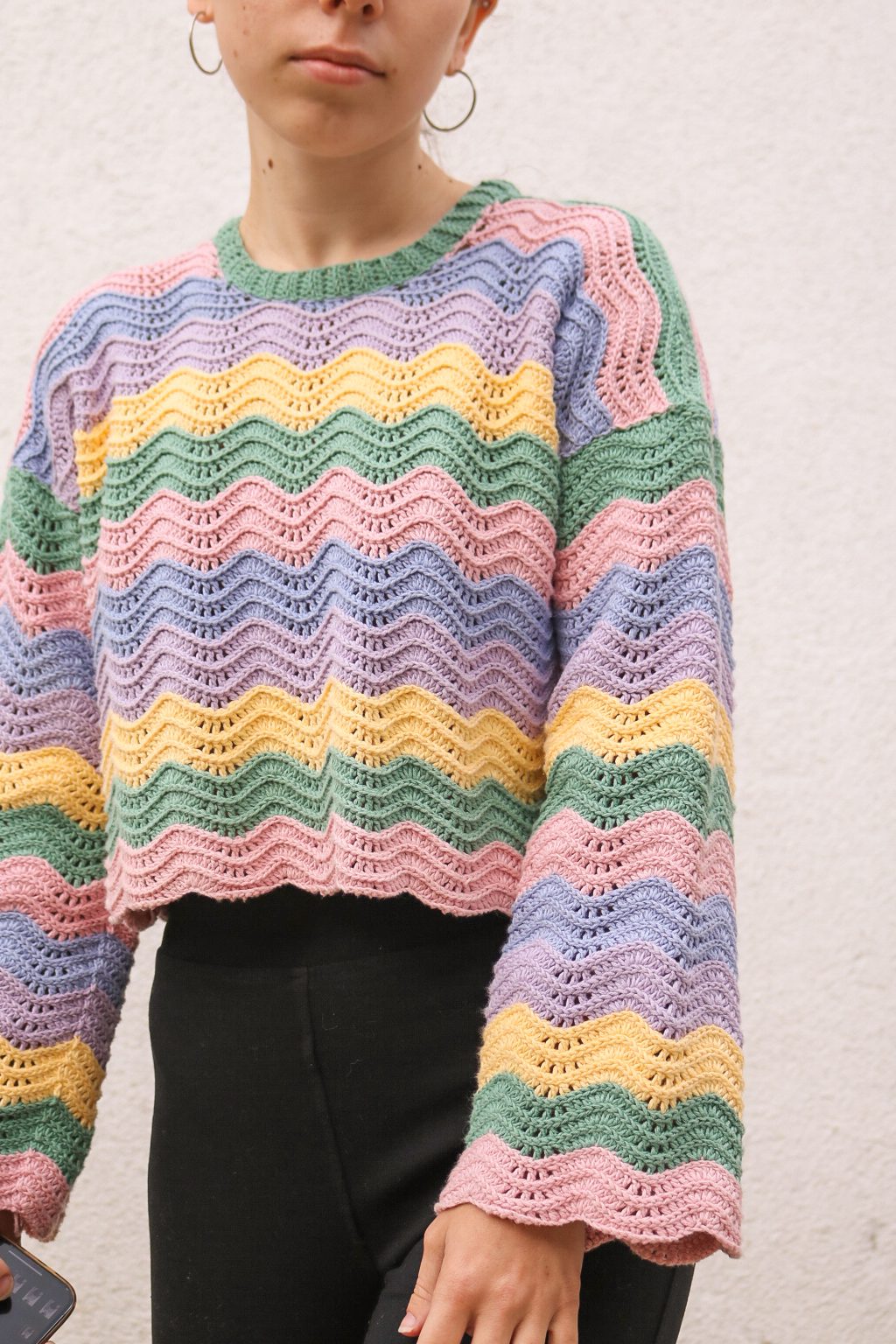
The wave comes from the stitch, not from the colour changes. The rows mix stitch heights, from single crochet up to treble, and some rows are worked into the front loop only. That pushes the fabric up into a peak and lets it fall into a trough, and every stripe bends along with it. The exact repeat is in the PDF.
It is worked in flat panels that are seamed together at the end. That means there is sewing up to do when you finish, and it also means you are only ever holding a rectangle, which is easy to take out of the house.
The fit is oversized, with about 25 cm (10 in) of positive ease. Positive ease is the gap between the finished garment and your own body. Twenty five centimetres is a lot of it, and it is why the sample looks boxy rather than fitted.
In the download
What’s inside the PDF
- Instructions graded for nine sizes, XS to 5XL, in English and US crochet terms.
- Photos, videos and charts for the techniques the pattern uses.
- Finished chest circumference for every size.
- Yarn amounts per size, in grams and in metres and yards.
- The gauge, given as pattern repeats rather than as a stitch count.
- Panel construction with seaming, so each piece is worked flat.
This list is what the product page and the Ravelry page state. Neither gives a page count, so I have not put one here.
Materials
- Yarn: sport weight, or a heavy fingering. The sample is DROPS Safran, 100% Egyptian cotton, 50 g = 160 m (175 yd). Amounts run from 500 g at XS to 1000 g at 5XL, and the next section breaks that down per size and per colour.
- Hook: 3 mm, or whichever hook gets you the gauge. If you buy hooks by US letter, note that 3 mm does not have one. The Craft Yarn Council chart goes from C-2 at 2.75 mm to D-3 at 3.25 mm and skips straight over 3 mm, so a set sold only in letters will not contain the size this pattern asks for.
- Notions: a yarn needle for the seams and the ends, and stitch markers.
Sport weight is category 2, Fine, on the Craft Yarn Council scale, one step finer than DK. A 3 mm hook sits well inside the B-1 to E-4 range that category recommends.
How much of each colour
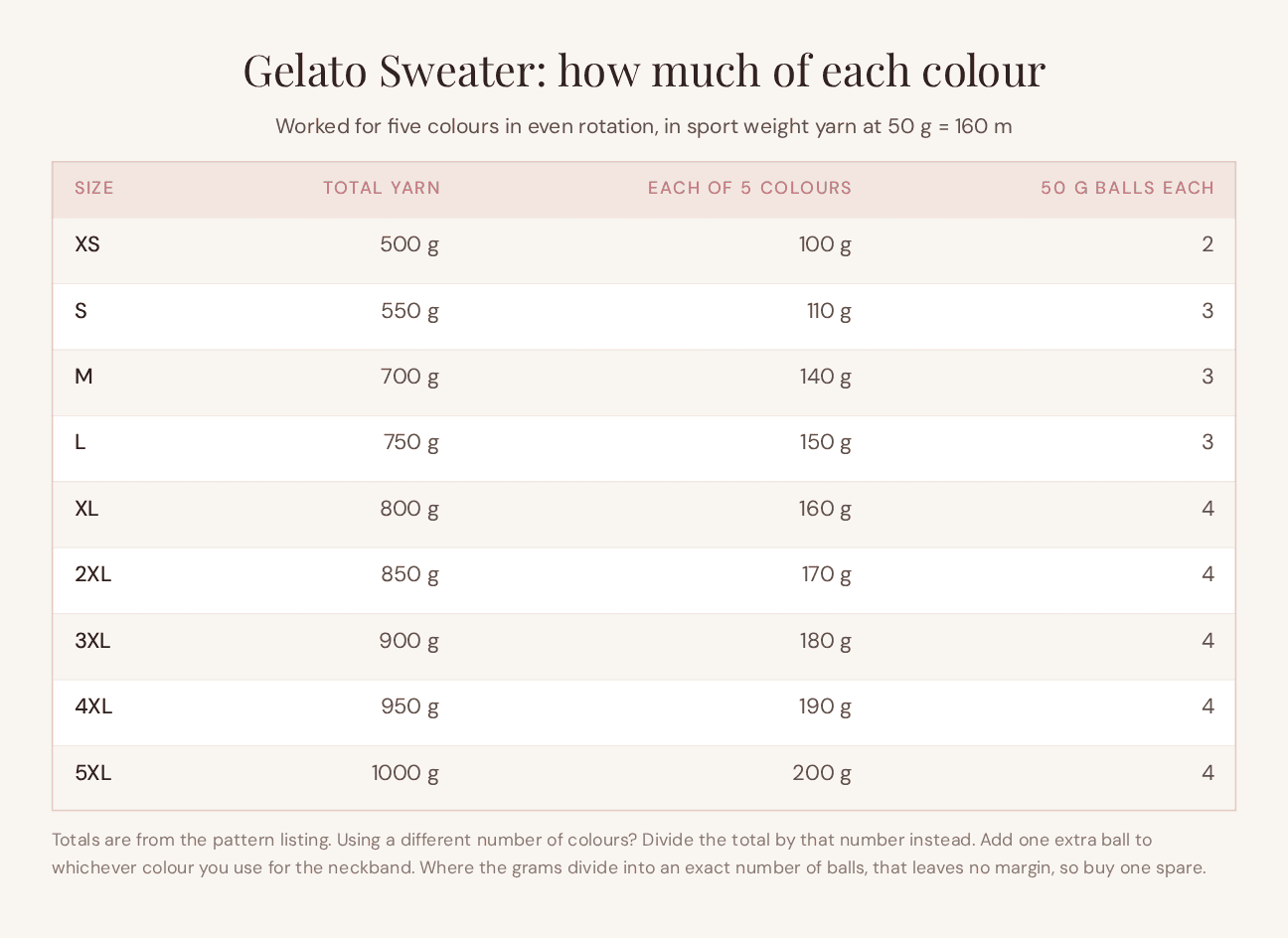
The totals are for the whole sweater, and nothing tells you how to split them across the stripes. The arithmetic is simple: divide your size’s total by the number of colours you plan to use, then round up to the next whole ball.
Then add one ball to whichever colour you pick for the neckband, because that colour gets used for the band as well as for its share of the stripes. On the sample that is the sage green.
How to measure gauge on a wavy stitch pattern
The gauge for this pattern is 2 pattern repeats to 10 cm (4 in) in the wavy stitch, so one repeat should come out about 5 cm (2 in) wide. You measure across the repeats, from the same point on one wave to the same point on the next, and you do not count stitches at all.
Ripple and chevron patterns are usually given this way, because the stitches do not sit in straight columns and counting them tells you very little. It catches people out, so here is the method in full.
- Work a swatch at least four repeats wide. The first and last repeat sit at the edge of the fabric and never behave quite like the ones in the middle, so you need spares to measure between.
- Work it tall enough to finish at least two colour bands, so you are measuring settled fabric rather than the first few rows.
- Wash it and dry it the way you will treat the sweater, then measure. Cotton has almost no elastic recovery. It does not spring back the way wool does, so whatever it does wet is what it will do on you.
- Lay it flat and let it relax. Do not pull it straight. Wavy fabric squashes together on itself, and pulling it flat gives you a wider repeat than the sweater will actually have.
- Measure peak to peak across the middle of the swatch, from the top of one wave to the top of the next, and count how many repeats fall inside 10 cm (4 in). Two is the target.
- More than two repeats in 10 cm means your waves are too narrow, so go up a hook size. Fewer than two means they are too wide, so go down.
Why half a centimetre matters here
A wave that comes out 5.5 cm instead of 5 cm is 5 mm off, which sounds like nothing. On a garment it is not nothing, because the error repeats across every wave in the panel.
Take the size M. The finished circumference is 122 cm, so each panel is about 61 cm wide, which at 5 cm a wave is roughly twelve repeats. Twelve repeats at 5.5 cm is 66 cm, and two panels of that put the finished chest near 132 cm. The sizes on this pattern step by 11 cm, so that half centimetre has moved you a whole size up.
It works the same in the other direction, which is the version people notice too late, when a size L comes out as an M. If your swatch is off and you are not sure what to change, I went through the arithmetic for getting to the right hook in one jump in my gauge swatch never matches the pattern.
Size chart
| Size | Finished chest | Fits bust | Yarn | 50 g balls |
|---|---|---|---|---|
| XS | 100 cm / 39 in | 75 cm / 29.5 in | 500 g | 10 |
| S | 111 cm / 43.7 in | 86 cm / 34 in | 550 g | 11 |
| M | 122 cm / 48 in | 97 cm / 38 in | 700 g | 14 |
| L | 133 cm / 52.4 in | 108 cm / 42.5 in | 750 g | 15 |
| XL | 144 cm / 56.7 in | 119 cm / 47 in | 800 g | 16 |
| 2XL | 155 cm / 61 in | 130 cm / 51 in | 850 g | 17 |
| 3XL | 166 cm / 65.4 in | 141 cm / 55.5 in | 900 g | 18 |
| 4XL | 177 cm / 69.7 in | 152 cm / 60 in | 950 g | 19 |
| 5XL | 188 cm / 74 in | 163 cm / 64 in | 1000 g | 20 |
If you want less than 25 cm of ease, pick by finished chest instead. Measure a jumper you already own and like flat across the chest, double that number, and choose the size closest to it.
How to choose the colours for the stripes
The sample uses five colours in a repeating rotation. Any number works, and the number matters far less than how much contrast there is between them.
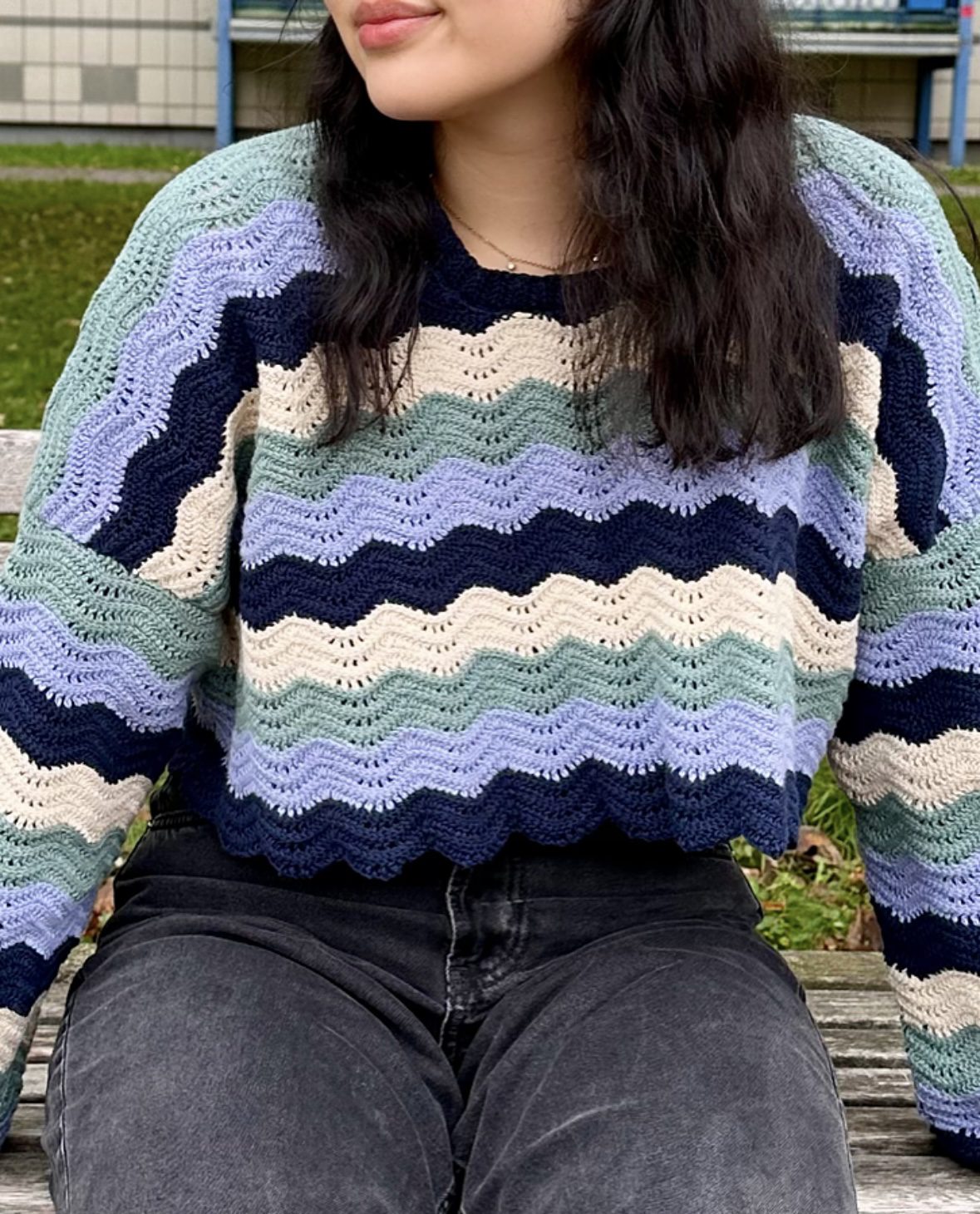
Put a dark navy next to a cream and you read stripes. The wave becomes a path the stripes travel along, and the colour is the first thing anyone sees. That is what the navy and cream version above is doing.
Keep everything within a shade or two of each other and you read texture instead. The waves turn into ridges in a single piece of fabric, and you notice the stitch before you notice the colour. The brown and cream version below is the same pattern doing the opposite job.
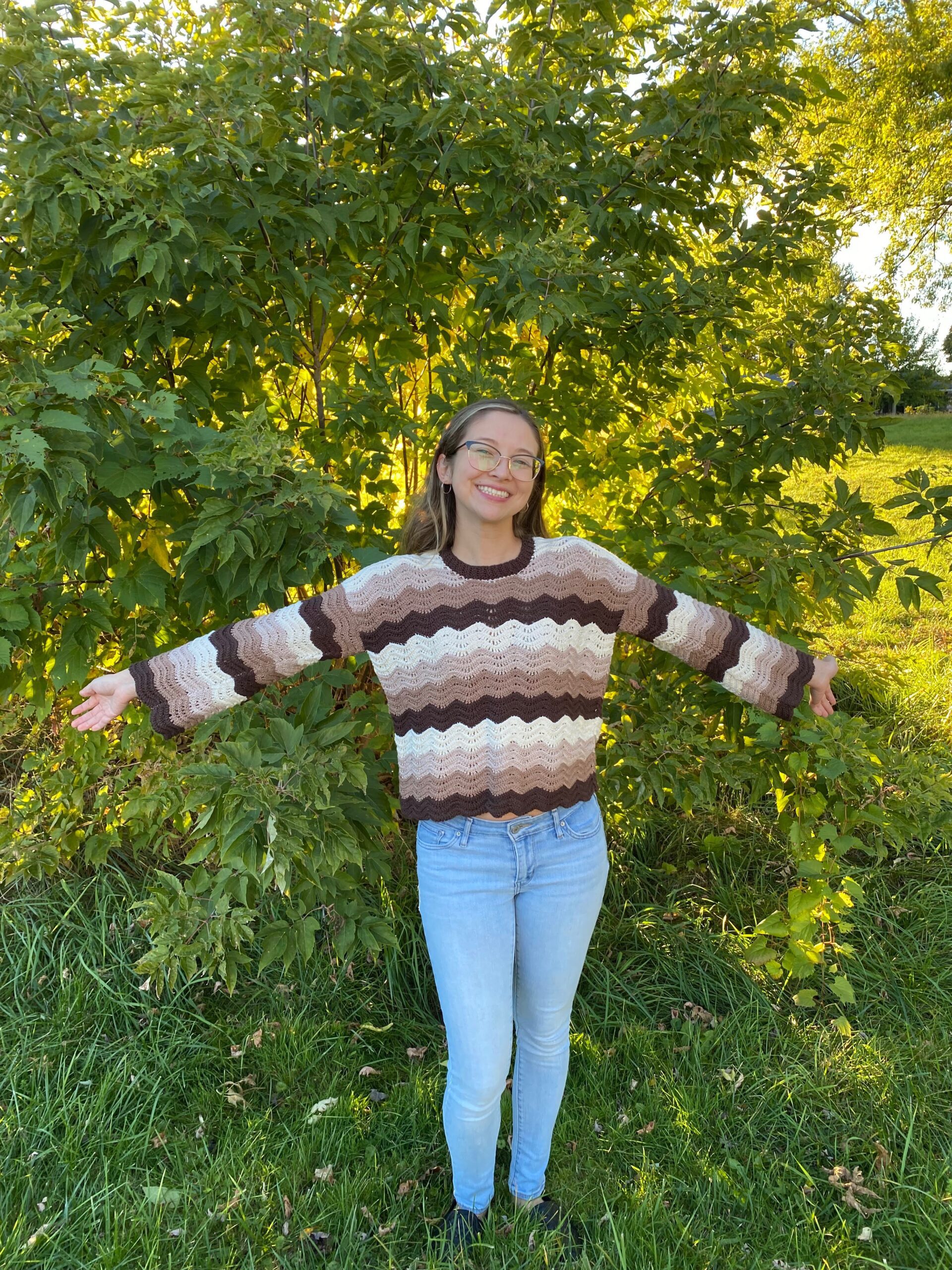
Neither is more correct. They are different sweaters, and it is worth deciding which one you want before you buy five colours of anything.
Yarn substitutions for DROPS Safran
DROPS Safran is a smooth 100% Egyptian cotton sport weight at 50 g to 160 m (175 yd), which is 320 m per 100 g. To replace it you want another smooth cotton or cotton blend at roughly the same length per gram.
There is a second test that only applies to a striped pattern: check the shade card before you check the match percentage. You need several colours that sit together, so a yarn with a short colour range can rule itself out however well it matches on paper.
The six below are from YarnSub, matched on weight, fibre, texture and gauge. The percentages are theirs. I have made this sweater in Safran and have not tested any of these myself, so swatch whatever you pick, and wash the swatch before you measure it.
Lana Grossa Elastico
96% cotton, 4% polyester · 50 g / 160 m · 98% match
The closest match on the list, and the same length per ball, so the ball counts above carry straight over. The small amount of polyester gives it a little of the springiness that plain cotton does not have.
Lotus Yarns Autumn Wind
90% cotton, 10% cashmere · 50 g / 160 m · 96% match
Same put-up again, so the ball counts carry over. The cashmere makes it softer and warmer than the original, which suits a cropped sweater you want to wear past summer.
BC Garn Summer in Kashmir
90% cotton, 10% cashmere · 50 g / 165 m · 95% match
A fraction more length per ball than Safran, so you need slightly fewer balls. GOTS certified if that matters to you.
Valley Yarns Granville
90% cotton, 10% merino · 50 g / 152 m · 95% match
A little shorter per ball. YarnSub puts it at 1.06 balls for every ball of Safran, so add roughly one extra ball for every sixteen the table asks for.
DROPS Loves You 7
100% cotton · 50 g / 170 m · 91% match
Same fibre and the same maker, so it sits in the same shops and the shade card is the easy part. It is a plied yarn rather than Safran’s construction, which changes the stitch surface a little.
Queensland Coastal Cotton Fine
100% cotton · 320 m balls · 92% match
Sold in bigger balls, so one of these covers two of Safran. Fewer ends to weave in, which adds up on a striped sweater.
If you are matching a yarn yourself rather than picking off a list, the checks I run before spending anything are in how to substitute yarn in any crochet pattern.
Skills you’ll need
- Single, double and treble crochet, so you can follow a row that changes stitch height as it goes.
- Working into the front loop only, which is what leaves the raised line along each wave.
- Slip stitch.
- Joining a new colour. The sweater is striped throughout, so you will do this many times and it is worth getting tidy at it early.
- Seaming, which is how the panels become a sweater.
- Reading a graded pattern, so you can follow one size through all nine.
If you want to try the fabric before you commit to a sweater’s worth of yarn, the Gelato Water Bottle Bag is free here on the blog and uses a related wavy stitch worked in the round. It takes scraps and an evening. The repeat is not identical to the sweater’s, but the look and the rhythm of it are the same.
The design process
The wave came before any of the Gelato pieces did. I had the stitch first and put it on small flat things while I worked out what else it could do: a bucket hat, a tote, a bottle bag. A wave is easy to like on something flat, because nothing has to fit.
The sweater took longest. Every row of a wavy stitch is a different height depending on where along the wave you are, so shaping fights it. That is why this one is worked in flat panels and seamed rather than in the round from the top down. Panels keep the waves lining up at the seams, and you can block each piece flat before anything is sewn.
The crop is deliberate too. With 25 cm of ease the body is already wide, and width plus length reads as a box. Stopping it above the waist puts the widest part over your ribs rather than over your hips.
The hem is the part I left alone. A wavy stitch ends in a scalloped edge, and the obvious move is to work a few straight rows to square it off. I did not, on the body or the cuffs, because the scalloped edge is the shape the stitch makes on its own and I wanted it visible.
Part of a collection
The Gelato collection
Four patterns built on the same wavy stitch, so whatever you learn on one carries over to the next. They all take sport weight yarn and a 3 mm hook, and the three small ones are good places to use up what the sweater leaves behind.
- Gelato Sweater: this one. Cropped crewneck, nine sizes.
- Gelato Bucket Hat: the wave worked in the round, with a flared brim.
- Gelato Tote: a flat panel bag, the quickest way to see the stitch at full size.
- Gelato Water Bottle Bag: also free here on the blog, if you want to try the fabric first.
- Gelato Pattern Bundle: all four together.
Tester calls always go out on Instagram first, and the newsletter sign-up is at the bottom of this page.
Questions I get asked
Is this a pattern or a finished sweater?
A pattern, which is a PDF you download and make yourself. Nothing physical is shipped. The download link arrives straight after checkout.
Can I use DK instead of sport weight?
Not without changing the numbers. DK is one category thicker, so on a 3 mm hook it gives a stiff fabric, and on a bigger hook your wave repeat comes out wider than 5 cm. If you want to use it anyway, swatch in the DK, measure how wide one repeat actually is, and use that to work out which size’s repeat count gives you the chest measurement you want.
How many colours do I need?
As many as you like. The sample uses five in rotation, and the other versions in the photos here use fewer and more than that. Divide your size’s total yarn by the number you choose, round up to whole balls, and add one ball to the neckband colour.
Will a cotton sweater stretch out of shape?
It will grow a little, yes. Cotton has no elastic recovery, so it stretches under its own weight and does not pull itself back. The crop helps, because there is less fabric hanging, and washing and reshaping it flat resets it. Store it folded rather than on a hanger.
Can I make it longer?
Yes. The body is a flat panel, so you keep working wave rows until it is the length you want, and the same goes for the sleeves. Buy an extra ball or two of each colour if you are adding much.
Do I have to seam it?
Yes, it is written as panels. If seaming is the part you dread, this is a gentle one: the sweater has a dropped shoulder rather than a set in sleeve, so the seams are straight runs rather than curves.
Can I sell what I make from it?
Yes, finished items are yours to sell. Please credit Artsy Maki as the designer, and never resell, copy or share the pattern file itself.
What if I get stuck?
Email me at artsymaki@gmail.com with a photo of where you are. I answer every message, usually within a day or two.
Ready to make one?
The full pattern, all nine sizes, with photos, videos and charts for the techniques. Instant download.