Get the pattern
Instant PDF download
8 sizes
XS to 4XL · DK weight · 5 mm hook
Craft
Crochet
Skill level
Advanced beginner
Yarn & hook
DK weight · 5 mm
Sizes
XS to 4XL
About this mesh stripe crochet cardigan pattern
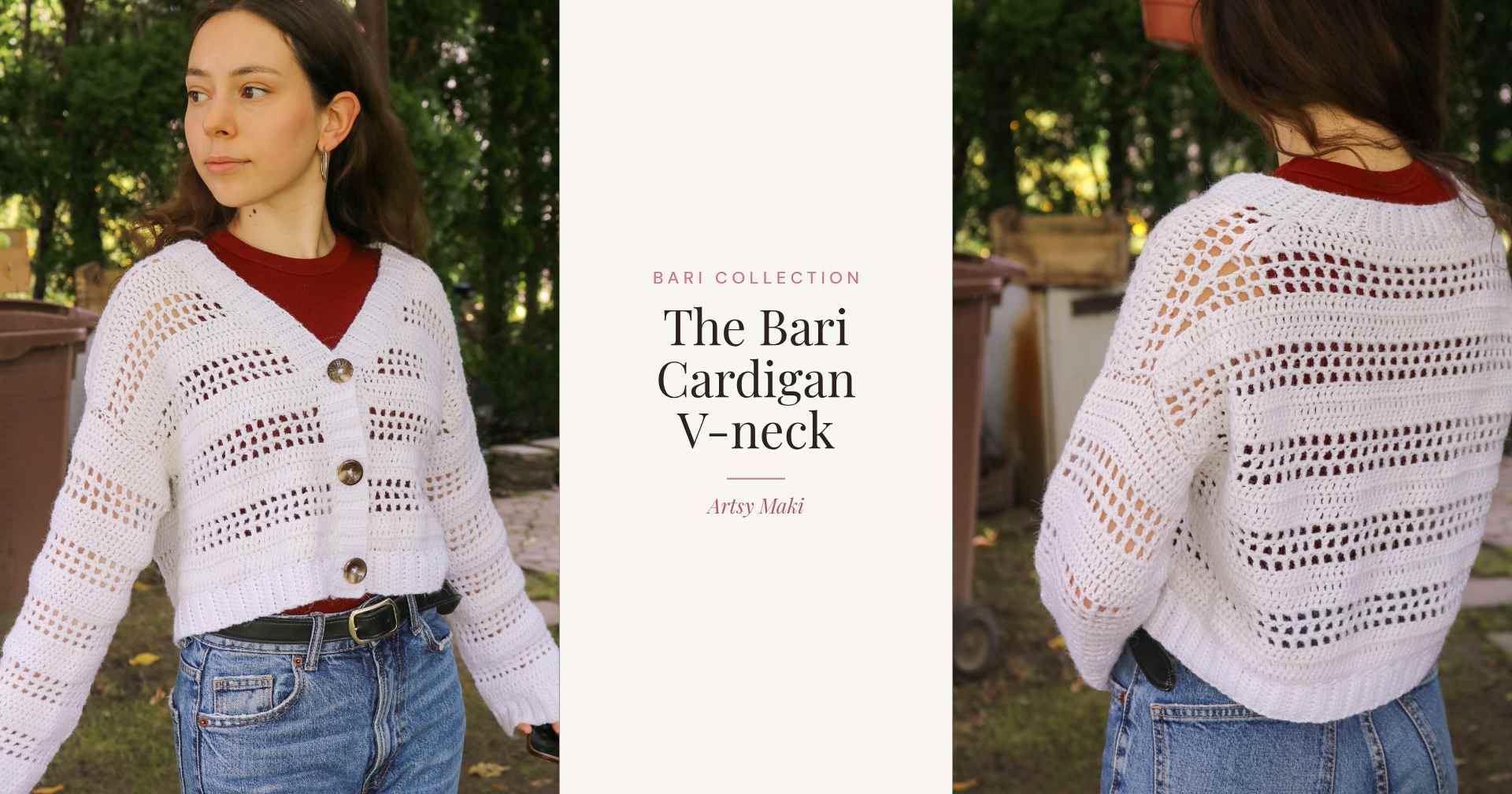
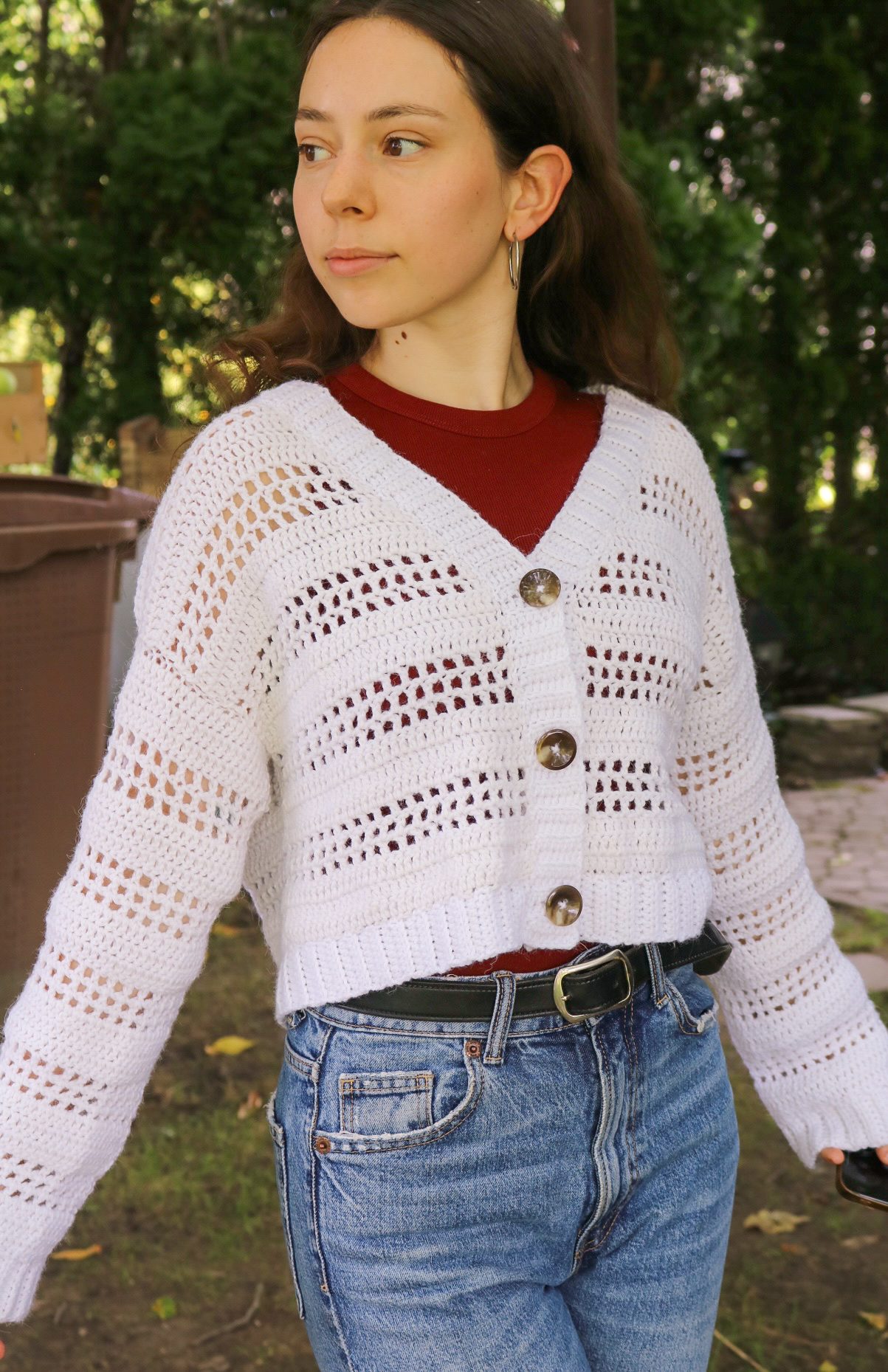
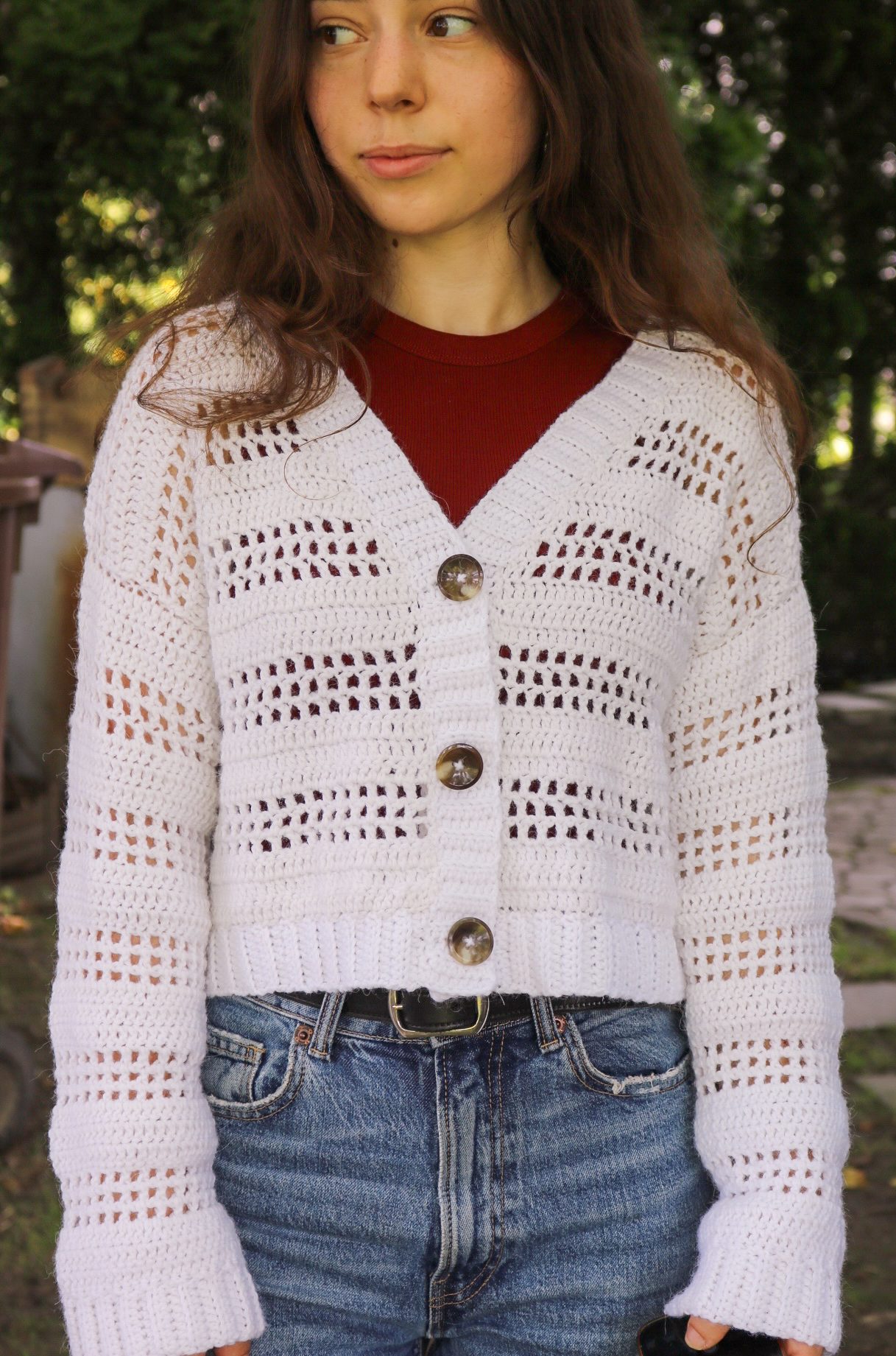
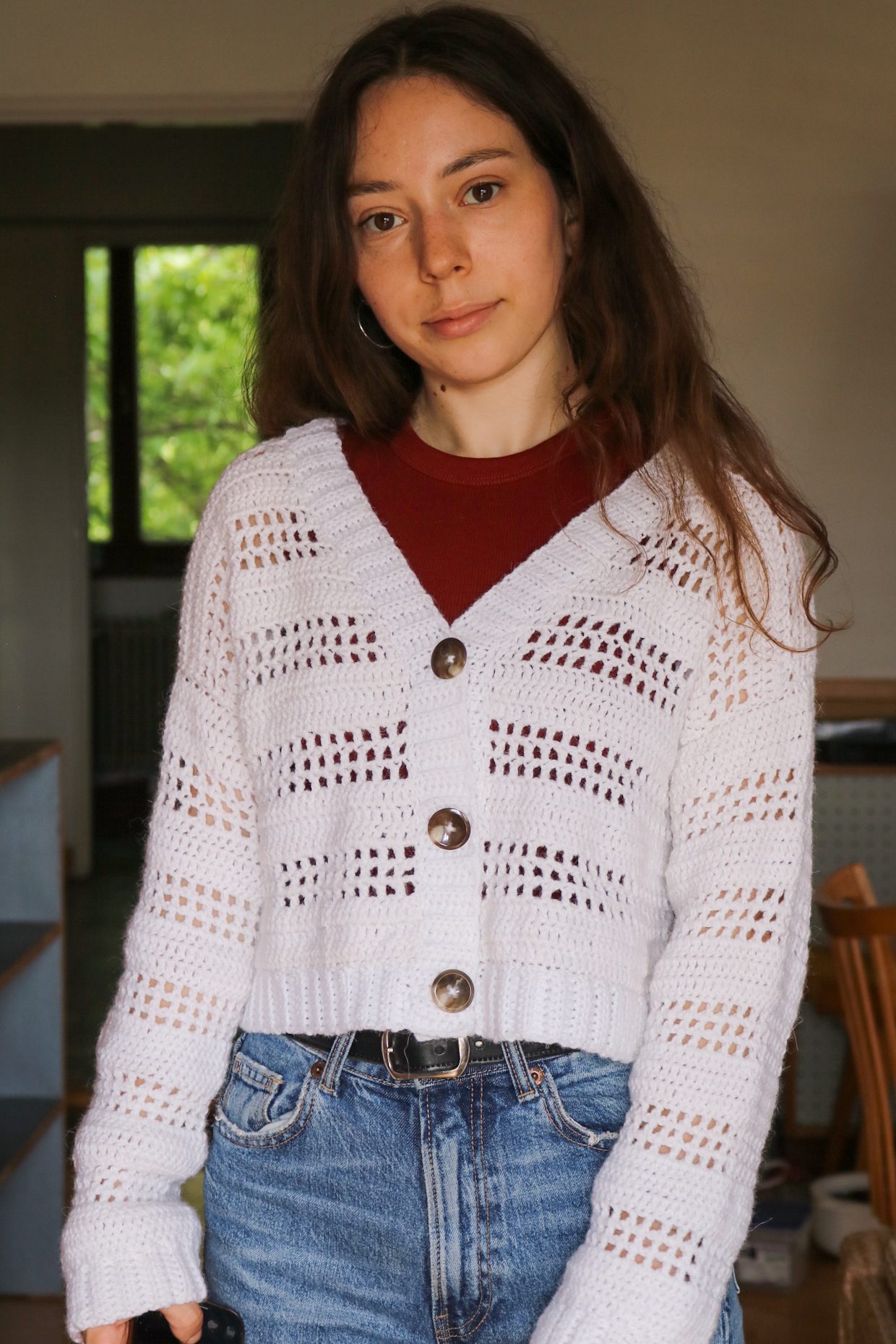
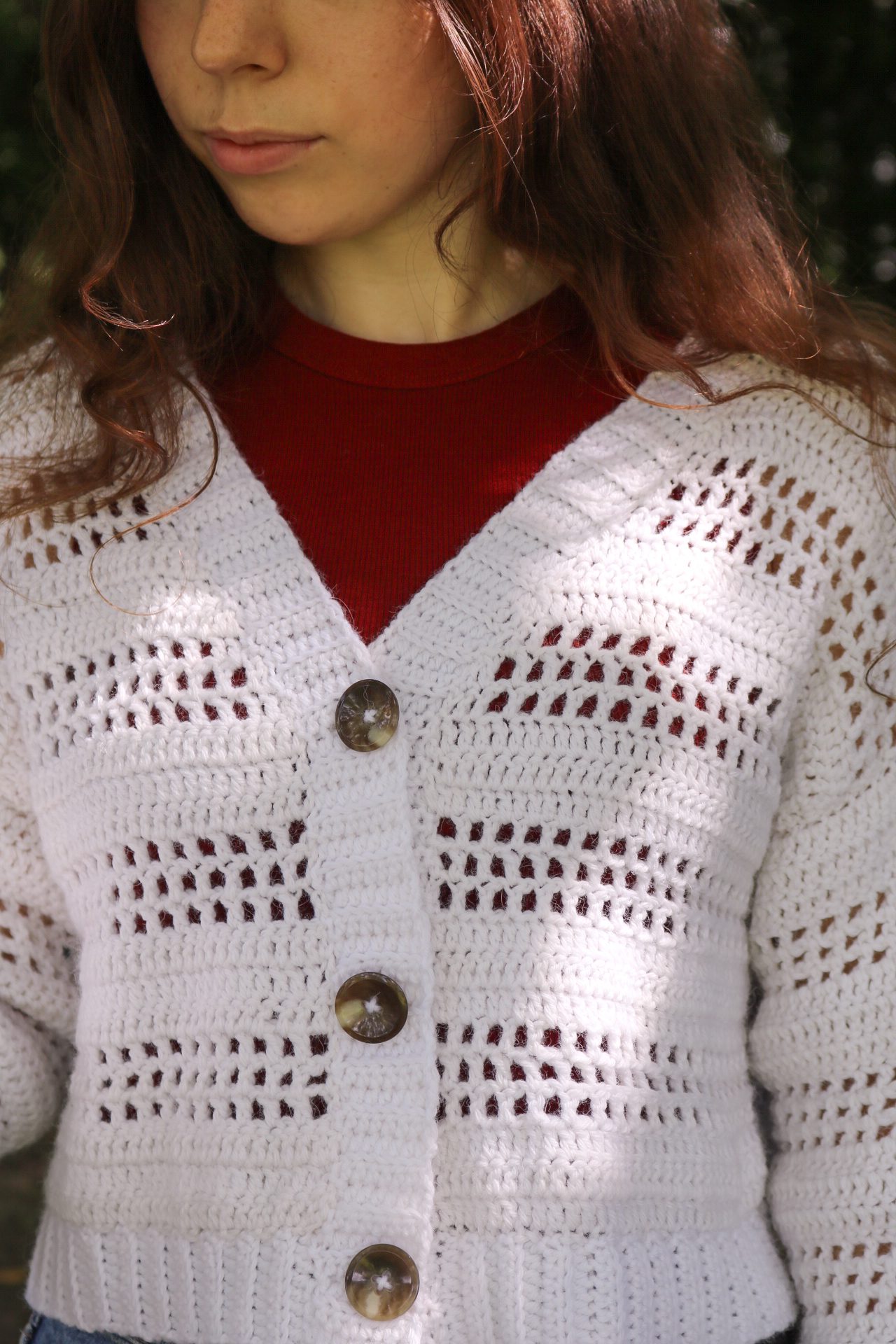
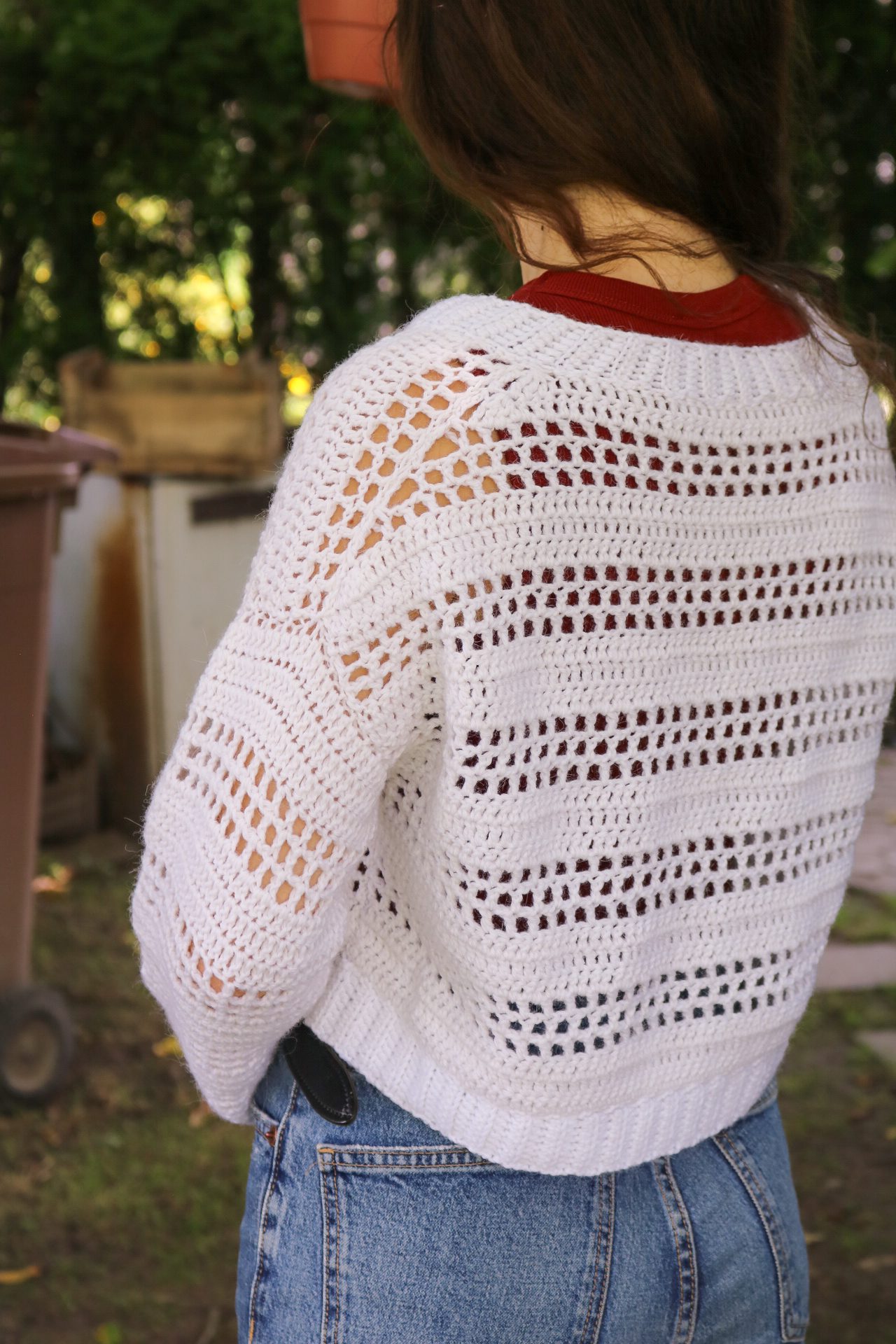
The Bari Cardigan V-neck is an oversized button front cardigan worked in the mesh stripe fabric the whole Bari collection is built on: bands of solid double crochet with rows of open mesh cut through them. The neckline is a deep V, the shoulders are dropped, and the body is cut wide.
It is worked flat in panels and seamed, with the V shaping built into the front panels. The sleeves are worked in the round from the top down, so there is no sleeve seam. The ribbed hem, the button bands and the neckline trim go on at the end.
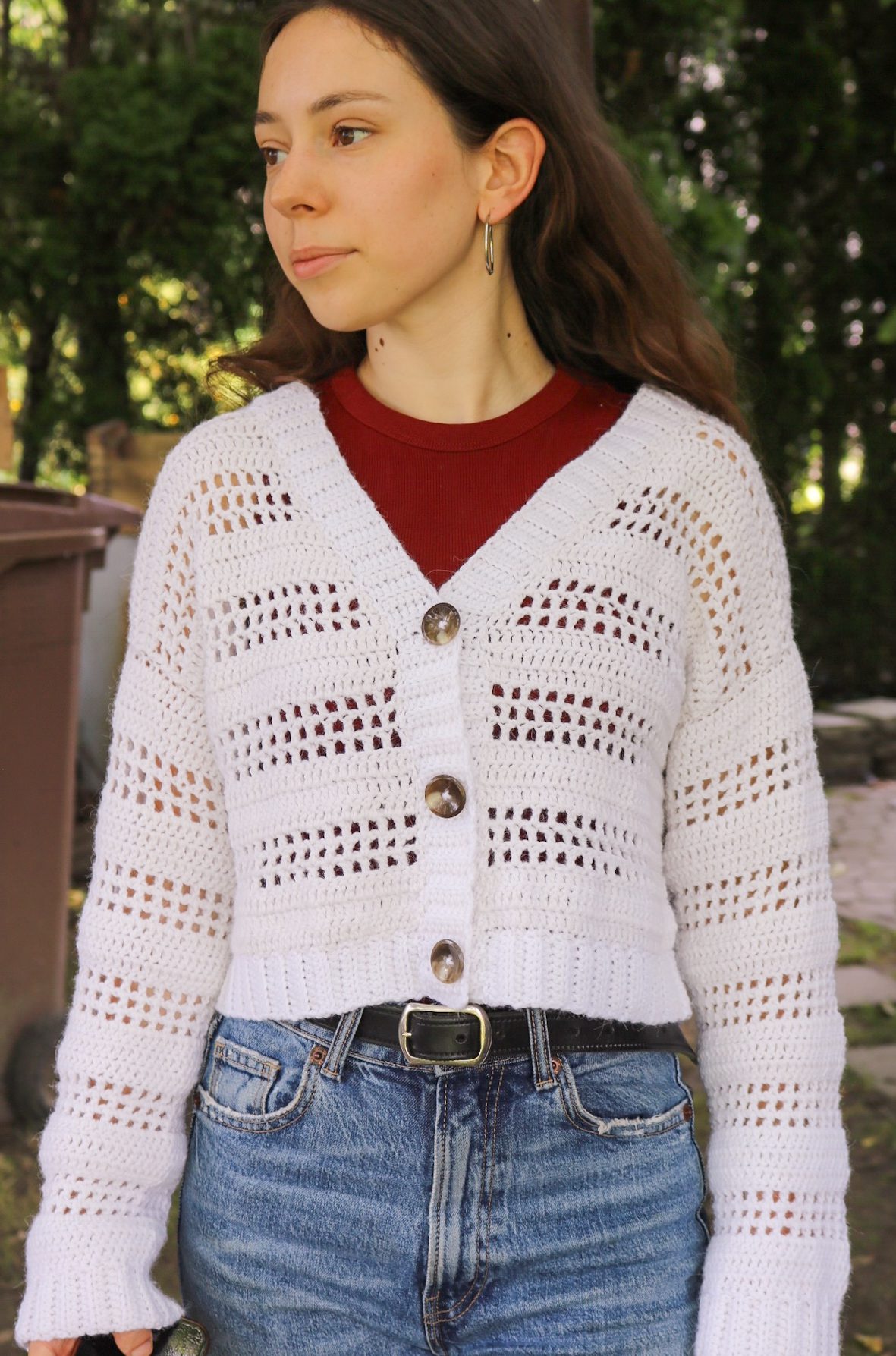
There are eight sizes, XS to 4XL, and the pattern includes a cropped version. The cardigan in these photos is the cropped one. It is written for an advanced beginner: if you can work double crochet and chain spaces and you are willing to seam four panels together, you have what you need.
In the download
What’s inside the PDF
- Graded instructions for all eight sizes, XS to 4XL.
- Row by row instructions with stitch counts.
- Charts for the stitch pattern.
- Video links for the stitches that are easier to watch than to read.
- Shaping instructions written out separately for each size.
- Instructions for the cropped version as well as the full length one.
- A measurement table with finished chest and length for every size.
Materials
- Yarn: 900 to 1800 m (985 to 1970 yds) of DK weight yarn depending on size. The sample is DROPS Lima, 65% wool and 35% alpaca, 50 g = 100 m / 109 yds, which works out at 9 to 18 balls.
- Hook: 5 mm (US H/8), or whichever hook gets you the gauge below.
- Buttons: 2 to 2.5 cm (0.75 to 1 in) across. 3 for cropped, otherwise 4
- Notions: yarn needle and stitch markers.
How to check your gauge
With a 5 mm hook, after blocking, 16 double crochet and 8 rows = 10 x 10 cm (4 x 4 in). Make the swatch, wet it, pin it flat, let it dry, and measure it then.
Those two words matter here more than they do in most patterns, because of the yarn. DROPS Lima is 35% alpaca, and alpaca has much less memory than wool. Fibres like alpaca and silk give lovely drape and they also grow when you wet block them, which is a point Marie Greene makes about blocking growth from the knitting side. If you measure your swatch dry and it is bang on 16 stitches, the blocked fabric is likely to be looser than that, and the finished cardigan comes out wider than the size chart.
Block it the way you will wash the cardigan. Lima is a hand wash yarn, so hand wash the swatch. If you want somewhere flat to pin things out, I have a tutorial on making a blocking board from a sheet of foam.
One more thing to count. The published gauge is measured over the solid double crochet, and the fabric is half mesh. The two alternate all the way up the body, so count your mesh rows as well: if the solid bands are on gauge and the mesh is not, the stripes will bunch or stretch instead of sitting flat. If your gauge is off and you are not sure which way to move, I wrote a whole post on getting a crochet gauge to match the pattern.
Size chart
| Size | Yarn needed | Balls | Finished length |
|---|---|---|---|
| XS | 900 m / 985 yds | 9 | 53 cm / 20.75 in |
| S | 1000 m / 1094 yds | 10 | 55 cm / 21.75 in |
| M | 1100 m / 1203 yds | 11 | 56 cm / 22 in |
| L | 1300 m / 1421 yds | 13 | 58 cm / 22.75 in |
| XL | 1400 m / 1531 yds | 14 | 60 cm / 23.5 in |
| 2XL | 1600 m / 1749 yds | 16 | 62 cm / 24.5 in |
| 3XL | 1700 m / 1859 yds | 17 | 64 cm / 25.25 in |
| 4XL | 1800 m / 1969 yds | 18 | 67 cm / 26.5 in |
Those lengths are for the full length version. The cropped one in the photos is shorter, and the pattern tells you where to stop.
How much ease does this cardigan have?
About 20 cm (8 in) of positive ease in the smaller sizes, and as little as 12 cm (4.75 in) at the top of the larger ones. Positive ease is the difference between the finished chest of the garment and your own bust measurement, so 20 cm of it means the cardigan measures 20 cm more than you do.
The listing gives an intended bust fit for each size as a band rather than a single number, and the bands are not all the same width. Through XS to L each band covers 5 cm (2 in) and the finished chest steps by 5 cm as well, so the ease stays between 18 and 23 cm (7 and 9 in) wherever in the band you sit. From XL upwards each band covers 10 cm (4 in) while the finished chest steps by 10 cm, so the ease runs from 22 cm (8.75 in) at the bottom of a band down to 12 cm (4.75 in) at the top.
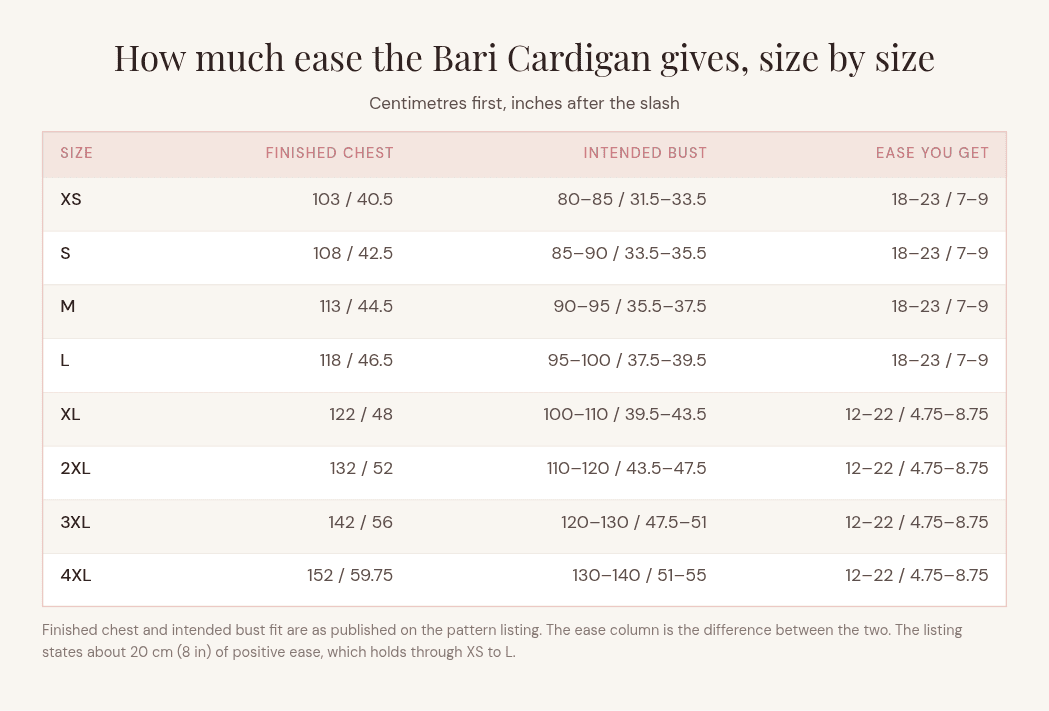
So choose by finished chest, not by which band your bust falls into. Measure your bust, add about 20 cm (8 in), and pick the size closest to that number. If you are at the top of the XL, 2XL, 3XL or 4XL band and you want the loose fit in the photos rather than a gently roomy one, take the next size up.
There is room to play here, because a cardigan is worn open most of the time. Less ease gives you something that still buttons and sits closer to the body. More gives you the oversized version.
Yarn substitutions for DROPS Lima
Any DK weight yarn that gets you the gauge will work. The number to match is the metres per gram. Lima gives 100 m per 50 g, and that tells you far more than the word DK does.
That puts Lima at the heavy end of DK. Ravelry lists it at 11 wraps per inch with a knitting gauge of 21 stitches to 10 cm (4 in), and the Craft Yarn Council’s category 3, the DK band, runs from 21 to 24 stitches to 10 cm. Lima sits at the loosest edge of it. Plenty of yarns sold as DK come in at 110 to 130 m per 50 g, and those are thinner.
This is also why the gram column on the listing is a DROPS Lima figure rather than a general one. 900 m of Lima weighs 450 g. The same 900 m of a DK at 125 m per 50 g weighs 360 g. Buy to the metres and ignore the gram column unless you are using Lima. There is more on all of this in my post on substituting yarn in any crochet pattern.
They are yarns I picked on fibre, weight and metres per 50 g from the makers’ own figures and from Ravelry, and I have not crocheted this cardigan in any of them.
DROPS Karisma
100% superwash wool · 50 g / 100 m
The simple swap. Same brand, same metres per ball, so the ball counts in the table hold. No alpaca, so expect crisper stitches and a little less haze.
Berroco Ultra Alpaca
50% wool, 50% alpaca · 100 g / 200 m
The closest fibre match here and the easiest of these to find in the US. Ravelry files it as worsted rather than DK, but the metres per gram are identical to Lima’s.
Cascade 220
100% Peruvian Highland wool · 100 g / 201 m
Again the same metres per gram, stocked almost everywhere, and a huge colour range. Hand wash, like Lima.
Sandnes Garn Peer Gynt
100% wool · 50 g / 91 m
A Scandinavian staple with clean stitch definition, which suits the edges of the mesh rows. It is 9 m short per ball, so allow about one extra ball in every ten.
DROPS Nepal, with care
65% wool, 35% alpaca · 50 g / 75 m
Exactly the same blend as Lima from the same brand, which makes it the swap people reach for first. It is an aran, and at 75 m per 50 g it is a third heavier per metre. Expect a bigger hook, your own swatch, and different yarn amounts.
Any DK at 100 m per 50 g
Look for about 21 sts per 10 cm on 4 mm needles
Match the metres per gram first, then swatch. A 5 mm hook is inside the Craft Yarn Council’s recommended range for DK, 4.5 to 5.5 mm, so you should not have to move far from it to hit gauge.
Skills you’ll need
- Double crochet and chain spaces.
- Working mesh over a chain space foundation.
- Seaming flat panels together neatly.
- Working a sleeve in the round from the top down.
- A buttonhole, and sewing buttons on straight.
- Reading a graded pattern so you can follow one size through.
Maki’s tip
Buttonholes made from a plain chain space stretch out over time and end up as gaping holes in a ribbed band. I wrote up the version I use instead in a separate tutorial, buttonholes on half double crochet ribbing without holes. Have a read before you get to the bands, whichever buttonhole your pattern gives you.
The design process
The Bari Sweater came first, and everything since has been the same idea in a different shape: solid double crochet with rows of mesh cut through it. The collection is named after the city the original yarn came from.
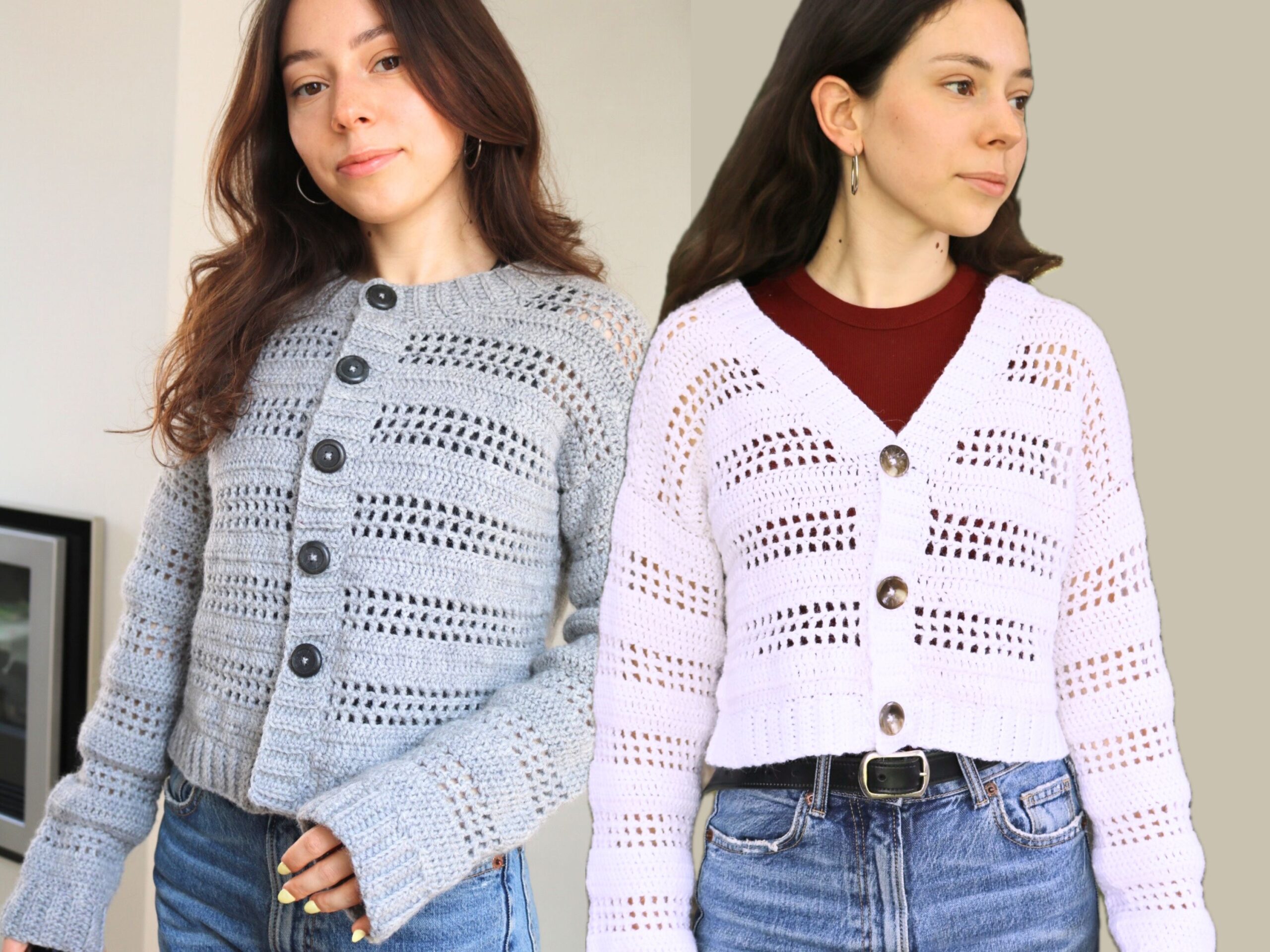
The two cardigans came out together in July 2025, and they are really one cardigan with two necklines. Put the listings side by side and every published number is the same: eight sizes, the same finished chest and length, the same yarn amounts, the same gauge, the same hook. Only the neckline and the button count differ.
The V is the version I reach for when I am layering. It sits open over a crew neck tee without two collars fighting each other, which is how it is worn in the photos above.
This one is built differently from my seamless patterns. It is worked flat in panels and sewn together, rather than in the round from the top down. A button front wants two straight edges down the centre and a band picked up along them, and flat panels give you that without any shaping in the way. The sleeves still go on from the top down in the round, so the only seams are at the shoulders and sides.
The mesh does more work on a cardigan than it does on the sweater. In DK at this width, solid crochet would make a heavy thing to wear indoors. Cutting mesh through it takes out some of the fabric and some of the yarn, so it stays a layering piece rather than a coat.
Part of a collection
The Bari collection
Every piece in the collection uses the same mesh stripe, so the stitch pattern you learn on one turns up again on all the others.
- Bari Cardigan V-neck: this one. Deep V, button front, cropped version included.
- Bari Cardigan crew neck: the same cardigan with a crew neckline and two more buttons. Both are also sold as a bundle.
- Bari Sweater: where the collection started. A cropped crewneck pullover in sport weight wool.
- Bari Top: the sleeveless summer version.
- Bari Vest and Bari Slipover: two layering pieces.
- Bari Bucket Hat: the small one, and a cheap way to try the mesh stripe before committing to a cardigan.
If you want to know when the next one lands, the newsletter sign-up is at the bottom of this page. Tester calls always go out on Instagram first.
Questions I get asked
Is this a pattern or a finished cardigan?
A pattern, which is a PDF you download and make yourself. Nothing physical is shipped. The download link arrives straight after checkout.
What is the difference between the V-neck and the crew neck version?
The neckline and the number of buttons. Everything published about the two is otherwise identical: the same eight sizes, the same finished chest and length, the same yarn amounts, the same gauge and the same hook. If you want both, there is a bundle.
Can I make it cropped?
Yes. The cropped version is written into the pattern, and the cardigan in these photos is the cropped one. It takes one button fewer.
Do I have to use DROPS Lima?
No. Any DK weight yarn that gets you 16 double crochet and 8 rows to 10 cm (4 in) after blocking will work. Match the metres per gram rather than the word on the band: Lima is 100 m per 50 g, and many yarns sold as DK are thinner than that.
Do I really need to block the swatch?
Yes, because the gauge in this pattern is a blocked gauge. A wool and alpaca blend relaxes when it gets wet, so a dry swatch reads tighter than the fabric you will end up with.
How many balls of yarn will I need?
Between 9 and 18 balls of 50 g / 100 m, depending on size. The table above gives the number for each one. If you are substituting, work from the metres and divide by the metres in your own ball.
Can I sell what I make from it?
Yes, finished items are yours to sell. Please credit Artsy Maki as the designer, and never resell, copy or share the pattern file itself.
What if I get stuck?
Email me at artsymaki@gmail.com with a photo of where you are. I answer every message, usually within a day or two.
Ready to make one?
All eight sizes, the cropped version, charts and video links throughout. Instant download.