Get the pattern
Instant PDF download
8 sizes
XS to 4XL · English · knitting
Craft
Knitting · in the round
Skill level
Intermediate
Yarn & needles
Fine merino · 4 mm and 3.5 mm
Sizes
XS to 4XL
About this mock neck knit sweater pattern
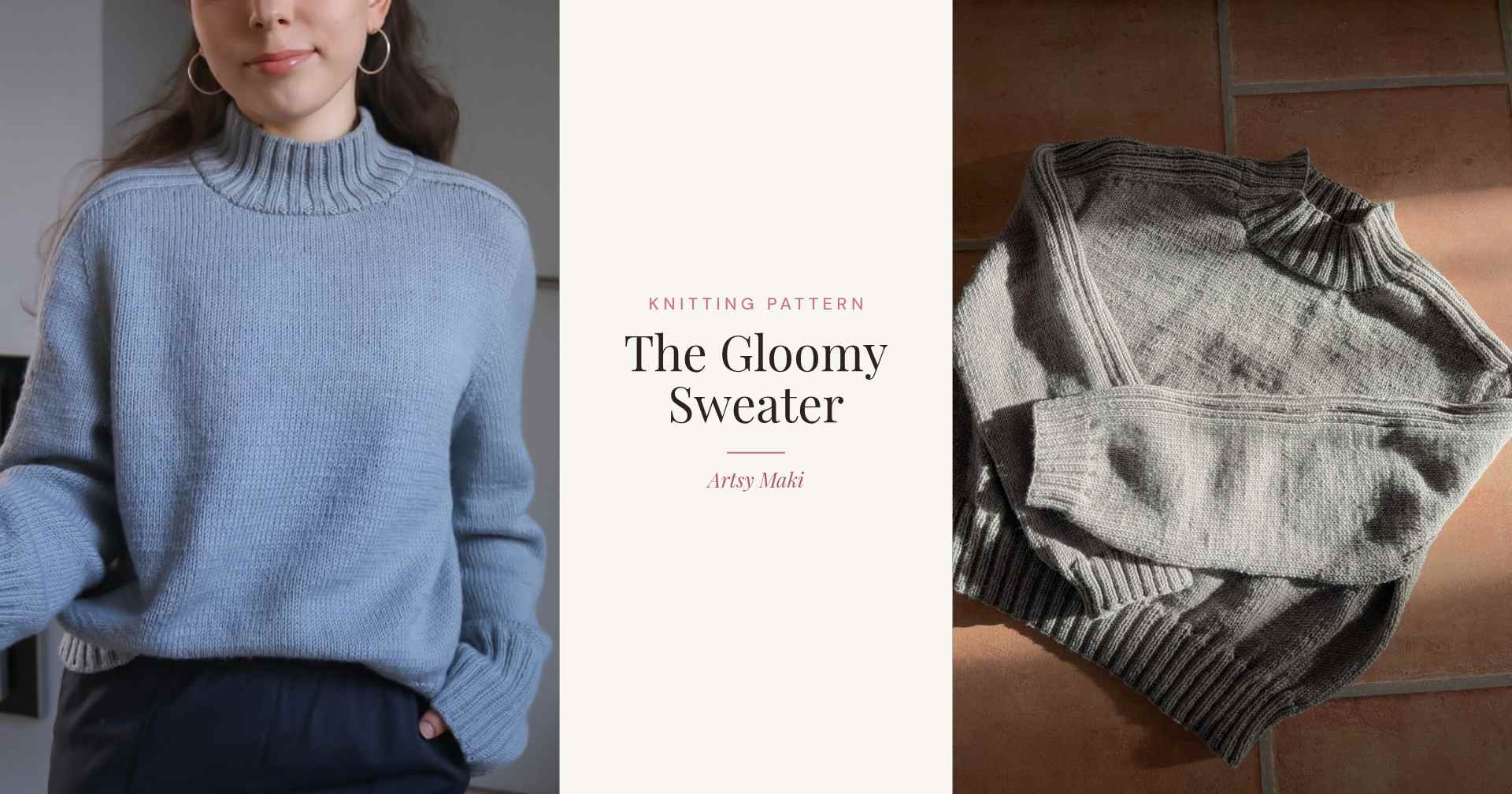
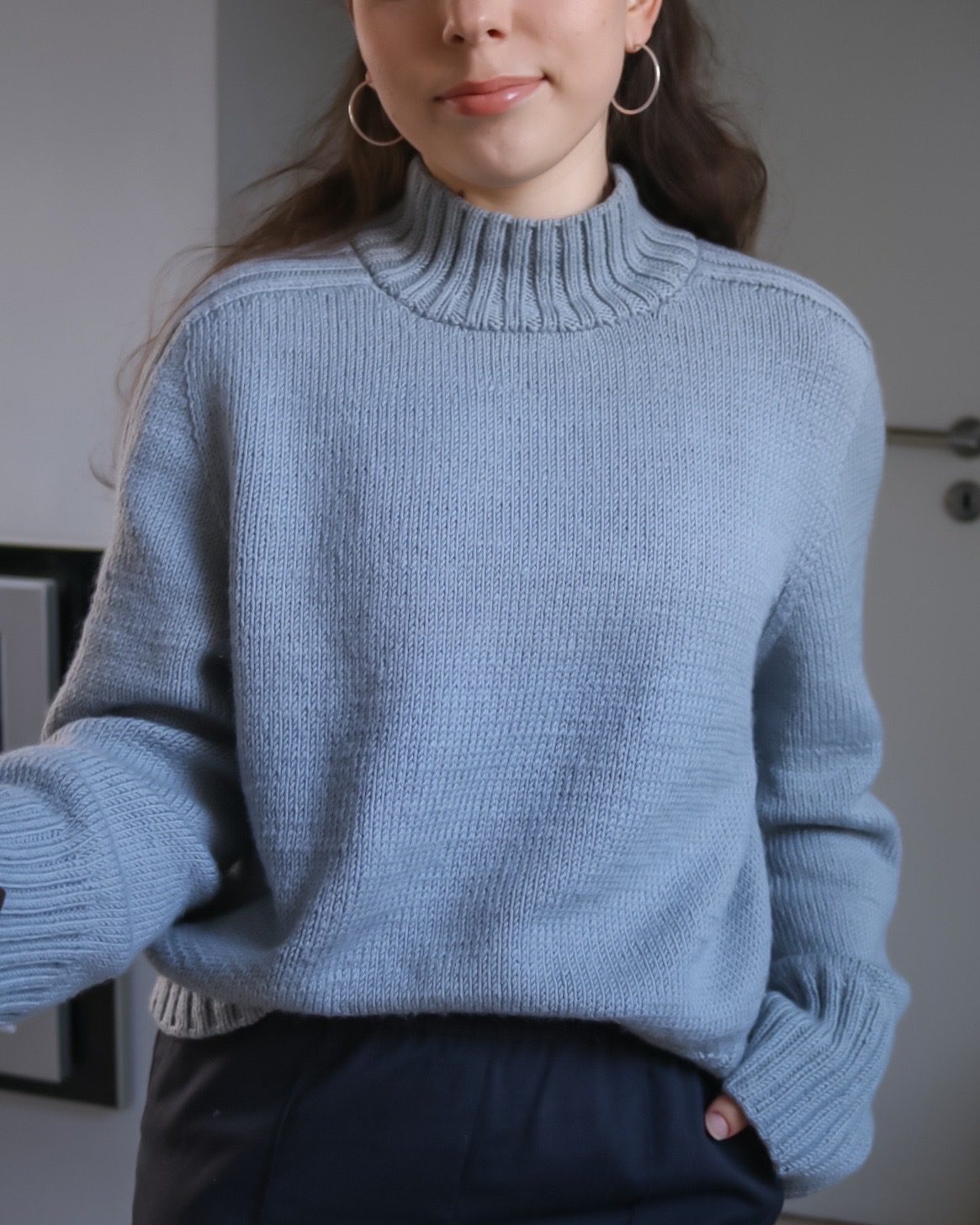
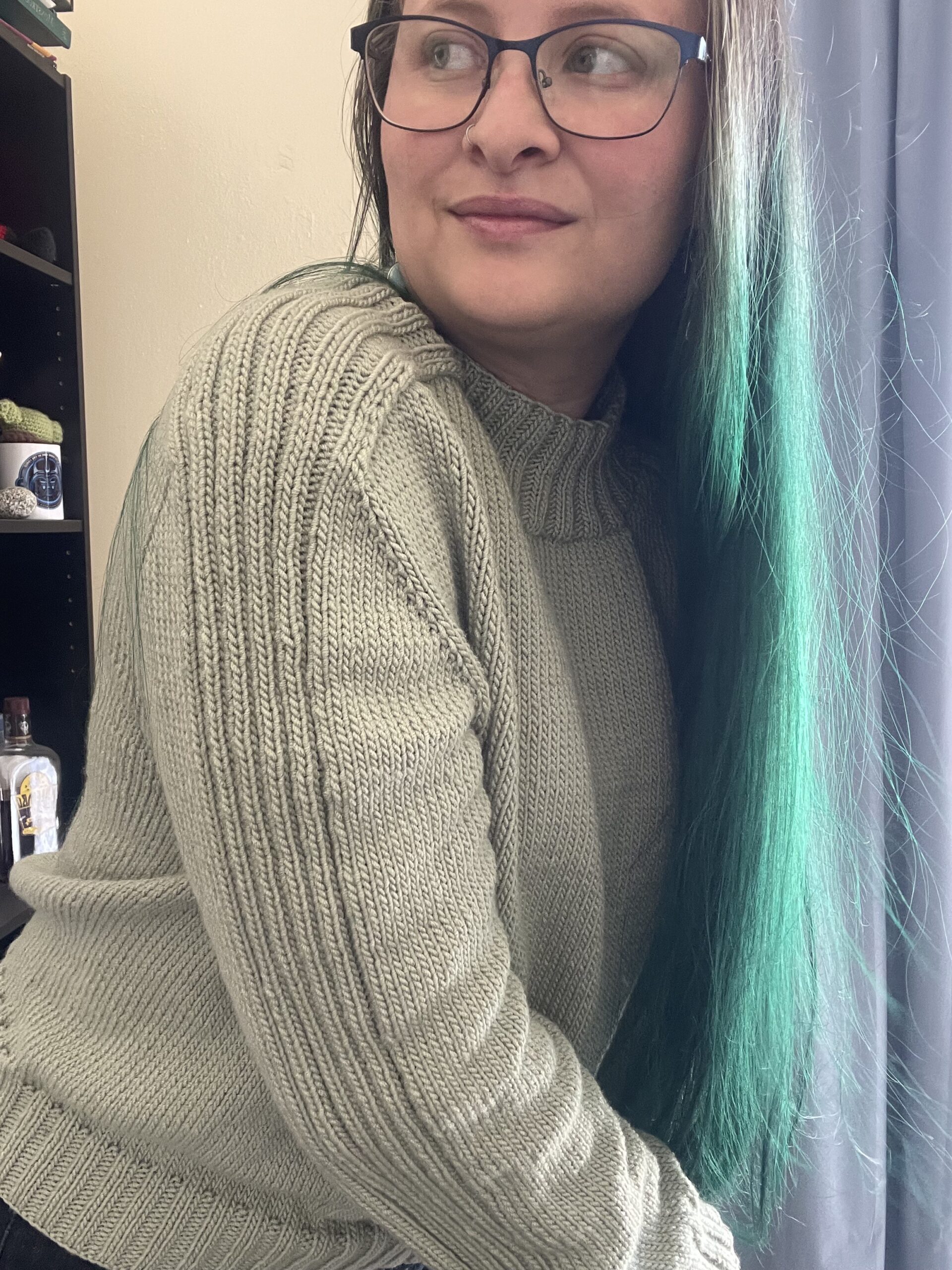
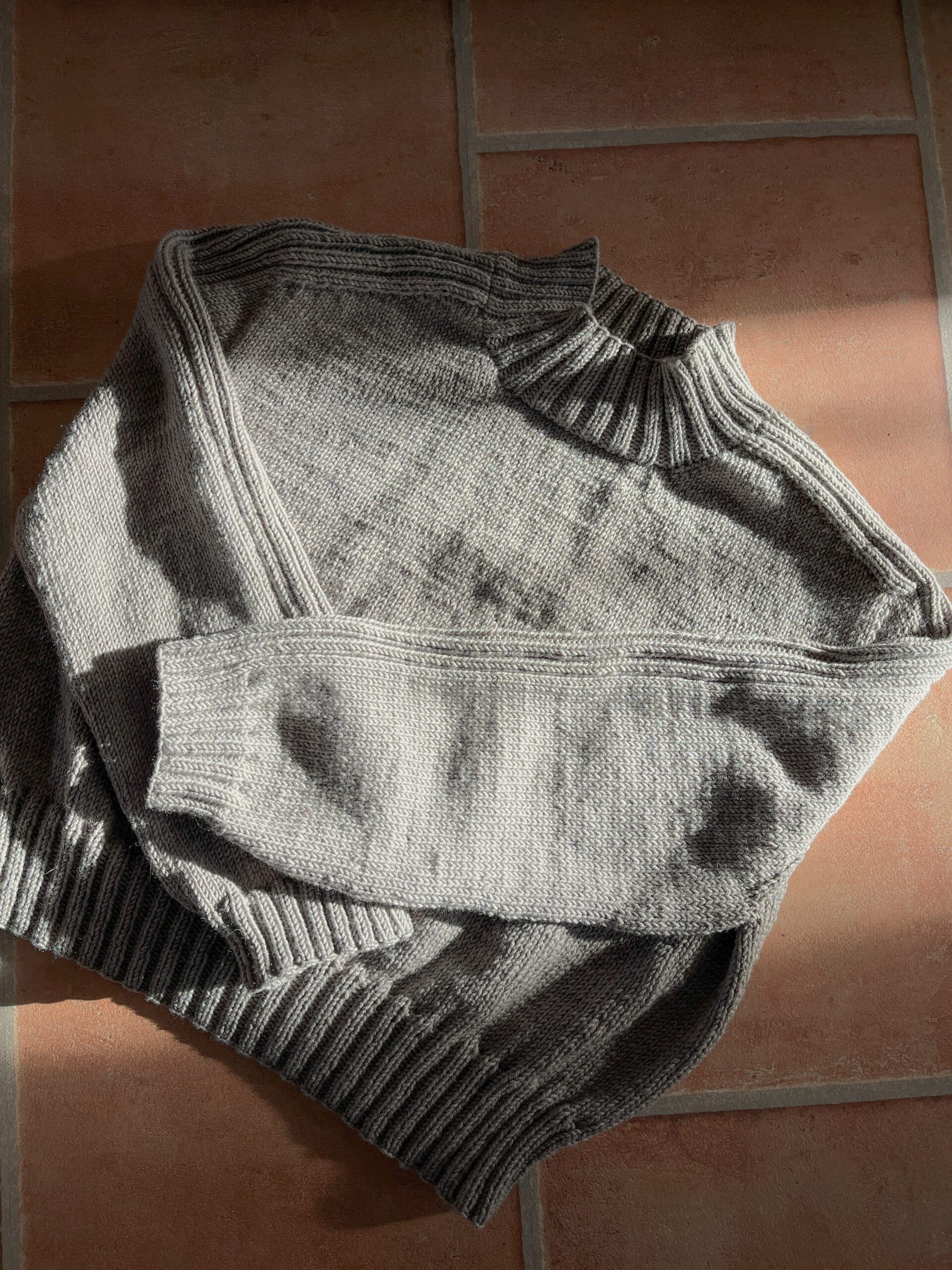
The Gloomy Sweater is a cosy pullover with a mock neck, a relaxed fit and a rib that runs from the neckline out along the top of each sleeve to the cuff. It is worked in the round from the top down with a saddle shoulder, so there is no seaming at the end.
Two things to say straight away, because they are the questions I get most. This is a knitting pattern, not crochet. It is the only knit pattern in my shop, and everything else here is worked with a hook. And it is written for an intermediate knitter: the shaping itself is gentle, but the finishing uses German short rows and an Italian bind-off, and both of those are worth a practice run if they are new to you. There is a section further down on exactly what those are and where they go wrong.
A saddle shoulder is the detail that makes this sweater look the way it does. Instead of a raglan line running diagonally from the underarm to the neck, a saddle is a strip of fabric that sits across the top of the shoulder and joins the front to the back. It gives a squarer shoulder line than a raglan and it stops the shoulder point sliding down your arm the way a drop shoulder does. Here the strip carries on as a rib all the way down the sleeve, so the construction is also the decoration.
In the download
What’s inside the PDF
- Graded instructions for all eight sizes, XS to 4XL, in English.
- The full materials list, including the yarn quantity for every size.
- The gauge, in stockinette stitch on 4 mm needles.
- A size guide with the bust range each size is meant to fit.
- Finished measurements for bust circumference and length, size by size.
- Seamless top down construction, so nothing is sewn together at the end.
Materials
- Yarn: 550 to 900 g depending on size, which is 19 to 32 oz, or 11 to 18 balls of 50 g. In metres that is 1155 to 1890 m (1263 to 2067 yd). The pattern names three: DROPS Merino Extra Fine (50 g = 105 m / 115 yd), Gabo Wool Fine Merino Wool (50 g = 105 m / 115 yd) or YarnArt Imperial Merino (50 g = 100 m / 109 yd). All three are 100% merino.
- Needles: 4 mm (US 6) and 3.5 mm (US 4) circulars, or whichever pair gets you the gauge below. You need circulars rather than straights because the body and sleeves are worked in the round.
- Notions: stitch markers, and a tapestry needle for the Italian bind-off.
Gauge, and why the row count matters here
With 4 mm needles, 21 stitches and 28 rows in stockinette stitch = 10 x 10 cm (4 x 4 in).
So swatch in the round if you can, since most of us knit a slightly different purl than knit and a flat swatch hides that. Then wash and dry the swatch the way you plan to wash the sweater, and measure it after. All three suggested yarns are superwash or machine washable merino, and superwash wool relaxes and grows when it gets wet in a way that untreated wool does not. DROPS say it themselves on the ball band information for Merino Extra Fine: with superwash, knit at a tight tension rather than a loose one. A swatch measured straight off the needles will tell you the wrong thing.
Size chart
| Size | To fit bust | Finished bust | Length | Yarn |
|---|---|---|---|---|
| XS | 80–85 cm / 31.5–33.5 in | 95 cm / 37½ in | 62 cm / 24½ in | 550 g · 1155 m / 1263 yd (11 balls) |
| S | 85–90 cm / 33.5–35.5 in | 105 cm / 41¼ in | 64 cm / 25¼ in | 600 g · 1260 m / 1378 yd (12 balls) |
| M | 90–95 cm / 35.5–37.5 in | 115 cm / 45¼ in | 66 cm / 26 in | 650 g · 1365 m / 1493 yd (13 balls) |
| L | 95–100 cm / 37.5–39.5 in | 125 cm / 49¼ in | 67 cm / 26½ in | 700 g · 1470 m / 1608 yd (14 balls) |
| XL | 100–110 cm / 39.5–43.5 in | 135 cm / 53¼ in | 68 cm / 26¾ in | 750 g · 1575 m / 1722 yd (15 balls) |
| 2XL | 110–120 cm / 43.5–47.5 in | 145 cm / 57 in | 70 cm / 27½ in | 800 g · 1680 m / 1837 yd (16 balls) |
| 3XL | 120–130 cm / 47.5–51 in | 155 cm / 61 in | 72 cm / 28¼ in | 850 g · 1785 m / 1952 yd (17 balls) |
| 4XL | 130–140 cm / 51–55 in | 165 cm / 65 in | 72 cm / 28¼ in | 900 g · 1890 m / 2067 yd (18 balls) |
Which size should you actually make?
Pick by the finished bust column, not by the fit range, and here is why. The pattern is described as having about 15 cm (6 in) of positive ease, meaning the sweater is meant to measure that much more than you do. Run the chart size by size and the ease you actually get climbs as the sizes go up: roughly 10 to 15 cm (4 to 6 in) at XS, 15 to 20 cm (6 to 8 in) at S, 20 to 25 cm (8 to 10 in) at M, 25 to 30 cm (10 to 12 in) at L, and 25 to 35 cm (10 to 14 in) from XL upwards.
None of that is wrong, it is just that a relaxed sweater on a larger frame needs proportionally more room, and the finished sizes step up in clean 10 cm jumps. But it does mean the “15 cm” line is a description of the smaller sizes rather than a promise across the range. So do this instead:
- Measure a jumper you already own and like the fit of, flat across the chest, and double it.
- Find the nearest number in the finished bust column. That is your size.
- If you fall between two, the sizes are 10 cm (4 in) apart, so going down gives a neater fit and going up gives the slouchy one in the photos.
One yarn weight, three different labels
This is the part I would read twice before buying yarn. The pattern names three yarns. Look them up and you will be told, in all seriousness, that one is a DK, one is a worsted and one is an aran. They are all being knitted at the same gauge on the same needles.
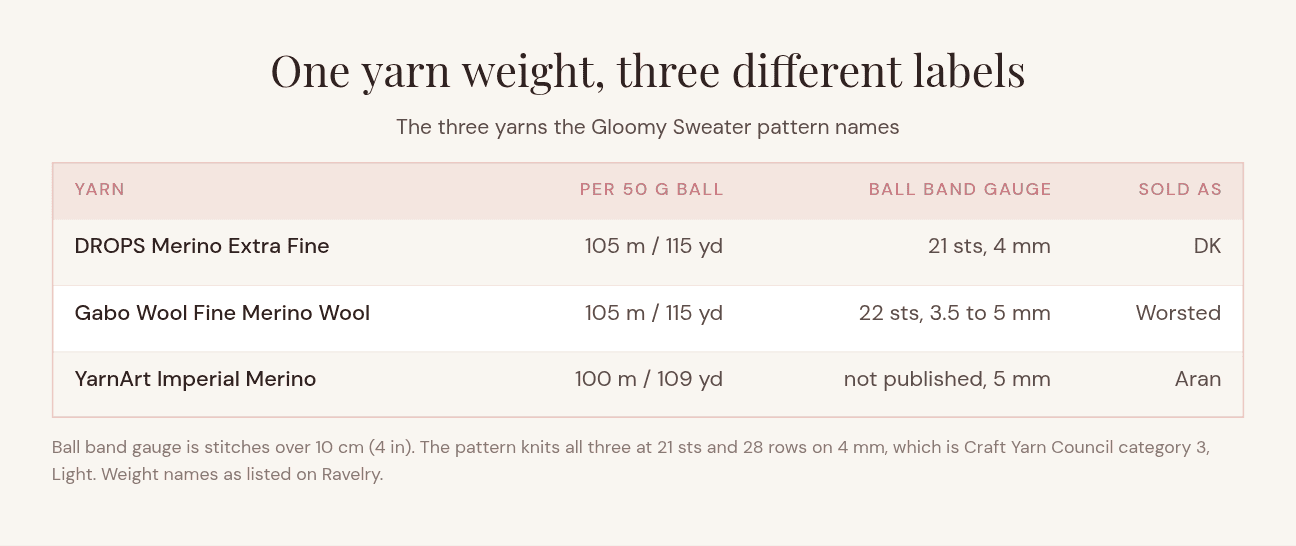
The name on the band is the least reliable thing about a yarn. What actually tells you how thick it is, is metres per 100 g, sometimes called grist. Two of these come out at 210 m per 100 g and the third at 200 m per 100 g, so they are the same yarn thickness to within 5%. The word printed on the label is a marketing decision.
The gauge settles the argument. The Craft Yarn Council’s standard weight system puts category 3, Light, at 21 to 24 stitches over 4 in on 3.75 to 4.5 mm needles, and category 4, Medium, at 16 to 20 stitches on 4.5 to 5.5 mm. At 21 stitches on 4 mm, this sweater sits inside category 3. Whatever the ball band says, you are shopping for a DK.
Two practical things fall out of that. First, DROPS Merino Extra Fine is the easy choice, because its own recommended tension is 21 stitches and 28 rows on 4 mm needles, which is the pattern gauge exactly. The Gabo band asks for 22 stitches and the YarnArt band suggests a 5 mm needle, so with either of those expect to change needle size after your swatch rather than being surprised by it.
Second, the yarn amounts in the pattern are given in grams, and grams only work if the ball length matches. YarnArt Imperial Merino is 100 m per 50 g rather than 105 m, so the same weight of it buys you about 55 m less at XS and 90 m less at 4XL. Not a disaster, but buy by metres, not by grams, and add a spare ball if you are substituting. A ball you did not need is returnable. A dye lot that has sold out is not.
If all you have in the house is something finer, holding two strands together is a legitimate route to DK, and the yarn weight calculator will tell you what any two yarns make when you hold them together. The longer explanation of why that is not simply the average of the two is in holding yarn strands together.
Yarn substitutions for DROPS Merino Extra Fine
I knit the sample in fine merino and I have not personally knitted this sweater in any of the yarns below. They are matched on YarnSub by fibre, construction, ball length and gauge, and the match percentages are theirs rather than mine. What I can tell you is what to look for: 100% merino or a merino blend, around 100 to 110 m per 50 g, and a ball band gauge near 21 stitches. Swatch whichever you choose, and wash the swatch.
Debbie Bliss Rialto DK
100% machine washable merino · 50 g / 105 m · 99% match
The closest match on the list, and an exact gauge match. Same ball length, so every ball count in the size chart carries straight over.
Ashford Merino DK
100% machine washable merino · 50 g / 105 m · 99% match
Also an exact gauge match on the same ball length. Easiest to find if you are in New Zealand or Australia.
Alize Merino Royal
100% machine washable merino · 50 g / 100 m · 98% match
Gauge matches, ball is 5 m shorter. Allow 1.05 balls for every ball in the chart, so one extra over a whole sweater.
Cheval Blanc Mérina
100% machine washable merino · 50 g / 100 m · 98% match
Another exact gauge match, easy to get in France and the rest of the EU. Same 1.05 balls per ball adjustment.
Katia Concept Merino 100%
100% machine washable merino · 50 g / 103 m · 95% match
Ball band gauge is a range of 21 to 23 stitches, which contains the pattern gauge. Practically the same ball count as the chart.
Sandnes Garn Merinoull
100% machine washable merino · 50 g / 105 m · 95% match
Same ball length, but the band asks for 22 stitches rather than 21, so expect to go up a needle size to hit gauge.
If you would rather work out the yarn for yourself than trust any chart, including mine, the fastest honest method is to open the finished projects on the Ravelry page and read what real people logged for your size. There are only three projects on there so far, so it is thin for this pattern today, but it is the method I would use for any pattern with a few dozen. I wrote it up properly in how much yarn you need for a sweater, which is written around crochet but works exactly the same for a knit one.
The three techniques, and where they go wrong
The pattern uses ssk, k2tog, M1R, M1L, German short rows and an Italian bind-off. The first four are ordinary decreases and increases and you have almost certainly done them. The last two are the ones that make people hesitate, so here is what they are and the mistake each one invites.
1. German short rows, for the back neck
A short row is a row you do not finish. Work a few of them across the back and the back of the sweater becomes taller than the front, which is what keeps a mock neck sitting level instead of riding backwards up your neck. The German version makes the turn by slipping a stitch and pulling the yarn firmly up over the needle, so the stitch below is dragged up and shows two legs. That is the double stitch.
Two ways it goes wrong, and they look the same from the front. Not pulling hard enough when you make the double stitch leaves it loose and you get a visible gap. Then, coming back round, working the two legs as two separate stitches instead of one leaves a small hole and an extra stitch in your count. The double stitch is one stitch. Knit or purl both legs together, always.
2. The Italian bind-off, for the mock neck
Also called the tubular bind-off. Rather than casting off with the needles, you break the yarn, thread it on a tapestry needle and sew the stitches closed in a repeating four step sequence. The edge that comes out is rounded rather than ridged, the ribbing appears to fold over itself, and it stretches and springs back where a normal bind-off would not.
It is the right choice for a mock neck for one reason: that collar has to go over your head, repeatedly, for years. Craft Yarn Council put adult head circumference at 53 to 58.5 cm (21 to 23 in). So before you weave in the end, stretch the collar out flat and check it reaches that, with a little to spare. If it does not, undo the bind-off and redo it looser. It is a horrible job and it is much less horrible than a finished sweater you cannot get on.
The other thing that catches people is running out of yarn halfway along, because the whole bind-off is sewn from a single tail. Leave a tail about three times the width of the edge you are binding off. On a mock neck that is a lot of yarn on the floor and it feels excessive right up until the moment it is not.
3. The saddle shoulder itself
Nothing here is difficult, but the saddle is worked in rows, so its length is decided by your row gauge rather than your stitch gauge. If your rows are off, the strip across your shoulder comes out narrow or wide and the sleeve ends up starting in slightly the wrong place. This is the other reason the row count in the gauge section is not optional.
The design process
Almost everything I design is crocheted. This one is not, and that is the whole story of it. I wanted the kind of plain jumper you reach for without thinking about it, and there is a particular smooth stockinette surface that knitting gives you and crochet, honestly, does not. So I knitted it instead.
Once that was decided, the shoulder was the only real question. A raglan is the default for a top down sweater and it is the easiest thing to grade across eight sizes, but a raglan line on a plain jumper is the only thing your eye has to look at, and it draws a diagonal across the chest. A saddle shoulder puts the structure along the top of the shoulder instead, where it flatters more, and it gave me somewhere to put the rib. That rib running from the neck to the cuff is the sweater’s one piece of decoration and it is also load bearing, which is my favourite kind of detail.
One honest note about sizing. The pattern goes to 4XL, but 2XL, 3XL and 4XL have not been test knitted. I graded them and I stand behind the maths, but nobody has yet held the finished garment. I would rather say that plainly than let you find out. If you knit one of those three sizes I would genuinely love to hear how it came out, and if you fancy testing one properly, message me.
Maki’s tip
Try it on before you commit to the length. Because the body is worked top down you can slide it onto a spare circular at any point, put it on and look. The chart says 66 cm at size M, but 66 cm lands somewhere different on a long torso than a short one, and a few extra rounds now are far easier than a reknit later. Weigh what is left of your yarn before you add much, though. The chart gives you the rate to think with: 3XL and 4XL are the same length and differ by 10 cm in the bust alone, and that 10 cm costs one extra 50 g ball. Extra length is not free either.
If you crochet rather than knit
The crocheted equivalents
The Gloomy Sweater is the only knitting pattern in the shop, so if you came here with a hook in your hand, these are the closest things I have. Both are worked seamlessly from the top down, the same as this one.
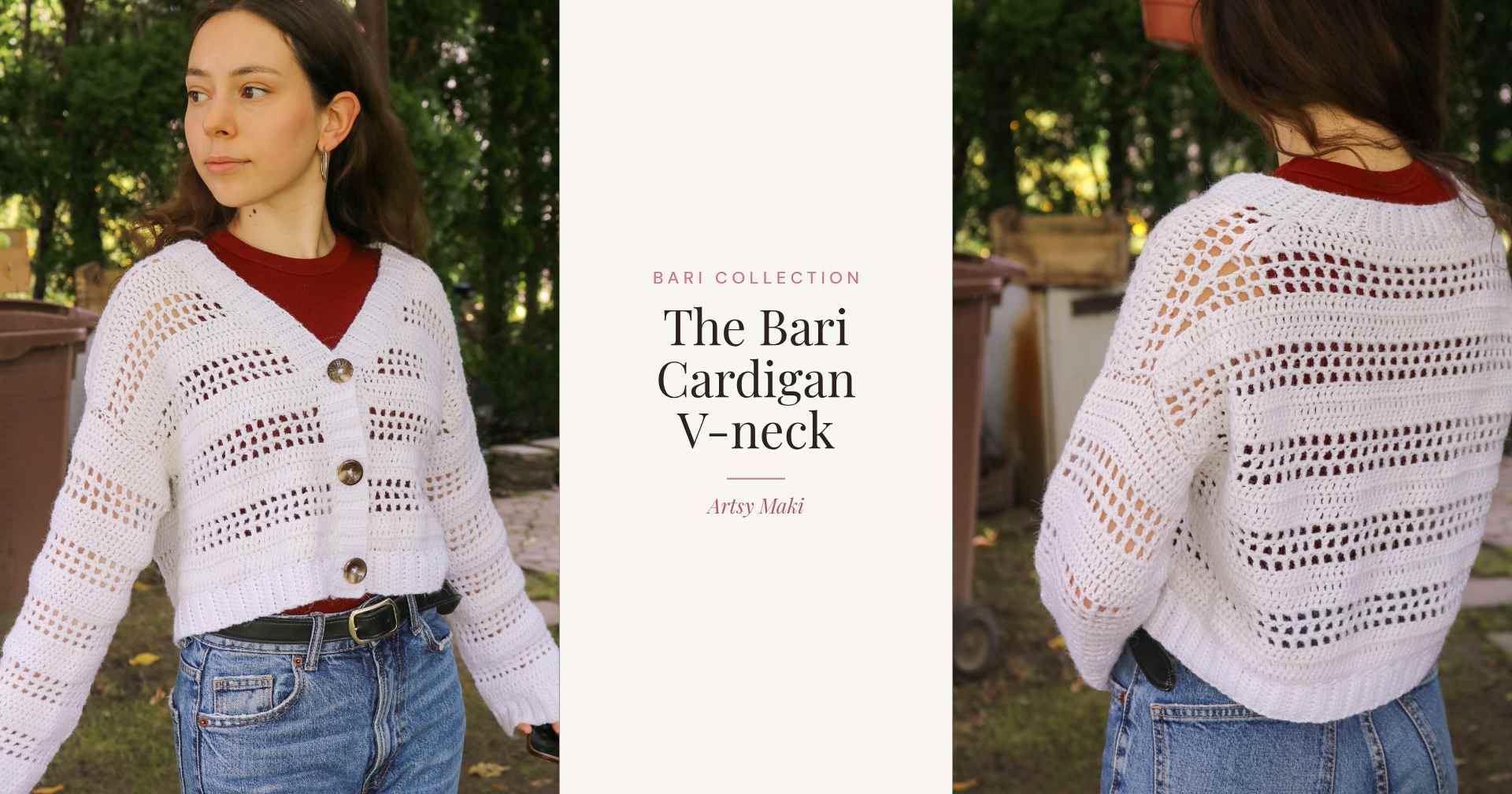
- The Bari Sweater: a relaxed crewneck with mesh stripes, eight sizes. The nearest thing to an everyday crocheted jumper here.
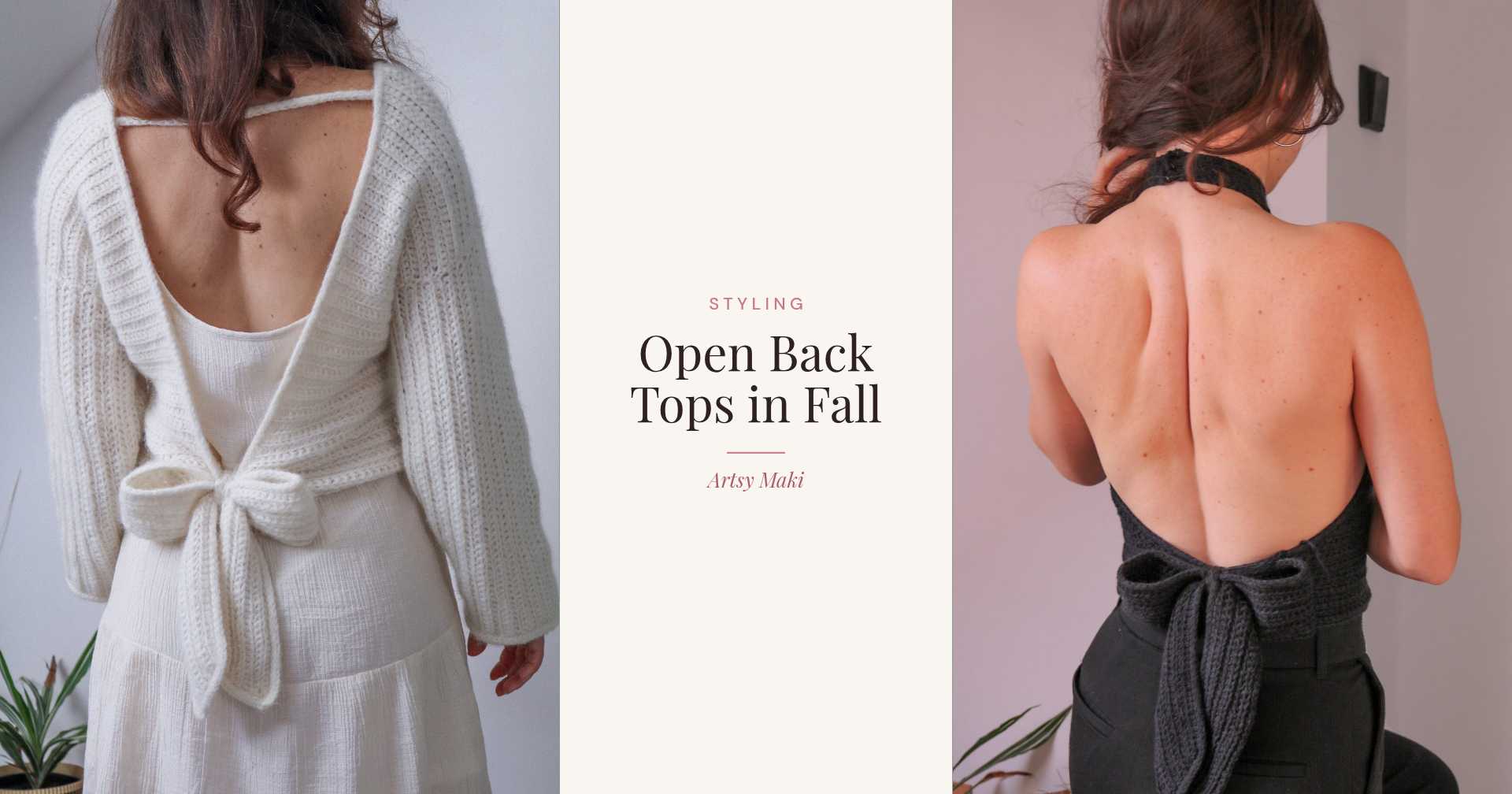
- The Claire Sweater: cropped, long sleeved, with an open back that ties at the waist. Quiet from the front, not from the back.
Tester calls, including for the larger sizes of this one, always go out on Instagram first.
Questions I get asked
Is this knitting or crochet?
Knitting. It is the one knitting pattern in my shop, and everything else on artsymaki.com is crochet. If you were looking for a crocheted sweater, the Bari and the Claire are linked above.
Is this a pattern or a finished sweater?
A pattern, which is a PDF you download and knit yourself. Nothing physical is shipped, and the download arrives straight after checkout.
Can I knit it on straight needles?
No. The body and sleeves are worked in the round from the top down, so you need circulars. For the sleeves you will want either a shorter circular, a long one for magic loop, or double pointed needles, whichever you already get on with.
How much yarn do I need if I substitute?
Work in metres rather than grams. Your size needs somewhere between 1155 m (1263 yd) at XS and 1890 m (2067 yd) at 4XL, and the size chart gives the figure for each one. Divide by the metres on your ball band, round up, and buy one spare.
My yarn says worsted, not DK. Is that a problem?
Probably not, and the yarn weight section above explains why. Ignore the word and check two numbers: metres per 100 g, which wants to be near 200 to 210, and the ball band gauge, which wants to be near 21 stitches over 10 cm. If both are close, swatch it and see.
Are the larger sizes tested?
XS to XL are. 2XL, 3XL and 4XL are graded but have not been test knitted yet, and the pattern says so. Message me if you would like to test one.
Can I sell what I make from it?
Yes, finished items are yours to sell. Please credit Artsy Maki as the designer, and never resell, copy or share the pattern file itself.
What if I get stuck?
Email me at artsymaki@gmail.com with a photo of where you are. I answer every message, usually within a day or two.
Ready to cast on?
The full pattern, all eight sizes, graded from XS to 4XL. Instant download.