You have a ball of bouclé in your hand. The band says one thing, the yarn feels like another, and the pattern you want to make asks for aran. So which is it?
Here is the honest answer, and it is not a dodge. Bouclé is not a yarn weight at all. It is a construction, the way chainette and blown yarns are constructions, and it is sold in everything from sport to super bulky. Asking what weight bouclé is comes out roughly like asking what weight wool is.
The useful part is what nobody says next: both of the shortcuts crocheters normally use to work out an unknown yarn’s weight give the wrong answer on bouclé, and they give wrong answers in opposite directions. I checked five bouclé yarns against their makers’ own figures to see how badly, and the gap is bigger than I expected.
It is worth sorting out now, because a lot of people are buying their first ball of this stuff. Every 2026 trend round up names texture as the thing of the season, KnitPro’s included, which lists bouclé alongside tweed fleck as the yarns growing fastest.
If you only read one box
The short version
- Bouclé on the shelf today runs from about 60 to 280 metres per 100 g (66 to 306 yd). That is more than a factor of four.
- Most bouclé sold for garments behaves like aran to chunky, so a 5 to 6 mm hook is the sensible first guess.
- Metres per gram reads a lofty bouclé as too thin, by one or two whole categories, because it cannot see the air in the loops.
- Wraps per inch reads the same yarn as too thick, because the loops will not lie flat. Two shortcuts, two wrong answers, one ball of yarn.
- The number that does work is the stitches per 10 cm on the band, or off your own swatch. It is the only one measured on fabric.
- Buying for a project: match metres, never grams.
How wide is the range, in real numbers?
These are five real bouclé yarns. The first four come from the makers’ own product pages and are cross-checked against Ravelry’s yarn database; the fifth, Rowan’s Purelife, I could only reach through Ravelry. Nothing here is estimated.
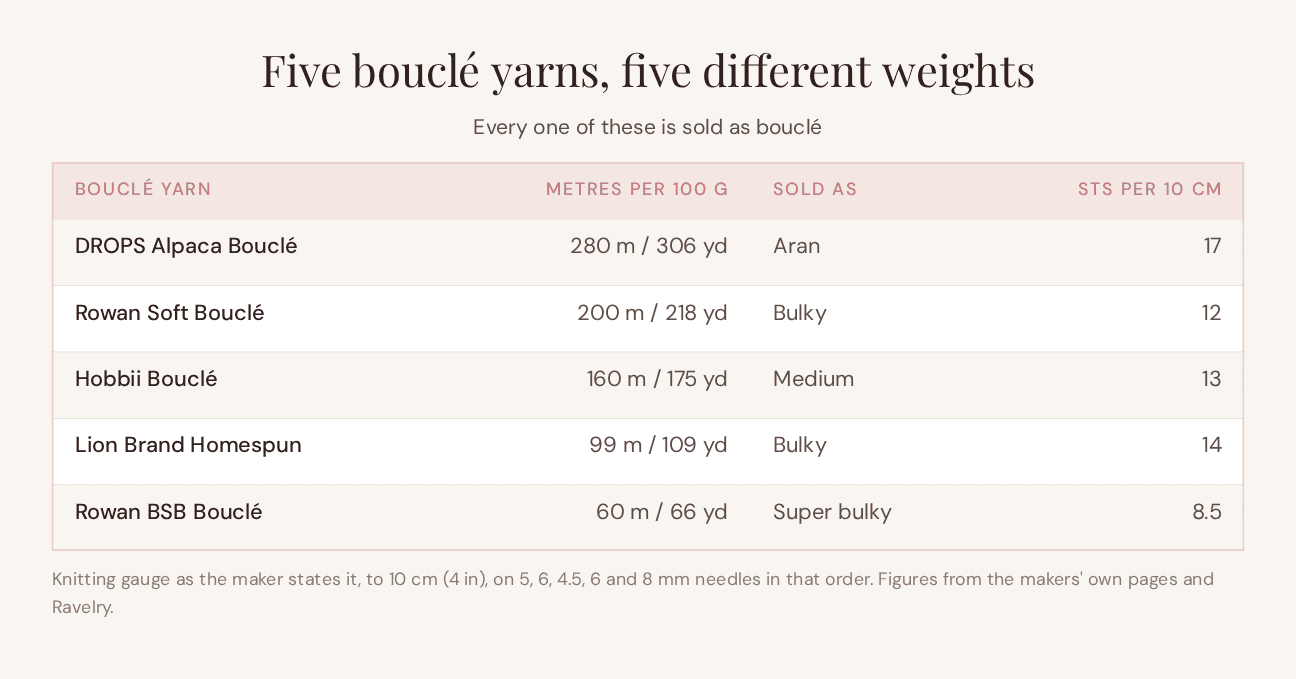
| Bouclé yarn | Metres per 100 g | Sold as | Sts per 10 cm | Needle |
|---|---|---|---|---|
| DROPS Alpaca Bouclé | 280 m / 306 yd | Aran, group C | 17 | 5 mm |
| Rowan Soft Bouclé | 200 m / 218 yd | Bulky | 12 | 6 mm |
| Hobbii Bouclé | 160 m / 175 yd | Medium | 13 | 4.5 mm |
| Lion Brand Homespun | 99 m / 109 yd | Bulky, 5 | 14 | 6 mm |
| Rowan Purelife British Sheep Breeds Bouclé | 60 m / 66 yd | Super bulky | 8.5 | 8 mm |
Five balls, all correctly labelled bouclé, and the hook you would reach for spans 4.5 mm to 8 mm. There is no single answer to give you, which is why every post that tries to give one ends up saying “check the label”.
So let us check the label properly, because the label is where it gets interesting.
The labels disagree with each other, and sometimes with themselves
Two of those five yarns carry two different weight categories depending on where you look.
- Rowan Soft Bouclé is listed as bulky by WEBS, who stock it. Ravelry’s database lists the same yarn as super bulky.
- Hobbii Bouclé is listed on Hobbii’s own product page as “Yarn Weight: Medium”. On the same page Hobbii give the knitting gauge as 13 stitches to 10 cm. The Craft Yarn Council’s medium band is 16 to 20 stitches. Thirteen sits in the bulky band, 12 to 15. Ravelry lists it as bulky.
Nobody is being careless here. The word on the label is a marketing category with no enforcement behind it, and for a smooth yarn it is usually close enough that nobody notices. On a textured yarn it drifts, because there is genuinely more than one defensible answer.
Which is why the rest of this post is about measurements rather than words.
Why metres per gram gets bouclé wrong
Metres per 100 g, sometimes called grist, is the standard way to identify a yarn whose band has gone missing. Weigh it, measure it, look it up. Paper Moon Knits publishes a clear set of bands for it: sport is 300 to 360 yd per 100 g, DK 240 to 280, worsted 200 to 240, aran 120 to 180, bulky 100 to 120. Worth noting that this splits worsted from aran where the Craft Yarn Council puts both in one band, category 4, medium. I am counting categories the Council’s way below.
It works well on smooth yarn. Run our five bouclés through it and it works on two of them.
- Lion Brand Homespun, 99 m per 100 g. Grist says bulky. It is bulky. Correct.
- Rowan Purelife Bouclé, 60 m. Grist says super bulky. It is super bulky. Correct.
- Hobbii Bouclé, 160 m. Grist says aran. Knits at 13 stitches, which is bulky. One category light.
- Rowan Soft Bouclé, 200 m. Grist says worsted. Knits at 12 stitches, which is bulky. One category light.
- DROPS Alpaca Bouclé, 280 m. Grist says sport. DROPS ask for a 5 mm needle and 17 stitches to 10 cm, which is squarely medium. Two categories light.
The two it got right are a 98% acrylic yarn and a chunky 100% wool one. The three it got wrong are alpaca and wool blends full of air.
That is the whole mechanism. A weight category is really a statement about how much room a metre of yarn takes up in fabric. Grist measures how much that metre weighs. The two only track each other if the yarn holds a predictable amount of air, and a bouclé’s loops are almost entirely air. How much air depends on the fibre, the size of the loops and how tightly the binder holds them, and all three vary wildly from one bouclé to the next. There is no correction factor to apply, which is exactly why you cannot shortcut it.
If you want that quantified, the clearest published example is not a bouclé at all. DROPS say of DROPS Air, their blown yarn, that “garments made in this yarn are about 30 to 35% lighter than those made with conventional spun yarns of the same thickness”. Same thickness, a third less mass. A method that weighs the yarn is going to miss by about that much, and it does.
I know that one from the inside rather than from a table. The Claire Sweater is written in DROPS Air, which is 150 m per 50 g, so 300 m per 100 g, a grist that says sport. I crochet it at 15 half double crochet to 10 cm on a 5 mm hook, which is not sport behaviour by any reading. My own patterns are written in blown and brushed yarns rather than bouclé, but the arithmetic that catches people out is identical.
Why wraps per inch gets it wrong too, in the other direction
Wraps per inch is the other standard trick: wind the yarn round a pencil or a ruler, count the wraps in an inch, look it up. The Craft Yarn Council publishes the method and the bands, and adds its own warning that “WPI is subjective, and results will vary depending on how tightly the yarn is wrapped”.
On smooth yarn that warning is a footnote. On bouclé it is the whole story, because the loops are compressible and the yarn’s diameter changes every couple of centimetres. Wrap gently and the loops hold the strands apart, so you count few wraps and read the yarn as thicker than it is. Wrap firmly and you squash the air out and read it as thinner. There is no correct pressure, and nobody tells you which one they used.
You can see it in the numbers. Ravelry lists DROPS Alpaca Bouclé at 8 wraps per inch, which the Council’s table puts in the bulky band. Its grist says sport. Its actual knitting gauge says medium. One ball of yarn, three methods, three different answers spanning three categories.
What to do instead: four steps, in order
Stop at the first one that works.
- Find the gauge on the band, and ignore the word next to it. Almost every band gives a tension: so many stitches to 10 cm on such a needle. That number is measured on fabric. Read it against the Craft Yarn Council’s knitting bands: 21 to 24 stitches is light or DK, 16 to 20 is medium or aran, 12 to 15 is bulky, 7 to 11 is super bulky. Where the band’s own word and the band’s own gauge disagree, as on the Hobbii ball, the gauge is right.
- No gauge? Use the recommended hook. The Council maps categories to hook sizes: 4.5 to 5.5 mm is light, 5.5 to 6.5 mm is medium, 6.5 to 9 mm is bulky, 9 to 15 mm is super bulky. It is a wider target than a gauge but it is still a measurement of the fabric the maker got.
- No band at all? Swatch it, do not wrap it. Work a square about 15 cm (6 in) across in plain double crochet on whatever hook feels right, measure the stitches per 10 cm across the middle, and read the category off that. A swatch takes twenty minutes. Wrapping takes two and tells you nothing you can rely on.
- Then check the gap. Put the ball’s grams and metres into my yarn weight calculator. What comes back is the smooth yarn answer: the weight this yarn would be if all of its mass were doing structural work. Hold that next to the hook on the band. If they agree, the grist is honest and you can plan quantities the ordinary way. If they are two categories apart, you have a very lofty yarn, and the next section is the one that matters.
A rule of thumb, with its limits stated
From these five yarns: if your bouclé is alpaca, mohair or a wool blend that feels light for its size, add one to two categories to whatever the metres per gram say. If it is acrylic, or a heavy pure wool with tight loops, the metres per gram are probably right.
That is five yarns, not five hundred, and I am telling you so rather than dressing it up as a law. Use it to pick which hook to swatch with first, not to skip the swatch.
How much bouclé do you actually need?
This is where the loft stops being trivia and starts costing money, and it catches people in both directions.
The rule for any substitution is to match the metres, not the grams. Two yarns that make the same fabric use roughly the same length of yarn to make it, and the length is what a pattern is really asking for. On smooth yarns of the same category the grams work out close enough that people get away with ignoring this. On bouclé they do not.
Take a pattern that wants 1000 m (1095 yd) of aran yarn.
- In a typical smooth aran at 160 m per 100 g, that is 625 g (22 oz), so thirteen 50 g balls.
- In DROPS Alpaca Bouclé, also sold as aran, it is 280 m per 100 g, so 357 g (12½ oz), so eight 50 g balls.
Buy by weight and you come home with thirteen balls, which is 1820 m. You have bought 820 m you will never use, for a project that needed 1000. Go the other way, substituting a dense cotton bouclé into a pattern written in an alpaca one, and you run out somewhere in the second sleeve.
balls to buy = metres the pattern asks for ÷ metres per ball, rounded up, plus one
The spare ball is not padding. A join shows more in a looped fabric than in a smooth one, so you want the freedom to put it somewhere sensible, and running a metre short at the neckband is a bad afternoon.
If the pattern only gives you grams or a number of balls and not metres, convert before you buy: multiply the balls by the metres per ball of the original yarn, then divide by the metres per ball of yours. And if you want a real number rather than a chart, other people’s finished projects in the same pattern are better data than any of this. I go through that method in how much yarn a crochet sweater takes.
Maki’s tip
This is why I write yarn quantities into my patterns in metres and never in balls. The Claire Sweater says 1050 m (1148 yd) for a size M, not “seven balls”, because I have no idea which yarn you will hold in your hands and a ball is not a unit of anything. If a pattern hands you a ball count, do the conversion yourself before you get to the till.
What bouclé actually is, in thirty seconds
Worth knowing, because it explains every awkward thing the yarn does.
A bouclé is three plies doing three different jobs. A core carries the strength. An effect ply is fed in faster than the core, so it has nowhere to go but buckle, and that buckling is the loops. A binder is then twisted back the other way to lock the loops in place so they cannot slide along. The name is French, from boucler, to buckle.
Three consequences follow straight from that, and they are the three things people complain about:
- The loops sit proud of the core, so the yarn is much fatter than its mass suggests. That is the grist problem above.
- The loops are free at one end, so your hook goes through them instead of round them, and the loose strand snags if you are rough with it.
- The diameter changes along the length of the yarn, so your stitches are never quite the same size as each other. This is normal and it is why bouclé fabric looks the way it does.
It is not the same as chenille, which is short pile fibres trapped between two core threads, and not the same as the pre-looped “finger knitting” yarns, which have no core at all.
What goes wrong when you crochet it
My own designs are in blown and brushed yarns rather than bouclé, so this section is gathered from crocheters who use it constantly rather than from my project bag, and I would rather say so than let it read as experience. Heart Hook Home has the most detailed account I found.
Your stitch pattern disappears
Textured stitches lose all definition in bouclé. Cables, bobbles, post stitches and anything you chose for the way it looks are simply invisible under the loops, and the effort is wasted. Even plain double crochet can go soft and sloppy in a loose bouclé, which is why single crochet and half double crochet are the usual advice.
The same applies to the alternating front loop and back loop ribbing the whole Claire collection is built on. In a bouclé you would not see any of it. Save the stitch you love for a yarn that shows it, and let the bouclé do the work in plain rows.
You cannot see where the stitches are
Three fixes, all of them worth doing before you are forty rows in:
- Go up a hook size, possibly two. Too small a hook buries the core inside the loops, and the core is the part you need to see. This is also why a bouclé often wants a bigger hook than its grist would suggest.
- Look for the core, not the fluff. The little V at the top of each stitch is there, it is just underneath. Once you find it you stop counting loops.
- Use markers, and more than you think. First and last stitch of every row, and one every ten stitches while you are learning the yarn. Recounting a bouclé row is much slower than marking it was.
A light pad under the work makes a real difference on dark colours, which is the one tip I had not seen before researching this and would not have guessed.
Frogging snaps the yarn
This is the one that ruins projects. Pulling hard on a bouclé drags the loops tight against the binder, they bunch, they jam, and the yarn breaks before it comes undone.
Hold the fabric taut with your other hand so the stitches are open, and ease the yarn out rather than yanking it. Slowly. If you feel it catch, stop and open that stitch with your hook instead of pulling through it. Budget far more time for undoing bouclé than you would for a smooth yarn and you will not lose any of it.
Your gauge keeps moving
Because the yarn’s thickness varies along its length, a small swatch can land on a thick run or a thin one and give you a number the whole garment will not repeat. Make your bouclé swatch bigger than you would for a smooth yarn, at least 20 cm (8 in) across, and measure in two or three places rather than one.
One more thing worth trying if the yarn is fighting you: Heart Hook Home rate Tunisian crochet highly for bouclé, because the stitches lie flatter and the loops are easier to find, and they report it using less yarn than ordinary crochet for the same piece. Keep the return pass loose or the fabric narrows.
Questions I get asked
What weight is bouclé yarn?
There is no single answer, because bouclé is a way of spinning yarn and not a thickness. The five bouclés compared above run from 60 to 280 metres per 100 g (66 to 306 yd) and from super bulky down to aran. Most bouclé sold for garments behaves like aran to chunky and wants a 5 to 6 mm hook, but you confirm it from the gauge printed on the band rather than from the word.
What hook size should I use for bouclé yarn?
Start from the hook the band recommends and then go up one size, sometimes two. A bouclé worked on its nominal hook tends to come out dense, and worse, it buries the core so you cannot see your stitches. Across the five yarns here the recommended needles ran from 4.5 mm to 8 mm, so there is no universal answer, only a starting point and a swatch.
Can I substitute bouclé for the yarn a pattern asks for?
Yes, if you match the gauge and accept that the fabric will look different. What you cannot do is match the category word and assume it will work: two yarns both labelled aran can be 120 metres apart per 100 g. Swatch to the pattern’s stitches per 10 cm, then buy by metres. Also check what the stitch pattern is doing, because a pattern built on texture will not survive the swap.
How much bouclé yarn do I need for a sweater?
Work in metres. Take the metres the pattern asks for, divide by the metres per ball of your bouclé, round up and add one ball. Doing it in grams instead is where people go wrong: 1000 m of a lofty alpaca bouclé weighs about 360 g (12½ oz) while 1000 m of a smooth aran weighs about 625 g (22 oz), and the pattern’s gram figure belongs to a yarn you are not using.
Why do I get a different gauge every time I swatch bouclé?
Because the yarn is genuinely not the same thickness all the way along, so a small swatch samples a small part of that variation. Make the swatch at least 20 cm (8 in) wide, measure in two or three different places and average them. If your readings still spread by more than half a stitch per 10 cm, take the middle one and check again 15 cm into the actual project.
Is bouclé yarn good for beginners?
It is forgiving of uneven tension, which is lovely, and unforgiving of mistakes, which is not. The texture hides wobbly stitches beautifully, so a beginner’s fabric looks better in bouclé than in a smooth yarn. But you cannot see your stitch count, and undoing a mistake risks snapping the yarn. If it is your first project, make something rectangular where a missed stitch does not matter.
Can I hold bouclé together with another yarn?
You can, and it is a good way to get a bouclé you love up to a weight a pattern wants. Holding a fine bouclé with a strand of mohair or a smooth 4 ply is common. Two strands do not simply add up, though, so work out the combined weight before you commit: I wrote up what actually happens in holding yarn strands together, and the calculator does the arithmetic for any combination you own.
Is bouclé the same as chenille or loop yarn?
No. Bouclé has a core, an effect ply that buckles into loops and a binder holding them. Chenille has short pile fibres clamped between two twisted core threads, which is why it sheds and why a single stitch can pop out into a little loop of its own months later. The chunky pre-looped yarns sold for finger knitting are a third thing again, a chain of loops with no core, and they cannot be crocheted in the normal way at all.
The one sentence to keep
A yarn’s weight lives in the fabric it makes, not on its label and not on your kitchen scales. On smooth yarn you can get away with forgetting that. Bouclé is the yarn that reminds you.
Check what you have actually got
Put in the grams and metres from your ball band, on its own or held with another yarn, and it gives you the weight category, a hook range and a gauge estimate. Grams or ounces, metres or yards. Free, and it runs entirely in your browser.